Gymnema sylvestre
(Retz.) Schultes
Australian cow-plant
iNaturalist· cc0
no rights reserved, uploaded by 葉子
iNaturalist· cc-by-nc
(c) Tony Benn, some rights reserved (CC BY-NC)
iNaturalist· cc-by-nc
(c) Tony Benn, some rights reserved (CC BY-NC)
Summary
Source: WikipediaGymnema sylvestre is a perennial woody vine native to Asia (including the Arabian Peninsula), Africa and Australia. It has been used in Ayurvedic medicine. Common names include gymnema, Australian cowplant, and Periploca of the woods, and the Hindi term gurmar, which means "sugar destroyer" The leaves and extracts contain gymnemic acids, the major bioactive constituents that interact with taste receptors on the tongue to temporarily suppress the taste of sweetness.
Description
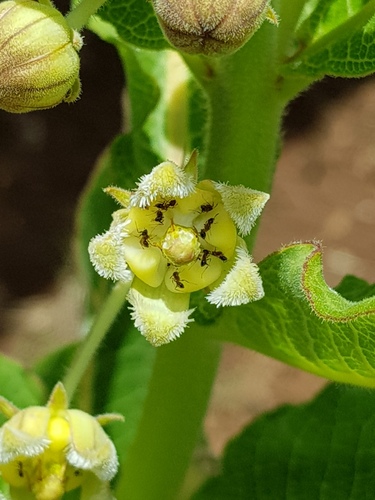
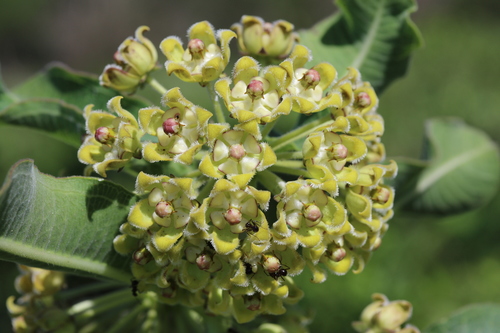
A small climber. It grows 1-3 m tall. It has a woody rootstock and slender stems. Young growth is softly hairy. The leaves are 2.5-5 cm long by 1.5-2 cm wide. They are oval or sword shaped. The flowers are 0.3 cm across. The flowers occur in paired groups in the axils of leaves. The follicles are 6-8 cm long by 0.8-1 cm wide. They are slender and pointed.
Edible Uses
The leaves are eaten raw or cooked as a vegetable or added to soups. After being eaten, they temporarily block the ability to taste sweetness, making even bitter foods taste sweet. In India and China the leaves are known as 'sugar destroyer' for this reason. The fruit is roasted, then peeled and eaten after discarding the seeds; the taste is similar to potatoes.
Traditional Uses
The leaves when chewed paralyse the sense of taste for sweet and sour. The leaves are used as a potherb. Caution: The fruit are roasted in hot ashes.
Medicinal Uses
Gurmar is an important bitter-tasting Ayurvedic herb used especially to reduce blood sugar levels in diabetics, using both roots and leaves. The plant contains gymnemic acids — a complex mixture of at least 9 closely related oleanane-type triterpenoid saponin glycosides with taste-modifying activity — and gurmarin, a sweet taste-suppressing polypeptide. Studies show the leaf powder may exert antidiabetic effects by reducing glucose uptake from the small intestine, improving glycogen synthesis, glycolysis, gluconeogenesis, and hepatic and muscle glucose uptake, and reversing glycosylation of haemoglobin and plasma proteins. The plant is also antidote, astringent, diuretic, emetic, hypoglycaemic, purgative, refrigerant, stomachic, and tonic. Leaves are used to treat fevers and coughs. Powdered leaf is considered to curb cravings for sweets and to have lipid-lowering effects; it is added to food supplements as a weight-loss aid and also helps prevent caries. Applied externally, leaves are combined with castor oil as a poultice for swollen glands. The roots are used as an antidote to snakebite — applied to the wound as a powder, made into a paste with water, or given internally as a decoction. Pounded and cooked roots are added to food and eaten as a treatment for epilepsy, and root powder or pounded cooked root is applied externally to treat boils.
Distribution
A tropical plant. It grows in open woods, bushland between 100–1000 m altitude in China. It can be on the edges of mangroves and along rivers. In Yunnan.
Where It Grows
Africa, Asia, Australia, Botswana, Burkina Faso, Central Africa, Central African Republic, CAR, China, Congo, East Africa, Gabon, Guinea, Guinée, Guinea-Bissau, India, Indochina, Indonesia, Japan (Ryukyu Islands), Laos, Malaysia, Mali, Mauritania, Namibia, Nigeria, SE Asia, Senegal, South Africa, Southern Africa, Sri Lanka, Sudan, Taiwan, Tanzania, Vietnam, West Africa,
Cultivation
Plants are grown from seed.
Propagation
Seed has a short period of viability and should be sown as soon as it is ripe.
Other Uses
None known
Notes
It is used in medicine. It is useful for tackling diabetes. There are about 25 Gymnema species.
Synonyms
Also Known As
Adigam, Buko-bipilate, Chi geng teng, Gumar, Kavali, Podapatri, Pola atram, Sirukuranjan
References (17)
- Ambasta, S.P. (Ed.), 2000, The Useful Plants of India. CSIR India. p 251
- Elliot, W.R., & Jones, D.L., 1990, Encyclopedia of Australian Plants suitable for cultivation. Vol 5. Lothian. p 170
- Facciola, S., 1998, Cornucopia 2: a Source Book of Edible Plants. Kampong Publications, p 32
- Grivetti, L. E., 1980, Agricultural development: present and potential role of edible wild plants. Part 2: Sub-Saharan Africa, Report to the Department of State Agency for International Development. p 25
- Grubben, G. J. H. and Denton, O. A. (eds), 2004, Plant Resources of Tropical Africa 2. Vegetables. PROTA, Wageningen, Netherlands. p 562
Show all 17 references Hide references
- Jardin, C., 1970, List of Foods Used In Africa, FAO Nutrition Information Document Series No 2.p 79
- Kuhnlein, H. V., et al, 2009, Indigenous Peoples' food systems. FAO Rome p 192
- Leger, S., 1997, A Description of Today's Use of Plants in West Bushmanland (Namibia). German Development Service. PO Box 220035, 14061 Berlin, Germany. http://www.sigridleger.de/book/
- Li Ping-tao; Michael G. Gilbert, W. Douglas Stevens, ASCLEPIADACEAE Flora of China.
- Martin, F.W. & Ruberte, R.M., 1979, Edible Leaves of the Tropics. Antillian College Press, Mayaguez, Puerto Rico. p 177
- Raponda-Walker, A & Sillans, R., 1961, Les Plantes Utiles du Gabon. Editions Paul Lechevalier, Paris. p 98
- Samydurai, P., et al, 2012, Wild habits of Kolli Hills being staple food of inhabitant tribes of eastern Ghats, Tamil Nadu, India. Indian Journal of Natural Products and Resources. 3(3) September 2012 pp 432-437
- Seidemann J., 2005, World Spice Plants. Economic Usage, Botany, Taxonomy. Springer. p 171
- Singh, H.B., Arora R.K.,1978, Wild edible Plants of India. Indian Council of Agricultural Research, New Delhi. p 26
- Syst. veg. 6:57. 1820
- Terra, G.J.A., 1973, Tropical Vegetables. Communication 54e Royal Tropical Institute, Amsterdam, p 49
- World Checklist of Useful Plant Species 2020. Royal Botanic Gardens, Kew