Raphionacme hirsuta
(E. Mey.) R. A. Dyer
iNaturalist· cc-by-nc-sa
(c) David Hoare, some rights reserved (CC BY-NC-SA), uploaded by David Hoare
iNaturalist· cc-by-nc
(c) juddkirkel, some rights reserved (CC BY-NC)
iNaturalist· cc-by-nc
(c) Robert Archer, some rights reserved (CC BY-NC), uploaded by Robert Archer
Description
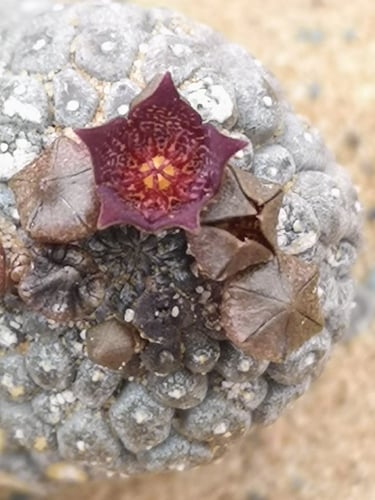
A herb. It forms a large, flattened round tuber. Several short forked shoots develop from this. These are less than 15 cm long. They have a few pairs of leaves that have short stalks. The leaf blades are 5 cm long by 2 cm wide. The midrib is easy to see. The flowers are low down on the branches. They are purple and slightly hairy.
Edible Uses
The underground tuber is mixed with sugar and brewed to make beer, and the fruit are eaten as a snack.
Traditional Uses
The underground tuber is mixed with sugar and brewed to make beer. Caution: It may be poisonous. The fruit are eaten as a snack.
This uses section is brief — help expand it
Medicinal Uses
The tuber is traditionally brewed into a beverage preparation.
Known Hazards
The plant may be poisonous.
Distribution
It is a subtropical plant. In Swaziland it grows only in the highveld.
Where It Grows
Africa, Botswana, Eswatini, South Africa, Southern Africa, Swaziland,
Cultivation
A plant of the subtropics, just entering into the tropics in southern Africa. Requires a very free-draining soil with plenty of moisture in the growing season and a distinct dry season when it is dormant.
Nutrition
| Part | Moisture | kJ | kcal | Protein | Vit A | Vit C | Iron | Zinc |
|---|---|---|---|---|---|---|---|---|
| Tubers | 85 | 203 | 49 | 1 | — | 10.4 | 0.8 | 0.2 |
Synonyms
Also Known As
Ghali, Indzema, Khadiwortel
References (11)
- Facciola, S., 1998, Cornucopia 2: a Source Book of Edible Plants. Kampong Publications, p 168
- Fox, F. W. & Young, M. E. N., 1982, Food from the Veld. Delta Books. p 292
- Lee, 1979,
- Long, C., 2005, Swaziland's Flora - siSwati names and Uses http://www.sntc.org.sz/flora/
- Ogle & Grivetti, 1985,
Show all 11 references Hide references
- Peters, C. R., O'Brien, E. M., and Drummond, R.B., 1992, Edible Wild plants of Sub-saharan Africa. Kew. p 66
- Ruiters-Welcome, A. K., 2019, Food plants of southern Africa. Ph.D. thesis. Univ. of Johannesburg p 27
- Swaziland's Flora Database http://www.sntc.org.sz/flora
- van Wyk, Be., & Gericke, N., 2007, People's plants. A Guide to Useful Plants of Southern Africa. Briza. p 110
- Wehmeyer, A. S, 1986, Edible Wild Plants of Southern Africa. Data on the Nutrient Contents of over 300 species
- Welcome, A. K. & Van Wyk, B.-E., 2019, An inventory and analysis of the food plants of southern Africa. South African Journal of Botany 122 (2019) 136–179