Grewia villosa
Willd.
Round-leaf grewia, Mallow raisons
iNaturalist· cc-by-nc
(c) Grainne El, some rights reserved (CC BY-NC), uploaded by Grainne El
iNaturalist· cc-by
(c) Robert Taylor, some rights reserved (CC BY)
iNaturalist· cc-by
(c) Robert Taylor, some rights reserved (CC BY)
Summary
Source: WikipediaGrewia villosa is a shrub, often scrambling and hardly exceeding 4 m in height. Leaves are fairly large, serrated and heart-shaped. It grows naturally, mainly in dry habitats. It is common in most of the semi-arid parts of Eastern Africa but may now be rare in parts of its natural distribution. It can be seen in Ein Gedi oasis in Israel, and in South Africa, where it is common. Its ripe copper-coloured fruits are eaten in East Africa.
Description
A shrub. It grows 2-4 m tall. It is usually much branched. It loses its leaves during the year. The leaves are oval or round and are large. They are 2.5-14 cm across. They have teeth along the edges. They are copper coloured. There are downy hairs on both surfaces. The leaves are more pale underneath. The fruit is red and hairy. The have 4 shallow lobes. They are 12 mm across. The fruit are edible.
Edible Uses
The fruit of the Grewia villosa were eaten both while immature and green and also once they had ripened and hardened to a dark, reddish-brown. The bark was stripped off and crushed in water or chewed to a pulp which was used to wash the body as well as to clean the hair and disinfect the scalp
Traditional Uses
The ripe orange fruit are usually eaten raw. The skin is rubbed off and the seeds discarded.
This uses section is brief — help expand it
Medicinal Uses
Grewia species are valued in many cultures for their medicinal virtues. The main medicinal action appears to come from the mucilage that is found in the leaves, stems and roots, which has been shown to have soothing and healing properties. Taken internally it is often used as a remedy for diarrhoea and dysentery, for example, whilst externally it is applied to wounds, cuts, ulcers, irritations etc. The plant can be taken as a simple infusion or decoction, or it can be applied topically as a poultice of the plant, or the mucilage can be extracted from the plant, if required, by maceration and then decoction. The roots are emetic. They are used to treat diarrhoea and body pains. The juice of the fresh bark is used in the treatment of urinary troubles, irritation in the bladder and gonorrhoea. The bark is used in the treatment of wounds, syphilis and smallpox.
Distribution
A tropical plant. It grows on rocky soils rich in iron. It grows in drier places. It grows in the Sahel. It occurs in low altitude mixed woodland. It Ethiopia it grows well between 800-1,800 m altitude. It can grow in arid places.
Where It Grows
Africa, Angola, Arabia, Asia, Botswana, Burkina Faso, Cameroon, Cape Verde, Central Africa, Chad, East Africa, Egypt, Eritrea, Eswatini, Ethiopia, Ghana, Guinea-Bissau, India, Israel, Kenya, Mali, Mediterranean, Middle East, Mozambique, Namibia, Niger, North Africa, Oman, Pakistan, Sahel, Senegal, Somalia, South Africa, South Sudan, Southern Africa, Sudan, Swaziland, Tanzania, Uganda, West Africa, Yemen, Zambia, Zimbabwe,
Cultivation
Plants are grown from seed. They are best planted directly.
Propagation
Seed - we have no specific information for this species but seed of this genus is generally best sown as soon as it is ripe. Stored seed has a hard seedcoat and may benefit from scarification before sowing in order to speed up and improve germination. This can usually be done by pouring a small amount of nearly boiling water on the seeds (being careful not to cook them!), allowing the mix to cool somewhat and then leaving it in a warm place to soak for 12 - 24 hours. Sow the seeds in situ or in a nursery seedbed or trays - do not allow the compost to become dry. Germination and early growth are usually quite quick. Cuttings - best taken with a heel.
Other Uses
A good quality fibre is obtained from the inner bark. Used for making ropes. An extract from the bark is used for gluing tobacco leaves. The small stems are used for walking sticks, spearshafts, bows and for making granaries.
Production
In Tanzania it is collected May to July. In NW Pakistan fruit are available in July.
Other Information
A much liked sweet fruit. The fruit are eaten especially by children.
Notes
There are about 200 Grewia species. They are mostly tropical. The fruit of most may be edible. These were in the Sparrmanniaceae and the Tiliaceae.
Synonyms
Also Known As
Amapayenyane, Amasendendwangu, Balneda, Banta, Barnedo, Bonkako, Chenulu, Chiamaguna, Citta, Dogomdii, Dohan, Epongai, Gangetî, Gariwa, Gomashaa, Gomesha, Gomosh, Habeleyta, Hlukayebe, Injarai, Ipopoi, Insarram Jalidar, Jenukallai, Kabish, Kashkasri, Kharmati, Kobbish, Korfu, Kubbish, Kullai, Kumorobasho, Lonkas, Luketa, Makow, Mallow raisin, Mallow-leaved cross-berry, Malvarosyntjie, Mbuu, Mkoma, Mokuwo, Mshoshote, Mugu, Mupunzu, Mushendewabosokwe, Muvu, Offissa, Ogadie, Ogomdii, Ogomteta, Ogumdi, Okura, Olmangulai, Olukuru, Padekhado, Parekhado, Pastuwanne, Perukadalai, Qoffissa, Rug, Sannudippe, Tomur al abid, Umjelekudzi, Umlekule, Vattachi
References (83)
- Abbiw, D.K., 1990, Useful Plants of Ghana. West African uses of wild and cultivated plants. Intermediate Technology Publications and the Royal Botanic Gardens, Kew. p 47
- Addis, G., et al, 2005, Ethnobotanical Study of Edible Wild Plants in Some Selected Districts of Ethiopia. Human Ecology, Vol. 33, No. 1, pp. 83-118
- Addis, G., Asfaw, Z & Woldu, Z., 2013, Ethnobotany of Wild and Semi-wild Edible Plants of Konso Ethnic Community, South Ethiopia. Ethnobotany Research and Applications. 11:121-141
- Addis, G., et al, 2013, The Role of Wild and Semi-wild Edible Plants in Household Food Sovereignty in Hamer and Konso Communities, South Ethiopia. Ethnobotany Research & Applications. 11:251-271
- Ahmad, K. & Pieroni, A., 2016, Folk knowledge of wild food plants among the tribal communities of Thakht-e-Sulaiman Hills, North-West Pakistan. Journal of Ethnobiology and Ethnomedicine, 12:17
Show all 83 references Hide references
- Ambasta, S.P. (Ed.), 2000, The Useful Plants of India. CSIR India. p 250
- Arinathan, V., et al, 2007, Wild edibles used by Palliyars of the western Ghats, Tamil Nadu. Indian Journal of Traditional Knowledge. 6(1) pp 163-168
- Asfaw, Z. and Tadesse, M., 2001, Prospects for Sustainable Use and Development of Wild Food Plants in Ethiopia. Economic Botany, Vol. 55, No. 1, pp. 47-62
- Assefa, A. & Abebe, T., 2010, Wild Edible Trees and Shrubs in the Semi-arid Lowlands of Southern Ethiopia. Journal of Science and Development 1 (1) 2010
- Bahru, T., et al, 2013, Wild Edible Plants: Sustainable Use and Management by Indigenous Communities in and the Buffer Area of Awah National Park, Ethiopia. Ethiop. J. Sci., 36(2): 93-108
- Balemie, K., & Kebebew, F., 2006, Ethnobotanical study of wild edible plants in Derashe and Kucha Districts, South Ethiopia. Journal of Ethnobiology and Ethnomedicine.
- Beche D, Gebeyehu G, Feyisa K., 2016, Indigenous Utilization and Management of Useful Plants in and around Awash National Park, Ethiopia. J Plant Biol Soil Health. 3(1):12.
- Bekele-Tesemma A., Birnie, A., & Tengnas, B., 1993, Useful Trees and Shrubs for Ethiopia. Regional Soil Conservation Unit. Technical Handbook No 5. p 266
- Burkill, H. M., 1985, The useful plants of west tropical Africa, Vol. 5. Kew.
- Busson, 1965,
- Dale, I. R. and Greenway, P. J., 1961, Kenya Trees and Shrubs. Nairobi. p 571
- Dalziel, J. M., 1937, The Useful plants of west tropical Africa. Crown Agents for the Colonies London.
- Dobriyal, M. J. R. & Dobriyal, R., 2014, Non Wood Forest Produce an Option for Ethnic Food and Nutritional Security in India. Int. J. of Usuf. Mngt. 15(1):17-37
- Duarte, M. C., et al, 2022, Diversity of Useful Plants in Cabo Verde Islands: A Biogeographic and Conservation Perspective. Plants 2022, 11, 1313 p 6
- Edwards. S., et al, (Eds), 1995, Flora of Ethiopia and Eritrea. Vol.2, Part 2 Canellaceae to Euphorbiaceae. Uppsala, Sweden. p 162
- Ethiopia: Famine Food Field Guide. http://www.africa.upenn.edu/faminefood/category3.htm
- Exell, A.W. et al, (Ed), 1963, Flora Zambesiaca Vol 2 Part 1 Crown Agents, London. p 62
- FAO, 1988, Traditional Food Plants, FAO Food and Nutrition Paper 42. FAO Rome p 314
- Feyssa, D. H., et al, 2011, Seasonal availability an consumption of wild edible plants in semiarid Ethiopia; Implications to food security and climate change adaptation. Journal of Horticulture and Forestry 3(5): 138-149
- Flora Somalia Vol. 1, 1993, http://plants.jstor.org
- Flora of Pakistan. www.eFloras.org
- Fowler, D. G., 2007, Zambian Plants: Their Vernacular Names and Uses. Kew. p 45
- Fox, F. W. & Young, M. E. N., 1982, Food from the Veld. Delta Books. p 355
- Gallagher, D. E., 2010, Farming beyond the escarpment: Society, Environment, and Mobility in Precolonial Southeastern Burkina Faso. PhD University of Michigan.
- Gemedo-Dalle, T., et al, 2005, Plant Biodiversity and Ethnobotany of Borana Pastoralists in Southern Oromia, Ethiopia. Economic Botany 59(1) pp. 43-65
- Ges. Naturf. Freunde Berlin Neue Schriften 4:205. 1803
- Goode, P., 1989, Edible Plants of Uganda. FAO p 30
- Grivetti, L. E., 1980, Agricultural development: present and potential role of edible wild plants. Part 2: Sub-Saharan Africa, Report to the Department of State Agency for International Development. p 41, 47
- Hedrick, U.P., 1919, (Ed.), Sturtevant's edible plants of the world. p 334
- Ichikawa, M., 1980, The Utilization of Wild Food Plants by the Suiei Dorobo in Northern Kenya. J. Anthrop. Soc. Nippon. 88(1): 25-48
- INFOODS:FAO/INFOODS Databases
- Jardin, C., 1970, List of Foods Used In Africa, FAO Nutrition Information Document Series No 2.p 79, 141
- Kebebew, M. & Leta, G., 2016, Wild Edible Plant Bio-diversity and Utilization System in Nech Sar National Park, Ethiopia. International Journal of Bio-resource and Stress Management 2016, 7(4):885-896
- Khan, D. & Shaukat, S.S., 2006, The Fruits of Pakistan: Diversity, Distribution, Trends of Production and Use. Int. J. Biol. Biotech., 3(3):463-499
- Kidane, B., et al, 2014, Ethnobotany of Wild and Semi-wild Edible Fruit Species used by Maale and Ari Ethnic Communities in South Ethiopia. Ethnobotany Research and Applications. Vol. 12, 1546-3465-12-455
- Le Houerou, H. N., (Ed.), 1980, Browse in Africa. The current state of knowledge. International Livestock Centre for Africa, Ethiopia. p 163
- Long, C., 2005, Swaziland's Flora - siSwati names and Uses http://www.sntc.org.sz/flora/
- Lulekal, E., et al, 2011, Wild edible plants in Ethiopia: a review on their potential to combat food insecurity. Afrika Focus - Vol. 24, No 2. pp 71-121
- Magwede, K., van Wyk, B.-E., & van Wyk, A. E., 2019, An inventory of Vhavenḓa useful plants. South African Journal of Botany 122 (2019) 57–89
- Mannheimer, C. A. & Curtis. B.A. (eds), 2009, Le Roux and Muller's Field Guide to the Trees and Shrubs of Namibia. Windhoek: Macmillan Education Namibia. p 328
- Martin, F.W. & Ruberte, R.M., 1979, Edible Leaves of the Tropics. Antillian College Press, Mayaguez, Puerto Rico. p 221 (Also as Grewia corylifolia)
- Masters, T., 2021, Traditional food plants of the upper Aswa River catchment of northern Uganda—a cultural crossroads. Journal of Ethnobiology and Ethnomedicine (2021) 17:24
- Maundu, P. et al, 1999, Traditional Food Plants of Kenya. National Museum of Kenya. 288p
- Maydell, H. von, 1990, Trees and shrubs of the Sahel: their characteristics and uses. Margraf. p 299
- Mbuya, L.P., Msanga, H.P., Ruffo, C.K., Birnie, A & Tengnas, B., 1994, Useful Trees and Shrubs for Tanzania. Regional Soil Conservation Unit. Technical Handbook No 6. p 292
- Miller, A. G., Morris, M. & Stuart-Smith, S., 1988, Plants of Dhofar. The Southern Region of Oman, Traditional, Economic and Medicinal Uses. Sultanate of Oman. p 284
- Mokganya, M. G. et al, 2018, An evaluation of additional uses of some wild edible fruit plants of the Vhembe District Municipality in the Limpopo Province, South Africa. Indian Journal of Traditional Knowledge. Vol 17(2) April 2018, pp 276-281
- Msuya, T. S., et al, 2010, Availability, Preference and Consumption of Indigenous Foods in the Eastern Arc Mountains, Tanzania, Ecology of Food and Nutrition, 49:3, 208-227
- Mutie, F. G., 2020, Conservation of Wild Food Plants and Their Potential for Combatting Food Insecurity in Kenya as Exemplified by the Drylands of Kitui County. Plants 2020, 9, 1017
- Mutie, F. M., et al, 2023, Important Medicinal and Food Taxa (Orders and Families) in Kenya, Based on Three Quantitative Approaches. Plants 2023, 12, 1145
- Ojelel, S., et al, 2019, Wild edible plants used by communities in and around selected forest reserves of Teso-Karamoja region, Uganda. Journal of Ethnobiology and Ethnomedicine (2019) 15:3
- Palgrave, K.C., 1996, Trees of Southern Africa. Struik Publishers. p 582
- Palmer, E and Pitman, N., 1972, Trees of Southern Africa. Vol. 2. A.A. Balkema, Cape Town p 1442
- Peters, C. R., O'Brien, E. M., and Drummond, R.B., 1992, Edible Wild plants of Sub-saharan Africa. Kew. p 194
- Ramachandran, V. S., 2007, Wild edible plants of the Anamalais, Coimbatore district, western Ghats, Tamil Nadu. Indian Journal or Traditional Knowledge. 6(1) pp 173-176
- Rasingam, L., 2012, Ethnobotanical studies on the wild edible plants of Irula tribes of Pillur Valley, Coimbatore district, Tamil Nadu, India. Asian Pacific Journal of Tropical Biomedicine. (2012) S1493-S1497
- Reddy, K. N. et al, 2007, Traditional knowledge on wild food plants in Andhra Pradesh. Indian Journal of Traditional Knowledge. Vol. 6(1): 223-229
- Roodt, V., 1998, Trees & Shrubs of the Okavango Delta. Medicinal Uses and Nutritional value. The Shell Field Guide Series: Part 1. Shell Botswana. p 197
- Royal Botanic Gardens, Kew (1999). Survey of Economic Plants for Arid and Semi-Arid Lands (SEPASAL) database. Published on the Internet; http://www.rbgkew.org.uk/ceb/sepasal/internet [Accessed 11th June 2011]
- Ruffo, C. K., Birnie, A. & Tengnas, B., 2002, Edible Wild Plants of Tanzania. RELMA p 356
- Ruiters-Welcome, A. K., 2019, Food plants of southern Africa. Ph.D. thesis. Univ. of Johannesburg p 77
- Sasi, R. & Rajendran, A., 2012, Diversity of Wild Fruits in Nilgiri Hills of the Southern Western Ghats - Ethnobotanical Aspects. IJABPT, 3(1) p 82-87
- SAXENA,
- SHANKARNARAYAN & SAXENA,
- Shumsky, S., et al, 2013, Institutional factors affecting wild edible plant (WEP) harvest and consumption in semi-arid Kenya. Land Use Policy 38 (2014) 48-69
- Shumsky, S., et al, 2014, Understanding the contribution of wild edible plants to rural social- ecological resilience in semi-arid Kenya. Ecology and Society 19(4): 34
- Singh, H.B., Arora R.K.,1978, Wild edible Plants of India. Indian Council of Agricultural Research, New Delhi. p 62
- Swaziland's Flora Database http://www.sntc.org.sz/flora
- Teklehaymanot, T., 2017, An ethnobotanical survey of medicinal and edible plants of Yalo Woreda in Afar regional state, Ethiopia. Journal of Ethnobiology and Ethnomedicine 13:40
- Termote, C., et al, 2014, Assessing the potential of wild foods to reduce the cost of a nutritionally adequate diet: An example from eastern Baringo District, Kenya. Food and Nutrition Bulletin, vol. 35, no. 4
- Vanderjagt, F. J., et al, 2000, The trypsin inhibitor content of 61 wild edible plant foods of Niger. Plant Foods for Human Nutrition 55: 335–346, 2000.
- van Wyk, Be., & Gericke, N., 2007, People's plants. A Guide to Useful Plants of Southern Africa. Briza. p 44
- Vivien, J., & Faure, J.J., 1996, Fruitiers Sauvages d'Afrique. Especes du Cameroun. CTA p 354
- Wehmeyer, A. S, 1986, Edible Wild Plants of Southern Africa. Data on the Nutrient Contents of over 300 species
- Welcome, A. K. & Van Wyk, B.-E., 2019, An inventory and analysis of the food plants of southern Africa. South African Journal of Botany 122 (2019) 136–179
- World Checklist of Useful Plant Species 2020. Royal Botanic Gardens, Kew
- www.worldagroforestrycentre.org/treedb/
- www.zimbabweflora.co.zw 2011
More from Malvaceae
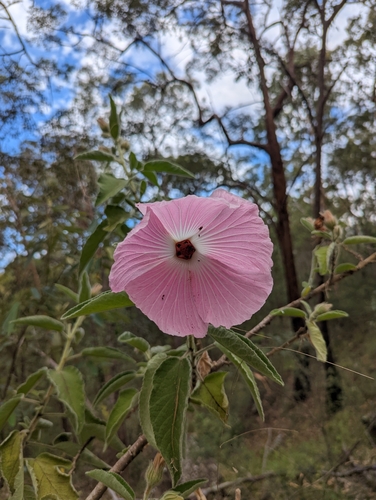
Hibiscus splendens
Pink Hibiscus, Hollyhock tree, Splendid hibiscus
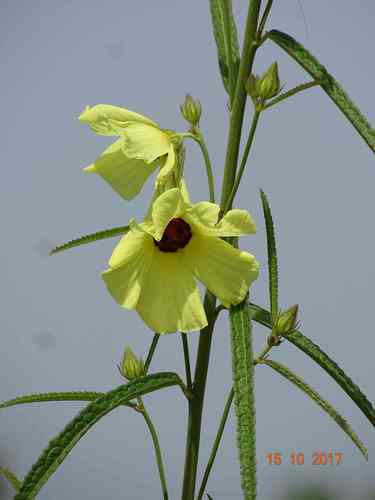
Hibiscus squamosus
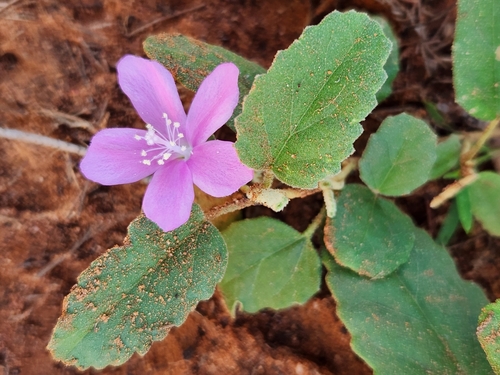
Hibiscus sturtii
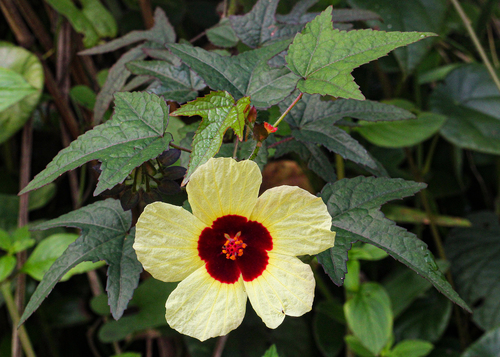
Hibiscus surattensis
Wild sour, Bush sorrel
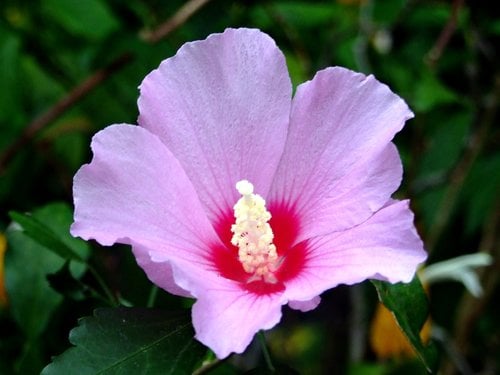
Hibiscus syriacus
Syrian Hibiscus, Blue Hibiscus, Rose of Sharon
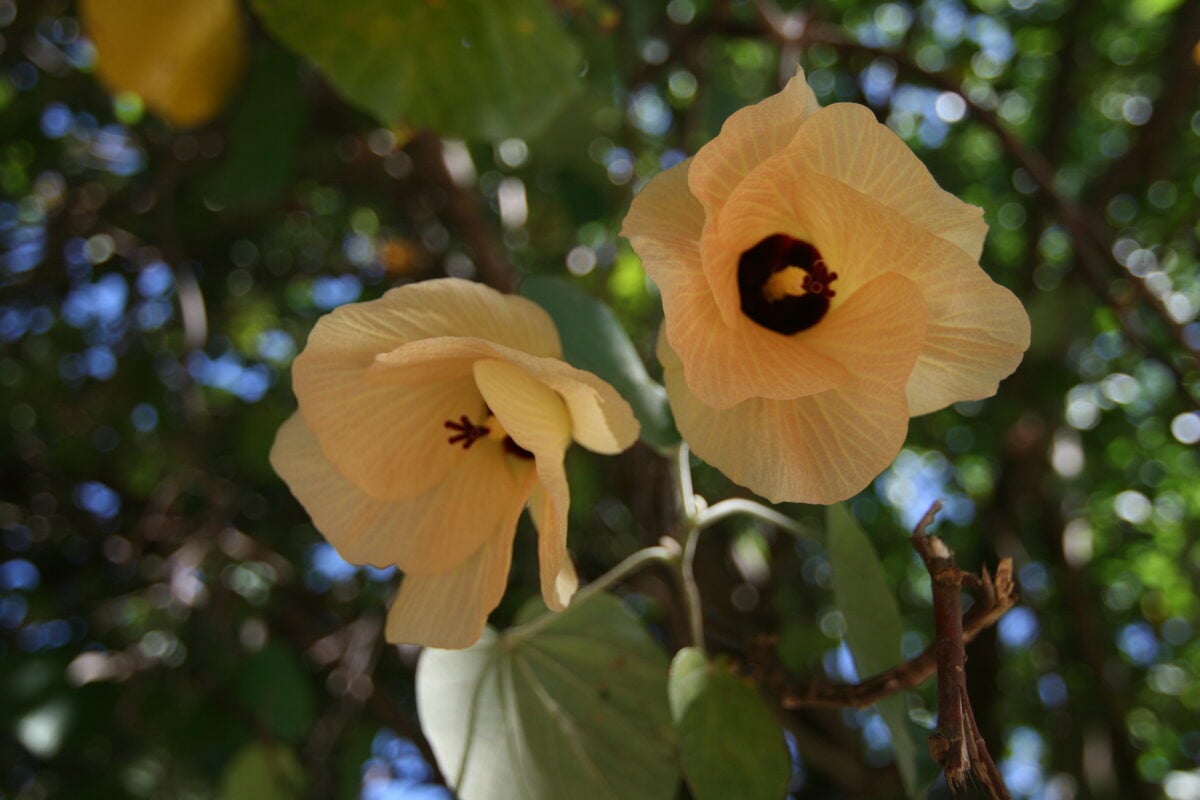
Hibiscus tiliaceus
Cotton Tree, Beach Hibiscus, Country mallow, Sea hibiscus, Yellow mallow