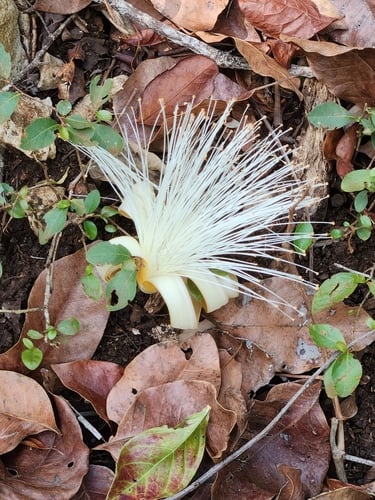
Clappertonia ficifolia
(Willd.) Druce
Bolo-bolo
iNaturalist· cc-by-nc-sa
(c) 106611639464075912591, some rights reserved (CC BY-NC-SA), uploaded by 106611639464075912591
iNaturalist· cc-by-nc
(c) Mathias D'haen, some rights reserved (CC BY-NC)
iNaturalist· cc-by-nc
(c) Mathias D'haen, some rights reserved (CC BY-NC)
Summary
Source: WikipediaClappertonia ficifolia is a species of flowering plant belonging in the family Malvaceae.
Description
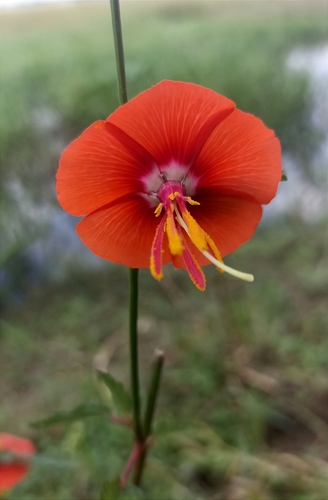
A woody herb or small shrub that grows in water. It grows about 2 m high. The leaves and stems have a grey coating. The leaves can be simple or have 3-5 lobes. They can be heart shaped. The leaves are 13 cm long by 7 cm wide.
Edible Uses
None known
Medicinal Uses
In traditional medicine in DR Congo, the leaves are used as a treatment for liver malfunction.
Distribution
It is a tropical plant. It grows in wet grass savannah, temporary pools and flooded rice fields.
Where It Grows
Africa, Burkina Faso, Central Africa, Central African Republic, CAR, East Africa, Guinea, Guinée, Guinea-Bissau, Indonesia, Malaysia, Mozambique, Pacific, SE Asia, Sierra Leone, West Africa,
Propagation
Propagation is possible by root cuttings or seed. Experiments in Nigeria shortly after the Second World War demonstrated that an excellent fibre could be obtained by retting the stems of flowering plants for approximately 28 days.
Other Uses
The stems yield a valuable fibre resembling jute (Corchorus spp.), which is used to make rope, twine, cordage, mats, nets, hammocks, fish traps, and paper pulp. Clappertonia ficifolia is one of the fibre-producing species within the mandate of the International Jute Study Group — alongside jute (Corchorus spp.), kenaf (Hibiscus cannabinus), roselle (Hibiscus sabdariffa), and Urena lobata. Although most research attention focuses on Corchorus olitorius, the broader prospects for natural fibres make Clappertonia spp. worth further investigation. The plant is also widely grown in gardens as an ornamental.
Production
In Central African Republic flowers and fruit have been recorded in April.
Notes
These have also been in the Tiliaceae.
Synonyms
Also Known As
Cue-madzi
References (3)
- East African Herbarium records, 1981,
- Peters, C. R., O'Brien, E. M., and Drummond, R.B., 1992, Edible Wild plants of Sub-saharan Africa. Kew. p 190
- Slik, F., www.asianplant.net