Grewia trichocarpa
Hochst ex A.Rich.
iNaturalist· cc-by-nc-sa
(c) Cédric de Foucault, some rights reserved (CC BY-NC-SA), uploaded by Cédric de Foucault
iNaturalist· cc-by
(c) Jacky Judas, some rights reserved (CC BY)
iNaturalist· cc-by
(c) Jacky Judas, some rights reserved (CC BY)
Description
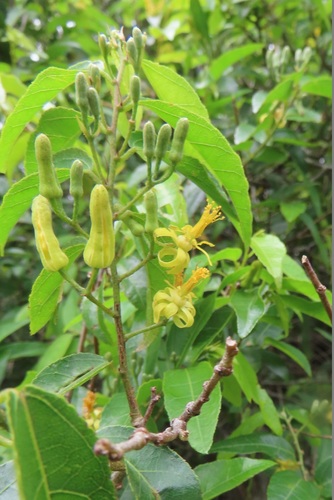
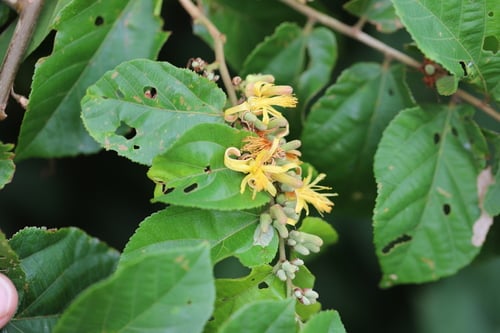
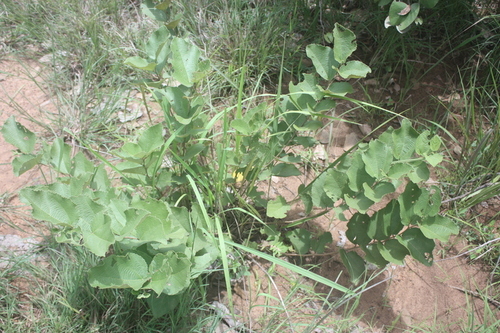
An erect evergreen shrub. It grows 2-6 m high. The bark is silver-grey. The leaves are thin and papery. The leaves are narrowly oval. They are 3-11 cm long by 1-5 cm wide. The flowers are yellow. There are several flowers in a group. The fruit is orange and can have 1 or 2 lobes. It is 5-7 mm long.
Edible Uses
Fruit - raw. A sweet flavour, they are eaten as a snack, especially by children. The orange berries are 5 - 7mm in diameter.
Traditional Uses
The fruit are eaten raw. They are sweet.
This uses section is brief — help expand it
Medicinal Uses
Grewia species are valued in many cultures for their medicinal virtues. The main medicinal action appears to come from the mucilage that is found in the leaves, stems and roots, which has been shown to have soothing and healing properties. Taken internally it is often used as a remedy for diarrhoea and dysentery, for example, whilst externally it is applied to wounds, cuts, ulcers, irritations etc. The plant can be taken as a simple infusion or decoction, or it can be applied topically as a poultice of the plant, or the mucilage can be extracted from the plant, if required, by maceration and then decoction. A root decoction is drunk to expel worms and as a treatment against diarrhoea. A watery extract of the root, combined with that of Grewia tenax, is rubbed in to treat skin tuberculosis and other skin ailments. The leaf sap is drunk to treat coughs, colds, abscesses and anaemia. A decoction of the leaf is drunk to expel the placenta, and is used as an enema against intestinal parasites. A leaf dressing is applied against furuncles.
Distribution
A tropical plant. It grows in sandy soil. It grows between 600-2,150 m above sea level. It can grow in arid places. In Tanzania it grows in areas with a rainfall between 900-1,400 mm.
Where It Grows
Africa, Angola, Botswana, Burundi, Central Africa, Congo, East Africa, Ethiopia, Kenya, Rwanda, Senegal, Somalia, Southern Africa, Sudan, Tanzania, Uganda, West Africa,
Cultivation
Plants can be grown from seeds.
Propagation
Seed - we have no specific information for this species but seed of this genus is generally best sown as soon as it is ripe. Stored seed has a hard seedcoat and may benefit from scarification before sowing in order to speed up and improve germination. This can usually be done by pouring a small amount of nearly boiling water on the seeds (being careful not to cook them!), allowing the mix to cool somewhat and then leaving it in a warm place to soak for 12 - 24 hours. Sow the seeds in situ or in a nursery seedbed or trays - do not allow the compost to become dry. Germination and early growth are usually quite quick. Cuttings - best taken with a heel.
Other Uses
The fibre from the bark is used for tying when making huts etc. It is also used in basketry. The pounded bark is used for soap-making. The wood is used for building poles, floors of granaries, tool handles, walking sticks, bows, spear- and arrow-shafts, and withies. The wood is used for fuel. The tree is important as a source of bee forage.
Production
In Tanzania fruit are collected between April to June.
Other Information
The fruit are eaten especially by children.
Notes
There are about 200 Grewia species. They are mostly tropical. The fruit of most may be edible. These were in the Sparrmanniaceae and the Tiliaceae.
Nutrition
| Part | Moisture | kJ | kcal | Protein | Vit A | Vit C | Iron | Zinc |
|---|---|---|---|---|---|---|---|---|
| Fruit | 92.3 | — | — | — | — | 15.2 | 0.5 | — |
Synonyms
Also Known As
Ahawteta-daiyta, Alenkuato, Dawaita, Ekaliye, Lenquata, Mu-renda, Opobo, Powo, Roboy, Sitetit
References (22)
- Addis, G., et al, 2005, Ethnobotanical Study of Edible Wild Plants in Some Selected Districts of Ethiopia. Human Ecology, Vol. 33, No. 1, pp. 83-118
- Addis, G., Asfaw, Z & Woldu, Z., 2013, Ethnobotany of Wild and Semi-wild Edible Plants of Konso Ethnic Community, South Ethiopia. Ethnobotany Research and Applications. 11:121-141
- Anywar, G., et al, 2014, Wild Plants Used as Nutraceuticals from Nebbi District, Uganda. European Journal of medicinal Plants. 4(6):641-660
- Anymar, G., et al, 2017, Proximate Nutrient Composition of some Wild Edible Medicinal Plants from Uganda. Afr. J. Food gric. Nutr. Dev. 2017; 17(3): 12215-12226
- Dale, I. R. and Greenway, P. J., 1961, Kenya Trees and Shrubs. Nairobi. p 570
Show all 22 references Hide references
- Edwards. S., et al, (Eds), 1995, Flora of Ethiopia and Eritrea. Vol.2, Part 2 Canellaceae to Euphorbiaceae. Uppsala, Sweden. p 162
- Glover et al, 1966b,
- Goode, P., 1989, Edible Plants of Uganda. FAO p 30
- Grivetti, L. E., 1980, Agricultural development: present and potential role of edible wild plants. Part 2: Sub-Saharan Africa, Report to the Department of State Agency for International Development. p 45
- Ichikawa, M., 1980, The Utilization of Wild Food Plants by the Suiei Dorobo in Northern Kenya. J. Anthrop. Soc. Nippon. 88(1): 25-48
- Jardin, C., 1970, List of Foods Used In Africa, FAO Nutrition Information Document Series No 2. p 141
- Johns, T., and Kokwaro, J.O., 1991, Food Plants of the Luo of Siayo District, Kenya. Economic Botany 45(1), pp 103-113
- Kokwaro, J. O. and Johns. T., Luo Biological Dictionary. p 115
- Lulekal, E., et al, 2011, Wild edible plants in Ethiopia: a review on their potential to combat food insecurity. Afrika Focus - Vol. 24, No 2. pp 71-121
- Mutie, F. G., 2020, Conservation of Wild Food Plants and Their Potential for Combatting Food Insecurity in Kenya as Exemplified by the Drylands of Kitui County. Plants 2020, 9, 1017
- Mutie, F. M., et al, 2023, Important Medicinal and Food Taxa (Orders and Families) in Kenya, Based on Three Quantitative Approaches. Plants 2023, 12, 1145
- Ojelel, S., et al, 2019, Wild edible plants used by communities in and around selected forest reserves of Teso-Karamoja region, Uganda. Journal of Ethnobiology and Ethnomedicine (2019) 15:3
- Peters, C. R., O'Brien, E. M., and Drummond, R.B., 1992, Edible Wild plants of Sub-saharan Africa. Kew. p 193
- Royal Botanic Gardens, Kew (1999). Survey of Economic Plants for Arid and Semi-Arid Lands (SEPASAL) database. Published on the Internet; http://www.rbgkew.org.uk/ceb/sepasal/internet [Accessed 11th June 2011]
- Ruffo, C. K., Birnie, A. & Tengnas, B., 2002, Edible Wild Plants of Tanzania. RELMA p 354
- Seyoum, Y., et al, 2015, Edible Wild Fruit Trees and Shrubs and Their Socioeconomic Significance in Central Ethiopia. Ethnobotany Research & Applications. 14:183-197
- World Checklist of Useful Plant Species 2020. Royal Botanic Gardens, Kew