Grewia flavescens
Juss.
Donkey berry, Rough leaf raisin, Sandpaper raisin
iNaturalist· cc-by-nc
(c) Reuben Heydenrych, some rights reserved (CC BY-NC), uploaded by Reuben Heydenrych
iNaturalist· cc-by-nc
(c) Tony Benn, some rights reserved (CC BY-NC), uploaded by Tony Benn
iNaturalist· cc-by-nc
(c) Tony Benn, some rights reserved (CC BY-NC), uploaded by Tony Benn
Summary
Source: WikipediaGrewia flavescens, called rough-leaved raisin, sandpaper raisin, and donkey berry (a name it shares with Grewia bicolor), is a species of flowering plant in the family Malvaceae, native to sub‑Saharan Africa, Yemen, Saudi Arabia, and India. It is considered to be an underutilized crop, both for its fruit and its use for livestock forage. Caterpillars of Anaphe reticulata have been found to feed on the foliage.
Description
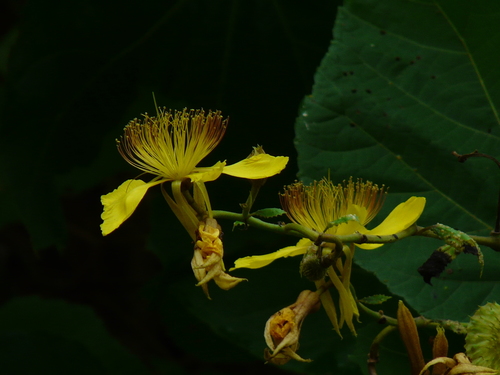
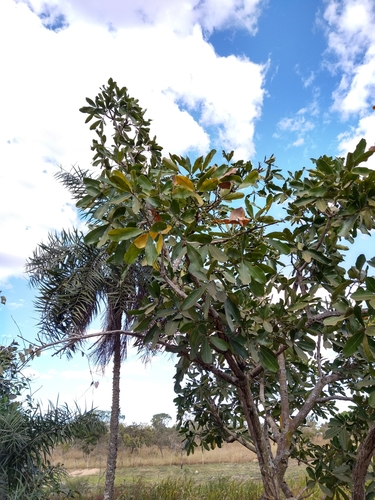
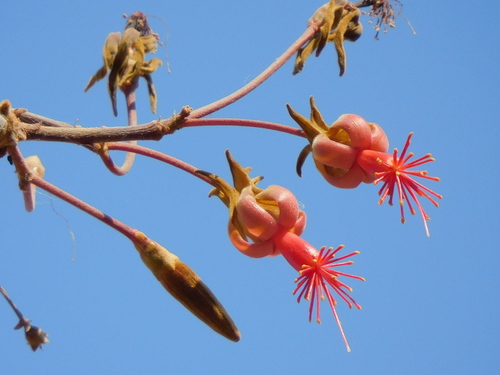
A small tree which loses its leaves during the year. It can grow 3-5 m tall. The crown is rounded. It can be a woody climber. It sometimes forms thickets. The stems are angular and form loops. Young branches are hairy. The leaves are oval and 10 cm long by 5 cm wide. There are coarse teeth along the edge and both sides of the leaves are hairy. The tips are pointed. The flowers are bright orange-yellow and star shaped with 5 slender gold petals. They occur in small bunches in the axils of leaves. The fruit are round and 12 mm across. The have slight lobes. They have very small hairs. They become yellow to red. They occur in groups of 4. They are edible.
Edible Uses
The ripe fruit are eaten raw or dried; the dry skin is rubbed off before eating the flesh. The fruit can be stored once dried and are added to porridge in place of sugar. The leaves are also edible.
Traditional Uses
The ripe fruit are eaten raw or dried. They can be stored once dried. The dry skin is rubbed off before eating the flesh. The fruit are also used for making an alcoholic drink. The fruit is edible. They are added to porridge in place of sugar.
Medicinal Uses
The fruit are used for making an alcoholic drink.
Distribution
A tropical plant. They grow is dry sands. It grows in the Sahel. They suit hot valley areas. They need a rainfall of more than 300 mm each year. It grows in open woodland often along dry stream beds. It grows between 100-1,525 m above sea level. It is tolerant of drought. It can grow in arid places. It is often on termite mounds. It grows in the lowlands and the highlands. In Tanzania it grows between 800-1,200 m above sea level.
Where It Grows
Africa, Angola, Arabia, Asia, Benin, Botswana, Burkina Faso, Cameroon, Central Africa, Chad, Congo, Côte d'Ivoire, East Africa, Eswatini, Ethiopia, Ghana, India, Ivory Coast, Kenya, Malawi, Mali, Middle East, Mozambique, Namibia, Niger, Nigeria, Sahel, Saudi Arabia, Senegal, South Africa, Southern Africa, South Sudan, Sudan, Swaziland, Tanzania, Uganda, West Africa, Yemen, Zambia, Zimbabwe,
Cultivation
Plants can be grown from seeds. The seeds do not germinate easily. They can take 3 months to germinate.
Propagation
Seed - we have no specific information for this species but seed of this genus is generally best sown as soon as it is ripe. Stored seed has a hard seedcoat and may benefit from scarification before sowing in order to speed up and improve germination. This can usually be done by pouring a small amount of nearly boiling water on the seeds (being careful not to cook them!), allowing the mix to cool somewhat and then leaving it in a warm place to soak for 12 - 24 hours. Sow the seeds in situ or in a nursery seedbed or trays - do not allow the compost to become dry. Germination and early growth are usually quite quick. Cuttings - best taken with a heel.
Other Uses
The wood is hard. It is used for building poles, weaving local doors, withies and walking sticks. The wood is used for fuel.
Production
The fruit are collected from April to June.
Other Information
They are a major food of the Bushmen. The fruit have a pleasant taste.
Notes
There are about 200 Grewia species. They are mostly tropical. The fruit of most may be edible. These were in the Sparrmanniaceae and the Tiliaceae.
Nutrition
| Part | Moisture | kJ | kcal | Protein | Vit A | Vit C | Iron | Zinc |
|---|---|---|---|---|---|---|---|---|
| Fruit | 18.2 | 589 | 141 | 7 | — | — | 9.2 | 0.8 |
| Flowers | 76.2 | 358 | 86 | 0.8 | — | — | — | — |
Synonyms
Also Known As
Amrurjii, Daiyta-arba, Dhabi-qurquraale, Elamuruke, Farangan, Goursoumhi, Guedeb, Gugur, Kabayna, Kakose, Kelehi, Laghojane, Lambonjane, Likloko, Mizwilaminzhi, Mkolelupini, Mkozepini, Mokgomphatha, Mopharatshena, Motsotsojana, Mpelemense, Mubhununu, Mubhubhunu, Mufhughuha, Mujonjoma, Muku, Mumbudzi, Mumhudzingwa, Muparatsheni, Muparafeni, Muundu, Nyamuzwila, Odaachu, Oleing'oni, Olmangulai, Omushe, Parhenkal, Phetara, Phunzunyeke, Rupundu, Sountago, Skurwerosyntjie, Tobongo, Ubhunzu, Ubhuxu, Umklampunzi, Umnaba, Umtewa
References (61)
- Addis, G., Asfaw, Z & Woldu, Z., 2013, Ethnobotany of Wild and Semi-wild Edible Plants of Konso Ethnic Community, South Ethiopia. Ethnobotany Research and Applications. 11:121-141
- Ambasta, S.P. (Ed.), 2000, The Useful Plants of India. CSIR India. p 248
- Ann. Mus. Natl. Hist. Nat. 4:91. 1804
- Arinathan, V., et al, 2007, Wild edibles used by Palliyars of the western Ghats, Tamil Nadu. Indian Journal of Traditional Knowledge. 6(1) pp 163-168
- Belem, B., et al, 2007, Use of Non Wood Forest Products by local people bordering the “Parc National Kaboré Tambi”, Burkina Faso. The Journal of Transdisciplinary Environmental Studies vol. 6, no. 1 p 9
Show all 61 references Hide references
- Bonou, A., et al, 2013, Valeur economique des Produits Forestiers Non Ligneux (PFNL) au Benin. Editions Universitaires Europeennes p 97
- Burkill, H. M., 1985, The useful plants of west tropical Africa, Vol. 5. Kew.
- Cheikhyoussef, A & Embashu, W., 2013, Ethnobotanical knowledge on Indigenous fruits in Ohangwena and Oshito regions in Northern Namibia. Journal of Ethnobiology and Ethnomedicine 9:34
- Dale, I. R. and Greenway, P. J., 1961, Kenya Trees and Shrubs. Nairobi. p 565
- Edwards. S., et al, (Eds), 1995, Flora of Ethiopia and Eritrea. Vol.2, Part 2 Canellaceae to Euphorbiaceae. Uppsala, Sweden. p 162
- Exell, A.W. et al, (Ed), 1963, Flora Zambesiaca Vol 2 Part 1 Crown Agents, London. p 46
- FAO, 1988, Traditional Food Plants, FAO Food and Nutrition Paper 42. FAO Rome p 306
- Feyssa, D. H., et al, 2011, Wild Edible Fruits of Importance for Human Nutrition in Semiarid Parts of East Shewa Zone, Ethiopia. Pakistan Journal of Nutrition January 2011
- Feyssa, D. H., et al, 2011, Seasonal availability an consumption of wild edible plants in semiarid Ethiopia; Implications to food security and climate change adaptation. Journal of Horticulture and Forestry 3(5): 138-149
- Fowler, D. G., 2007, Zambian Plants: Their Vernacular Names and Uses. Kew. p 45
- Gallagher, D. E., 2010, Farming beyond the escarpment: Society, Environment, and Mobility in Precolonial Southeastern Burkina Faso. PhD University of Michigan.
- Gilbert, T., et al, 2017, Diversity and local transformation of indigenous edible fruits in sahelian domain of Cameroon. Journal of Animal & Plant Sciences Vol. 26 (2): 5289-5300
- Goode, P., 1989, Edible Plants of Uganda. FAO p 30
- Grivetti, 1976, 1979,
- Grivetti, L. E., 1980, Agricultural development: present and potential role of edible wild plants. Part 2: Sub-Saharan Africa, Report to the Department of State Agency for International Development. p 41, 72, 79
- http://www.fao.org/forestry/25323-096344a3de335832e8f363c3ac5184a66.pdf (As Grewia platyclada)
- Le Houerou, H. N., (Ed.), 1980, Browse in Africa. The current state of knowledge. International Livestock Centre for Africa, Ethiopia. p 163
- Lulekal, E., et al, 2011, Wild edible plants in Ethiopia: a review on their potential to combat food insecurity. Afrika Focus - Vol. 24, No 2. pp 71-121
- Palmer, E and Pitman, N., 1972, Trees of Southern Africa. Vol. 2. A.A. Balkema, Cape Town p 1433
- Jardin, C., 1970, List of Foods Used In Africa, FAO Nutrition Information Document Series No 2.p 140
- Leger, S., 1997, A Description of Today's Use of Plants in West Bushmanland (Namibia). German Development Service. PO Box 220035, 14061 Berlin, Germany. http://www.sigridleger.de/book/
- Long, C., 2005, Swaziland's Flora - siSwati names and Uses http://www.sntc.org.sz/flora/
- Maguire, 1978,
- Magwede, K., van Wyk, B.-E., & van Wyk, A. E., 2019, An inventory of Vhavenḓa useful plants. South African Journal of Botany 122 (2019) 57–89
- Malaisse, F., 1997, Se nourrir en floret claire africaine. Approche ecologique et nutritionnelle. CTA., p 63
- Mannheimer, C. A. & Curtis. B.A. (eds), 2009, Le Roux and Muller's Field Guide to the Trees and Shrubs of Namibia. Windhoek: Macmillan Education Namibia. p 320
- Maroyi, A., 2011, The Gathering and Consumption of Wild Edible Plants in Nhema Communal Area, Midlands Province, Zimbabwe. Ecology of Food and Nutrition 50:6, 506-525
- Maroyi, A. & Cheikhyoussef, A., 2017, Traditional knowledge of wild edible fruit in southern Africa: A comparative use patterns in Namibia and Zimbabwe. Indian Journal of Traditional Knowledge. 16(3): 385-392
- Marshall, 1976,
- Mashile, S. P., et al, 2019, Indigenous fruit plants species of the Mapulana of Ehlanzeni district in Mpumalanga province, South Africa. South African Journal of Botany 122 (2019) 180–183
- Maydell, H. von, 1990, Trees and shrubs of the Sahel: their characteristics and uses. Margraf. p 293
- Mengistu, F. & Hager, H., 2008, Wild Edible Fruit Species Cultural Domain, Informant Species Competence and Preference in Three Districts of Amhara Region, Ethiopia. Ethnobotany Research & Applications 6:487-502
- Moksia, F., et al, 2019, Diversity and Socio-Economic Value of Wild Edible Plants in the Mounts Mandara Region, Cameroon. International Journal of Sciences. Vol. 8:10
- Motlhanka, D. M. T., et al, 2008, Edible Indigenous Fruit Plants of Eastern Botswana. International Journal of Poultry Science. 7(5): 457-460
- Neudeck, L. et al, 2012, The Contribution of Edible Wild Plants to Food Security, Dietary Diversity and Income of Households in Shorobe Village, Northern Botswana. Ethnobotany Research & Applications 10:449-462
- Newman, 1970, (As Grewia platyclada)
- Ogle & Grivetti, 1985,
- Palgrave, K.C., 1996, Trees of Southern Africa. Struik Publishers. p 571
- Peters, C. R., O'Brien, E. M., and Drummond, R.B., 1992, Edible Wild plants of Sub-saharan Africa. Kew. p 191
- Peters, C. R., O'Brien, E. M., and Drummond, R.B., 1992, Edible Wild plants of Sub-saharan Africa. Kew. p 193 (As Grewia platyclada)
- Prachi, K., et al, 2012, Underutilized wild fruits of North Maharashtra. Journal of Research in Plant Sciences. (2012) 1:071-076
- Reddy, K. N. et al, 2007, Traditional knowledge on wild food plants in Andhra Pradesh. Indian Journal of Traditional Knowledge. Vol. 6(1): 223-229
- Rodin, 1985,
- Roodt, V., 1998, Trees & Shrubs of the Okavango Delta. Medicinal Uses and Nutritional value. The Shell Field Guide Series: Part 1. Shell Botswana. p 81
- Royal Botanic Gardens, Kew (1999). Survey of Economic Plants for Arid and Semi-Arid Lands (SEPASAL) database. Published on the Internet; http://www.rbgkew.org.uk/ceb/sepasal/internet [Accessed 11th June 2011]
- Ruffo, C. K., Birnie, A. & Tengnas, B., 2002, Edible Wild Plants of Tanzania. RELMA p 348 (As Grewia platyclada)
- Ruiters-Welcome, A. K., 2019, Food plants of southern Africa. Ph.D. thesis. Univ. of Johannesburg p 75
- Sarvalingam, A., et al, 2014, Wild edible plant resources used by the Irulas of the Maruthamalai Hills, Southern Western Ghats, Coimbatore, Tamil Nadu. Indian Journal of Natural Products and Resources 5(2):198-201
- Silberbauer, 1965, 1981,
- Singh, H.B., Arora R.K.,1978, Wild edible Plants of India. Indian Council of Agricultural Research, New Delhi. p 62
- Tredgold, M.H., 1986, Food Plants of Zimbabwe. Mambo Press. p 70
- van Wyk, Be., & Gericke, N., 2007, People's plants. A Guide to Useful Plants of Southern Africa. Briza. p 44
- Vivien, J., & Faure, J.J., 1996, Fruitiers Sauvages d'Afrique. Especes du Cameroun. CTA p 353
- Wehmeyer, A. S, 1986, Edible Wild Plants of Southern Africa. Data on the Nutrient Contents of over 300 species
- World Checklist of Useful Plant Species 2020. Royal Botanic Gardens, Kew
- www.zimbabweflora.co.zw 2011