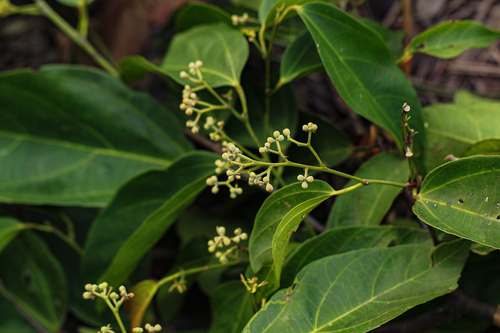
Grewia breviflora
Benth.
Wild currant, Emu berries, Coffee fruit
iNaturalist· cc-by-sa
(c) Michael Somerville, some rights reserved (CC BY-SA), uploaded by Michael Somerville
iNaturalist· cc-by
(c) Ian Cowie, some rights reserved (CC BY)
Description
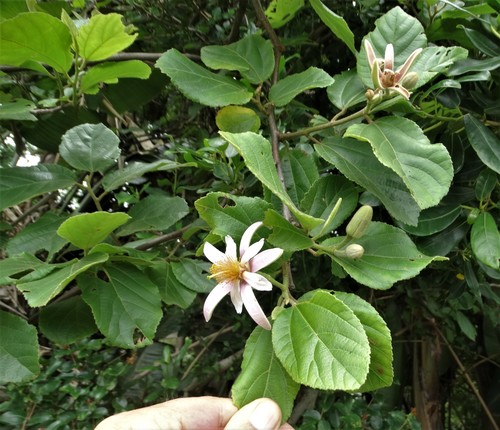
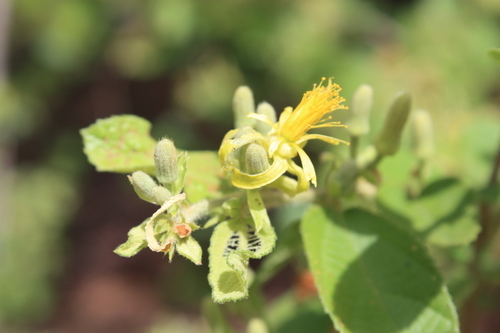
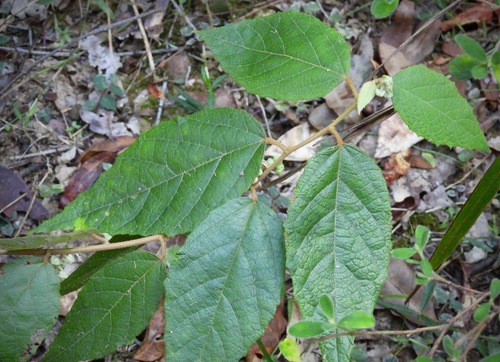
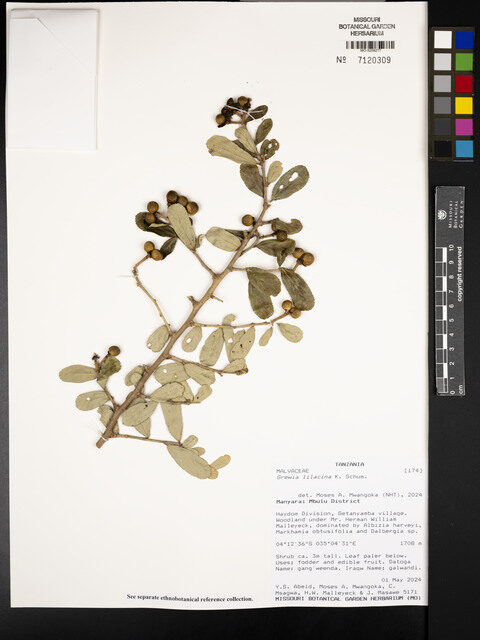
A small tree with many stems. It grows 3-8 m tall. The branches spread out. The tree loses its leaves during the year. The leaves have hairs on both surfaces. The leaf blade is 3.5-8 cm long by 2-4.5 cm wide. The veins are distinct. The edges have teeth. The flowers are yellow and about 0.5 cm long. The occur in small clusters in the axils of leaves. The fruit is smooth, round and fleshy. It has 1-2 lobes. They are about 0.6 cm across. They are dark black when ripe. They contain a hard shell with 2 seeds.
Edible Uses
The fruit are eaten raw.
Traditional Uses
The fruit are eaten raw.
This uses section is brief — help expand it
Distribution
A tropical plant. It grows naturally in coastal monsoon vine-thickets.
Where It Grows
Australia*, East Timor, SE Asia, Timor-Leste,
Notes
There are about 200 Grewia species. They are mostly tropical. The fruit of most may be edible. These were in the Sparrmanniaceae and the Tiliaceae.
Nutrition
| Part | Moisture | kJ | kcal | Protein | Vit A | Vit C | Iron | Zinc |
|---|---|---|---|---|---|---|---|---|
| Fruit | 44.3 | 839 | 201 | 3 | — | — | — | — |
Synonyms
Also Known As
Gulma, Guulmi
References (14)
- Brock, J., 1993, Native Plants of Northern Australia, Reed. p 209
- Cherikoff V. & Isaacs, J., The Bush Food Handbook. How to gather, grow, process and cook Australian Wild Foods. Ti Tree Press, Australia p 200
- Cowie, I, 2006, A Survey of Flora and vegetation of the proposed Jaco-Tutuala-Lore National Park. Timor-Lests (East Timor) www.territorystories.nt/gov.au p 53
- Cribb, A.B. & J.W., 1976, Wild Food in Australia, Fontana. p 37
- Hardwick, G., 2001, Economically Useful Plants for Northern Australia: Master Species List. Crusader eBooks.
Show all 14 references Hide references
- Kenneally, K.E., Edinger, D. C., and Willing T., 1996, Broome and Beyond, Plants and People of the Dampier Peninsula, Kimberley, Western Australia. Department of Conservation and Land Management. p 193
- Lazarides, M. & Hince, B., 1993, Handbook of Economic Plants of Australia, CSIRO. p 125
- Low, T., 1991, Wild Food Plants of Australia. Australian Nature FieldGuide, Angus & Robertson. p 116
- Paczkowska, G . & Chapman, A.R., 2000, The Western Australian Flora. A Descriptive Calatogue. Western Australian Herbarium. p 562
- Smith, M & Kalotas, A. C., 1985, Bardi Plants: An Annotated List of Plants and Their Use by the Bardi Aborigines of Dampierland, in North-western Australia. Rec. West Aust. Mus. 1985, 12(3): 317-359
- Smith, Nicholas et al. 1993, Ngarinyman Ethnobotany: Aboriginal Plant Use from the Victoria River Area Northern Australia. Northern Territory Botanical Bulletin No 16. Parks and Wildlife Commission of the Northern Territory. p 30
- Townsend, K., 1994, Across the Top. Gardening with Australian Plants in the tropics. Society for Growing Australian Plants, Townsville Branch Inc. p 241
- Vigilante, T., et al, 2013, Island country: Aboriginal connections, values and knowledge of the Western Kimberley islands in the context of an island biological survey. Records of the Western Australian Museum Supplement 81: 145-182
- Wheeler, J.R.(ed.), 1992, Flora of the Kimberley Region. CALM, Western Australian Herbarium, p 166