Gaultheria x wisleyensis
Marchant. & D.J. Middleton
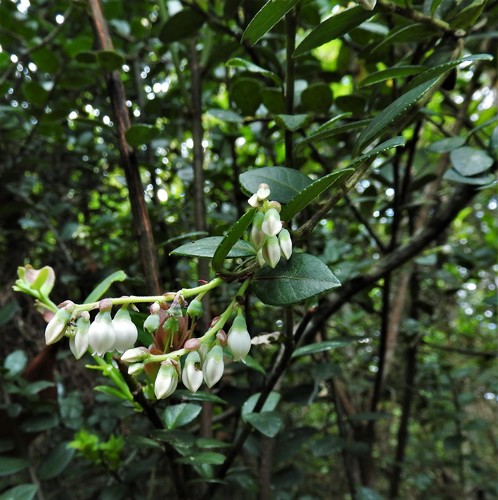
iNaturalist· cc-by
(c) Joe Potter Butler, some rights reserved (CC BY)
iNaturalist· cc-by
(c) Joe Potter Butler, some rights reserved (CC BY)
iNaturalist· cc-by
(c) Joe Potter Butler, some rights reserved (CC BY)
Summary
An evergreen shrub hybrid reaching 1m tall and wide, hardy to UK zone 6. Evergreen foliage with flowers May to June; hermaphroditic and insect-pollinated. Adapts to light sandy or medium loamy soils with mildly acid to very acid pH. Grows in full shade of deep woodland through semi-shade, preferring moist soil conditions.
Description
A low spreading shrub. A hybrid bred in England. It grows 1.6 m high. The stems develop suckers. The leaves are small and leathery. They vary in size and can be 35 mm long. The flowers are white. The fruit are red or purple berries. They occur in large clusters.
Edible Uses
The fruit can be eaten raw or cooked. It has little flavour but is reasonably palatable.
Medicinal Uses
None known.
Distribution
It is a temperate plant. It suits hardiness zones 6-9.
Where It Grows
Australia, Britain, Europe, North America, USA,
Cultivation
Prefers a cool moist but not boggy humus rich soil in shade or semi-shade. A peat and moisture loving species, it requires a lime-free soil. This species has not as yet got a valid name, having recently been moved from the genus Gaulnettya. Plants are hardy to about -20°c. Plants in this genus are notably resistant to honey fungus. Gaultheria × wisleyensis Marchant ex D.J.Middleton is an artificial hybrid. The hybrid formula of this artificial cross is G. mucronata × G. shallon.
Propagation
Seed requires cold stratification — pre-chill for 4–10 weeks, then surface sow in lime-free compost in a shady part of the greenhouse and keep the compost moist. Germination is usually good, typically within 1–2 months at 20°C, but seedlings are prone to damping off. Water carefully, ensure good ventilation, and watering with a garlic infusion can also help prevent damping off. Prick out seedlings into individual pots when about 25mm tall and grow on in light shade in the greenhouse for at least their first winter. Plant out in late spring or early summer; seedlings are susceptible to spring frosts and may need protection for their first few years outdoors. Leaves remain very small for the first few years. Note that this is a hybrid species and will not breed true from seed. Take cuttings of half-ripe wood 3–6cm long in July/August in a shaded frame; roots form in late summer or spring with a good success rate. Divide in spring when new growth is about 7cm tall. Larger clumps can go directly into permanent positions, though smaller clumps are best potted up and grown on in a cold frame until rooting well, then planted out in spring.
Other Uses
Makes a good ground cover for shady situations. Plants spread by suckers and form dense thickets.
Notes
There are about 170 Gaultheria species.
Synonyms
References (6)
- Cundall, P., (ed.), 2004, Gardening Australia: flora: the gardener's bible. ABC Books. p 627
- Etherington, K., & Imwold, D., (Eds), 2001, Botanica's Trees & Shrubs. The illustrated A-Z of over 8500 trees and shrubs. Random House, Australia. p 344
- Hibbert, M., 2002, The Aussie Plant Finder 2002, Florilegium. p 108
- Plants for a Future database, The Field, Penpol, Lostwithiel, Cornwall, PL22 0NG, UK. http://www.scs.leeds.ac.uk/pfaf/
- Ryan, S., 2008, Dicksonia. Rare Plants Manual. Hyland House. p 28
Show all 6 references Hide references
- Young, J., (Ed.), 2001, Botanica's Pocket Trees and Shrubs. Random House. p 408