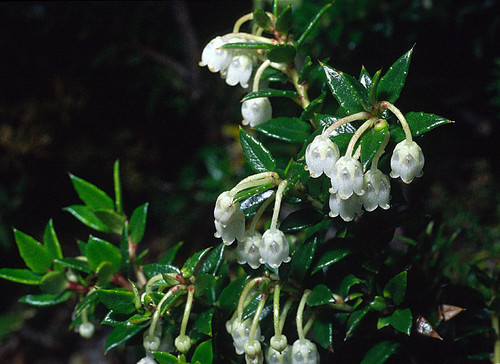
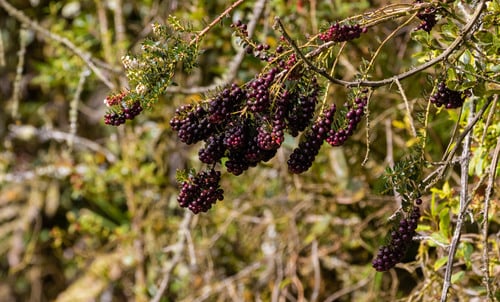
Rhododendron mucronulatum
Turcz.
Manchurian azalea
iNaturalist· cc-by
(c) Kim, Hyun-tae, some rights reserved (CC BY), uploaded by Kim, Hyun-tae
iNaturalist· cc-by-nc
(c) Игорь Поспелов, some rights reserved (CC BY-NC), uploaded by Игорь Поспелов
iNaturalist· cc-by-nc
(c) emanon, some rights reserved (CC BY-NC), uploaded by emanon
Summary
Source: WikipediaRhododendron mucronulatum, the Korean rhododendron or Korean rosebay (Korean: 진달래; RR: Jindalrae), is a rhododendron species native to Korea, Mongolia, Russia, and parts of northern China. It is a deciduous shrub that grows to 1–2 m (3.3–6.6 ft) in height, with elliptic or elliptic-lanceolate leaves, 3–7 cm (1+1⁄4–2+3⁄4 in) long by 1–3.5 cm (3⁄8–1+3⁄8 in) wide. The reddish-purple flowers appear in late winter or early spring, often on the bare branches before the foliage unfurls. It inhabits forested regions at 1,600–2,300 m (5,200–7,500 ft). The Latin specific epithet mucronulatum means "sharply pointed", referring to the leaf shape.
Description
A shrub. It loses its leaves during the year. It grows 1-2 m tall. It has many thin branches. The leaves are narrowly oval and 3-7 cm long by 1-4 cm wide. They are brown underneath. The flowers can occur singly or as 3 together. They are funnel shaped and pale red or purple.
Edible Uses
The flower petals can be eaten raw. Some caution is advised regarding toxicity.
Traditional Uses
The flowers are eaten raw. They are also used in dumplings and wine. The root is used to make a sweet drink with fermented wine.
This uses section is brief — help expand it
Medicinal Uses
None known.
Known Hazards
Although no specific mention of toxicity has been seen for this species, it belongs to a genus where many members have poisonous leaves. The pollen of many if not all species of rhododendrons is also probably toxic, being said to cause intoxication when eaten in large quantities.
Distribution
It is a temperate plant. It grows on the edges of forests in north China.
Where It Grows
Asia, China, Japan, Korea, Mongolia, Russia,
Cultivation
Succeeds in a most humus-rich lime-free soils except those of a dry arid nature or those that are heavy or clayey. Prefers a peaty or well-drained sandy loam. Succeeds in sun or shade, the warmer the climate the more shade a plant requires. A pH between 4.5 and 5.5 is ideal. Hardy to about -25°c. A very ornamental plant. Succeeds in a woodland though, because of its surface-rooting habit, it does not compete well with surface-rooting trees. Plants need to be kept well weeded, they dislike other plants growing over or into their root system, in particular they grow badly with ground cover plants, herbaceous plants and heathers. Plants form a root ball and are very tolerant of being transplanted, even when quite large, so long as the root ball is kept intact. Plants in this genus are notably susceptible to honey fungus.
Propagation
Seed is best sown in a greenhouse as soon as it is ripe in autumn under artificial light. Alternatively, sow in a lightly shaded warm greenhouse in late winter, or in a cold greenhouse in April. Surface-sow and keep the compost consistently moist. Pot up seedlings when large enough to handle and grow on under glass for at least the first winter. Layering can be done in late July and takes 15–24 months. Cuttings of half-ripe wood taken in August in a frame are possible but difficult.
Other Uses
None known.
Synonyms
Also Known As
Chindallae, Jindalrae, Kara-genkai-tsutsuji
References (7)
- Bull. Soc. Imp. Naturalistes Moscou 10(7):155. 1837
- Facciola, S., 1998, Cornucopia 2: a Source Book of Edible Plants. Kampong Publications, p 96
- Fan, L., et al, The Use of Edible Wild Plants and Fungi in Korean-Chinese Villages. Journal of Environmental Information Science 44-5 p 71-79
- Hwang, H., et al, 2013, A Study on the Flora of 15 Islands in the Western Sea of Jeollanamdo Province, Korea. Journal of Asia-Pacific Biodiversity Vol. 6, No. 2 281-310
- Hwang, HS, et al, 2014, Distribution characteristics of plant in the Ungseokbong Mountain, Gyeongsangnam-do, Korea. Journal of Asia-Pacific Biodiversity. 7(2014) e164-e178
Show all 7 references Hide references
- Kim, H. & Song, M., 2013, Ethnobotanical analysis for traditional knowledge of wild edible plants in North Jeolla Province (Korea). Genetic. Resour. Crop Evol. (2013) 60:1571-1585
- Pemberton, R. W. & Lee, N. S., 1996, Wild Food Plants in South Korea: Market Presence, New Crops, and Exports to the United States. Economic Botany, Vol. 50, No. 1, pp. 57-70