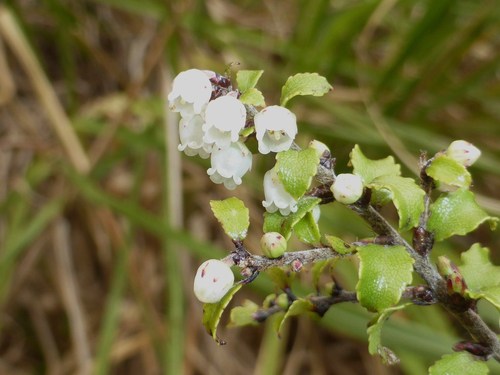
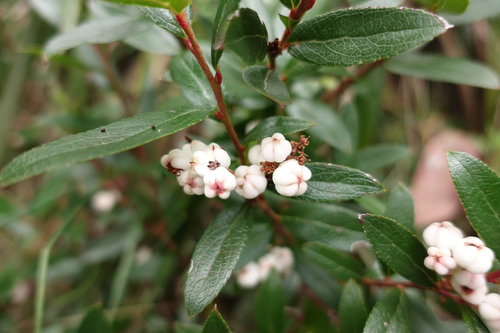
Rhododendron periclymenoides
(Michx.) Shinners
Pinxter flower, Honeysuckle azalea
iNaturalist· cc-by
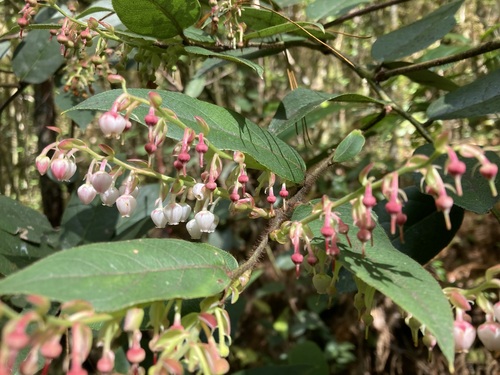
(c) Ana Ka'ahanui, some rights reserved (CC BY), uploaded by Ana Ka'ahanui
iNaturalist· cc-by
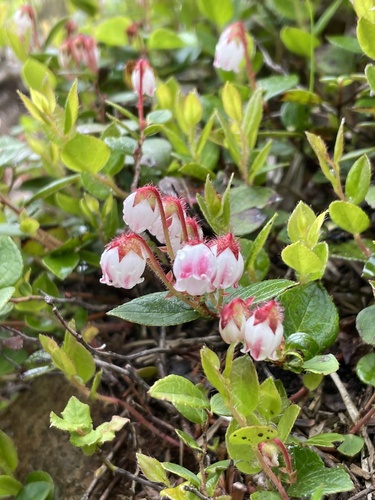
(c) Carrie Seltzer, some rights reserved (CC BY)
Summary
Source: WikipediaRhododendron periclymenoides, the pink azalea or pinxter flower, is a species of shrub in the heath family Ericaceae. It is native to eastern North America, where it is widespread from Alabama to New Hampshire. It is often found in riparian areas, in wet to dry forests. This species produces showy pink flowers in the spring. They have 2-inch (51 mm) long stamens; they carry a strong, sweet scent similar to petunias. The leaves are bright green and ovate. The trunk grows to be about 9 feet (2.7 m) tall. Like many members of the genus, the plant contains toxins in all parts of the flower.
Description
A shrub. It grows 1-2 m tall. It loses its leaves during the year. The flowers are white or pink.
This description is brief — help expand it
Edible Uses
An irregular growth found on the twigs is eaten as a thirst quencher. It can be sliced and added to tossed salads, or pickled in spiced vinegar. Note that the plant itself is highly toxic — all parts are poisonous and could be fatal if ingested. Honey produced by bees that collect pollen from Rhododendron species is known as 'mad honey'; consuming it can cause salivation, abdominal pain, diarrhoea, vomiting, difficulty breathing, paralysis, coma, hypotension, and cardiac rhythm irregularities.
Traditional Uses
An irregular growth on the twigs is eaten as a thirst quencher. It can be sliced and mixed with tossed salads. It is also pickled in spiced vinegar. Caution: The flowers are toxic.
Medicinal Uses
None known.
Known Hazards
Rhododendron periclymenoides has low levels of toxicity, and all parts of the plant may cause vomiting or diarrhoea if ingested in quantity. The poisons produced by rhododendrons are known as grayanotoxins, which are a class of neurotoxins. These neurotoxins work by blocking the inactivation of sodium channel receptors, causing cell dysfunction. The honey which is made by bees which collect pollen from genus Rhododendron species is referred to as “mad honey”. Humans who ingest this honey begin exhibiting many of the symptoms listed above as well as hypotension and other irregularities of cardiac rhythm. Outside of “mad honey” ingestion, human poisoning by rhododendrons is rare. However, pets and other livestock can still ingest the plant parts. While not common in the United States, “mad honey” is believed to have medicinal qualities in China.
Distribution
It is a temperate plant. It grows in moist locations. It suits hardiness zones 4-9. Arboretum Tasmania.
Where It Grows
Australia, North America, Tasmania, USA,
Propagation
Seed is best sown in a greenhouse as soon as it is ripe in autumn under artificial light. Alternatively, sow in a lightly shaded warm greenhouse in late winter, or in a cold greenhouse in April. Surface-sow and keep the compost consistently moist. Pot up seedlings when large enough to handle and grow on under glass for at least the first winter. Layering in late July takes 15–24 months. Cuttings of half-ripe wood taken in August in a frame are possible but difficult.
Other Uses
Rhododendron periclymenoides is used horticulturally as an ornamental plant. It is suitable as a foundation plant, in shrub borders, mixed borders, woodland gardens, shade gardens, and as a hedge.
Notes
Azalea nudiflora an illegitimate, superfluous name (ICBN Art. 52) as Linnaeus included type of A. lutea L.
Synonyms
References (4)
- Facciola, S., 1998, Cornucopia 2: a Source Book of Edible Plants. Kampong Publications, p 95 (As Azalea nudiflora)
- Jackes, D. A., 2007, Edible Forest Gardens
- Kermath, B. M., et al, 2014, Food Plants in the Americas: A survey of the domesticated, cultivated and wild plants used for Human food in North, Central and South America and the Caribbean. On line draft. p 743
- Sp. pl. ed. 2, 1:214. 1762