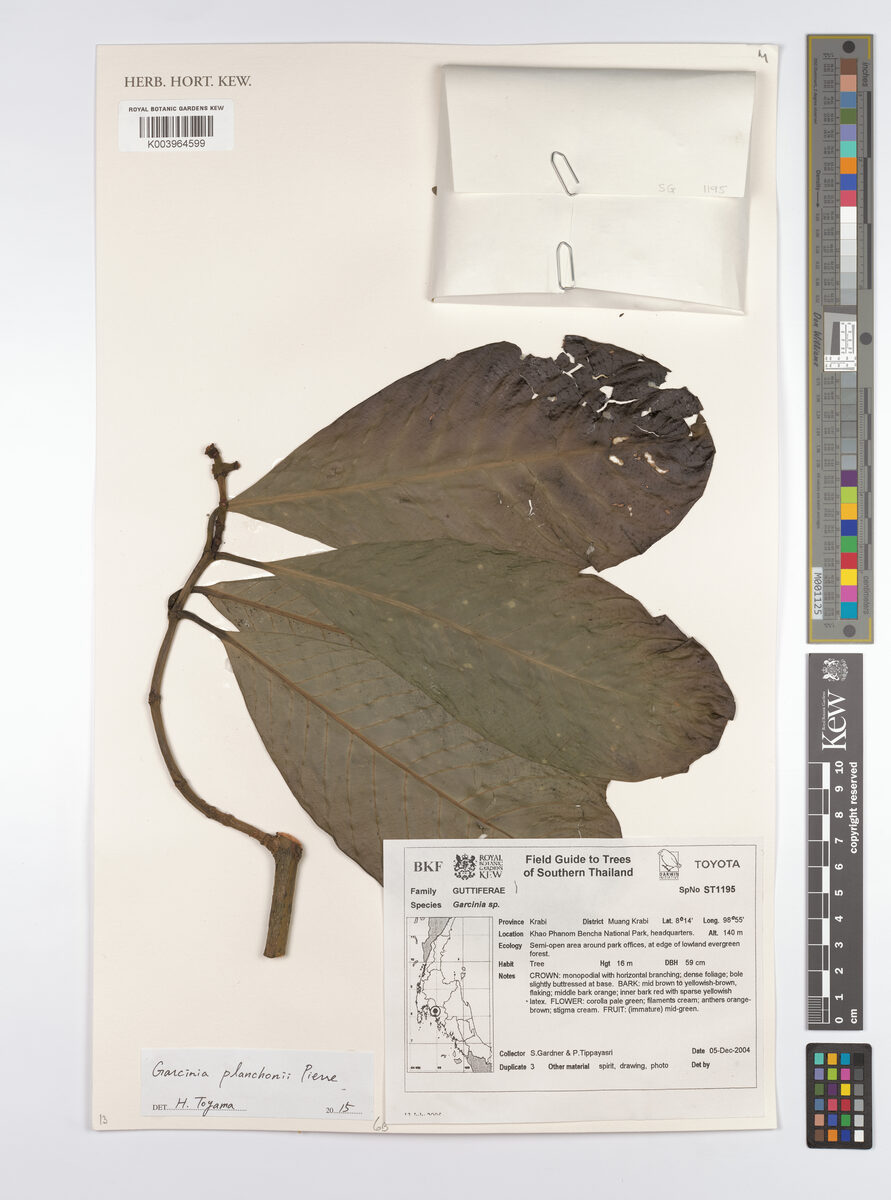
Garcinia livingstonei
T. Anderson
African mangosteen
iNaturalist· cc-by-nc
(c) ashleyraejordan, some rights reserved (CC BY-NC)
iNaturalist· cc-by-nc
(c) Kate Braun, some rights reserved (CC BY-NC), uploaded by Kate Braun
iNaturalist· cc-by
(c) Robert Taylor, some rights reserved (CC BY), uploaded by Robert Taylor
Summary
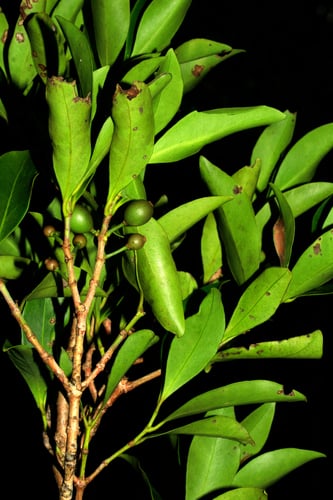
Source: WikipediaGarcinia livingstonei (African mangosteen, lowveld mangosteen, Livingstone's garcinia or imbe) is a species of Garcinia, native to a broad area of tropical Africa, from Côte d'Ivoire east to Somalia, and south to South Africa. It is an evergreen small tree, growing to 6–18 m tall. The leaves are borne in opposite pairs or whorls of 3–4, each leaf blue-green, oval, 6–11 cm long and 3–5.5 cm broad. The flowers are produced in clusters on the stems. The fruit is a small, bright, orange, thin-skinned berry 1–4 cm diameter, with one single large seed; the small yield of edible fruit is pleasantly sweet, yet acidic, but also containing a latex that some people find unpleasant.
Description
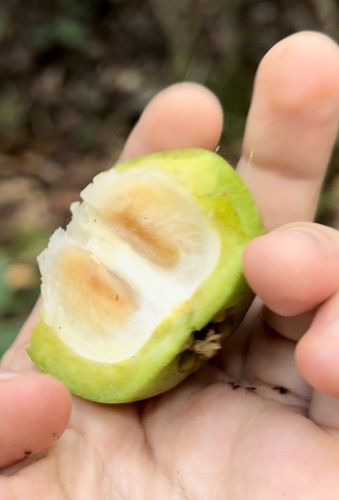
A slow growing evergreen shrub. It can grow to 5-10 m high and spread to 5 m wide. It has a twisted trunk. Most branches come out at right angles to the stem. The leaves are tough and leathery. They are 10-15 cm long and with white veins. They are glossy and dark green. The leaves come out in whorls of three. Fruit are about 5 cm across. They have a thin skin, are bright orange and usually have 2 seeds inside. There is a layer of orange pulp around these large seeds. The flesh is edible. The fruit grow on mature wood.
Edible Uses
The fruit can be eaten fresh, cooked with porridge, or used in ice cream, jam, and drinks. The fruit is also fermented to make an alcoholic drink that develops a purple colour.
Traditional Uses
The fruit can be eaten fresh. They are also cooked with porridge. They are also used in ice cream, jam and drinks. They are used to make an alcoholic drink. It develops a purple colour. Caution: Alcohol is a cause of cancer.
Medicinal Uses
Leaf and flower-extracts have given positive antibiotic tests. The roots are soaked in cold water and the infusion is mixed with milk then drunk to treat abdominal pains in pregnant women. The fruit is used in the treatment of mumps.
Known Hazards
Alcohol produced from this fruit is a cause of cancer.
Distribution
It is a tropical plant. It grows in the hot dry tropical lowlands. Trees grow best on acid soils. They have good salt tolerance. The leaves are wind resistant. Established trees are drought resistant but for best fruit production regular watering is needed. Trees are cold hardy. Trees can survive temperatures down to -3°C. Trees grow best with plenty of sunlight. They grow naturally in open woodland often under the shelter of larger trees. It grows in Miombo woodland. In Zimbabwe it grows up to 1,050 m above sea level. It does best with a pH of 5.5-7. It can grow in arid places. It suits hardiness zones 9-12. In Cairns BG.
Where It Grows
Africa*, Asia, Australia, Angola, Botswana, Brazil, Burkina Faso, Cameroon, Central Africa, Central America, Congo, Côte d'Ivoire, Cuba, East Africa, Eswatini, Ethiopia, Ghana, Guinea, Guinée, Guinea-Bissau, India, Indonesia, Ivory Coast, Jamaica, Kenya, Malawi, Mali, Mozambique, Namibia, Nigeria, North America, SE Asia, Senegal, Somalia, South Africa, Southern Africa, South America, Sudan, Swaziland, Tanzania, Togo, Uganda, USA, West Africa, West Indies, Zambia, Zimbabwe,
Cultivation
As male and female flowers occur on separate trees both male and female trees must be planted. A male tree can be grafted onto a female. Trees can be grown from seed but these take 5-6 years to reach fruiting age. Earlier fruiting can be achieved by grafting onto established rootstocks. Zinc deficiency is more common on alkaline soils. Trees can be grown by air-layering.
Propagation
Seed - best sown as soon as it is ripe. We have no specific information on this species, but the seed of most members of the genus can be slow to germinate, even if sown fresh, often taking 6 months or more. Grafting.
Other Uses
The bark yields a yellow gum which hardens to a substance like gamboge. It can be used as a yellow dye. The tree can be used as a rootstock for the mangosteen (Garcinia mangostana). The yellowish white wood is hard. It is said to be susceptible to borers. It is used for building poles, tool handles, wooden spoons, stirring sticks, pegs etc. The wood is used for fuel.
Production
Trees grow slowly. Seedling trees can take 5-6 years until fruiting. Grafted trees can fruit in 3 years. The fruit take 28 days until ripe after fruit set. Fruit are harvested when fully ripe and do not store well.
Other Information
It is an attractive fruit. It is a cultivated food plant. It is a commonly used fruit in Mozambique.
Notes
The leaves and flowers have proven antibiotic activity. The fruit leave lasting stains. There are about 300 Garcinia species.
Nutrition
| Part | Moisture | kJ | kcal | Protein | Vit A | Vit C | Iron | Zinc |
|---|---|---|---|---|---|---|---|---|
| Fruit | 83 | 254 | 61 | 0.8 | — | 5.4 | 0.3 | 0.2 |
Synonyms
Also Known As
Chedi, Chimbango, Etunganan, Himbi, Imbe, Impembe, Isinpula, Isinyula, Kikangakanywa, Kisambwe, Laeveldse geelmelkhout, Lisimpula, Livingstone garcinia, Lowveld mangosteen, Mbigo, Mgidzofidzo, Mfungatanzu, Mndee-mzize, Motsaodi, Motsaudi, Mpekecho, Mphimbi, Mpugopugo, Mtotozi, Muelece, Mukanga, Mufodzohi, Mukwananga, Mujanuo, Munhinzwa, Muphiphi, Mupimbi, Murongwe, Mutumbi, Mutungwa, Ngangakanywa, Pohon manggis afrika, Senyula, Shamper, Shanfarood, Sina, Sinyula, Tulla, Umpimbo, Ushika
References (71)
- Addis, G., et al, 2013, The Role of Wild and Semi-wild Edible Plants in Household Food Sovereignty in Hamer and Konso Communities, South Ethiopia. Ethnobotany Research & Applications. 11:251-271
- Ambasta, S.P. (Ed.), 2000, The Useful Plants of India. CSIR India. p 230
- Asfaw, Z. and Tadesse, M., 2001, Prospects for Sustainable Use and Development of Wild Food Plants in Ethiopia. Economic Botany, Vol. 55, No. 1, pp. 47-62
- Awodoyin, R.O., Olubode, O.S., Ogbu, J.U., Balogun, R.B., Nwawuisi, J.U. and Orji, K.O., 2015, Indigenous Fruit Trees of Tropical Africa: Status, Opportunity for Development and Biodiversity Management. Agricultural Sciences, 6, 31-41
- Barwick, M., 2004, Tropical and Subtropical Trees. A Worldwide Encyclopedic Guide. Thames and Hudson p 195
Show all 71 references Hide references
- Burkill, H. M., 1985, The useful plants of west tropical Africa, Vol. 2. Kew.
- Burkill, I.H., 1966, A Dictionary of the Economic Products of the Malay Peninsula. Ministry of Agriculture and Cooperatives, Kuala Lumpur, Malaysia. Vol 1 (A-H) p 1069
- Cundall, P., (ed.), 2004, Gardening Australia: flora: the gardener's bible. ABC Books. p 624
- Dale, I. R. and Greenway, P. J., 1961, Kenya Trees and Shrubs. Nairobi. p 231
- Darley, J.J., 1993, Know and Enjoy Tropical Fruit. P & S Publishers. p 45
- Edwards. S., et al, (Eds), 1995, Flora of Ethiopia and Eritrea. Vol.2, Part 2 Canellaceae to Euphorbiaceae. Uppsala, Sweden. p 159
- Etherington, K., & Imwold, D., (Eds), 2001, Botanica's Trees & Shrubs. The illustrated A-Z of over 8500 trees and shrubs. Random House, Australia. p 338
- Facciola, S., 1998, Cornucopia 2: a Source Book of Edible Plants. Kampong Publications, p 79
- FAO, 1988, Traditional Food Plants, FAO Food and Nutrition Paper 42. FAO Rome p 298
- Fowler, D. G., 2007, Zambian Plants: Their Vernacular Names and Uses. Kew. p 18
- Fox, F. W. & Young, M. E. N., 1982, Food from the Veld. Delta Books. p 155
- Goode, P., 1989, Edible Plants of Uganda. FAO p 30
- Grivetti, L. E., 1980, Agricultural development: present and potential role of edible wild plants. Part 2: Sub-Saharan Africa, Report to the Department of State Agency for International Development. p 44, 47, 72
- Hedrick, U.P., 1919, (Ed.), Sturtevant's edible plants of the world. p 324
- INFOODS:FAO/INFOODS Databases
- Jardin, C., 1970, List of Foods Used In Africa, FAO Nutrition Information Document Series No 2.p 139
- J. Linn. Soc., Bot. 9:263. 1867
- John, L., & Stevenson, V., 1979, The Complete Book of Fruit. Angus & Robertson p 187
- Johns, T., Mhoro, E. B. and Sanaya, P., 1996, Food Plants and Masticants of the Batemi of Ngorongoro District, Tanzania. Economic Botany, Vol. 50, No. 1, pp. 115-121
- Keay, R.W.J., 1989, Trees of Nigeria. Clarendon Press, Oxford. p 108
- Kidane, B., et al, 2014, Ethnobotany of Wild and Semi-wild Edible Fruit Species used by Maale and Ari Ethnic Communities in South Ethiopia. Ethnobotany Research and Applications. Vol. 12, 1546-3465-12-455
- Kiple, K.F. & Ornelas, K.C., (eds), 2000, The Cambridge World History of Food. CUP p 1789
- Long, C., 2005, Swaziland's Flora - siSwati names and Uses http://www.sntc.org.sz/flora/
- Lorenzi, H., Bacher, L., Lacerda, M. & Sartori, S., 2006, Brazilian Fruits & Cultivated Exotics. Sao Paulo, Instituto Plantarum de Estuados da Flora Ltda. p 377
- Lovett, J. C. et al, Field Guide to the Moist Forest Trees of Tanzania. p 66
- Lulekal, E., et al, 2011, Wild edible plants in Ethiopia: a review on their potential to combat food insecurity. Afrika Focus - Vol. 24, No 2. pp 71-121
- Lyle, S., 2006, Discovering fruit and nuts. Land Links. p 218
- Magwede, K., van Wyk, B.-E., & van Wyk, A. E., 2019, An inventory of Vhavenḓa useful plants. South African Journal of Botany 122 (2019) 57–89
- Mannheimer, C. A. & Curtis. B.A. (eds), 2009, Le Roux and Muller's Field Guide to the Trees and Shrubs of Namibia. Windhoek: Macmillan Education Namibia. p 344
- Martin, F. W., et al, 1987, Perennial Edible Fruits of the Tropics. USDA Handbook 642 p 29
- Maundu, P. et al, 1999, Traditional Food Plants of Kenya. National Museum of Kenya. 288p
- Mausse, S. D. & Bandeira, R. R., 2007, Ecological relationships between Ceratitis spp. (Diptera: Tephritidae) and other native fruit tree pests in southern Mozambique. Fruits, 2007, vol. 62, p 35-44
- Mbuya, L.P., Msanga, H.P., Ruffo, C.K., Birnie, A & Tengnas, B., 1994, Useful Trees and Shrubs for Tanzania. Regional Soil Conservation Unit. Technical Handbook No 6. p 280
- Mutie, F. G., 2020, Conservation of Wild Food Plants and Their Potential for Combatting Food Insecurity in Kenya as Exemplified by the Drylands of Kitui County. Plants 2020, 9, 1017
- Mutie, F. M., et al, 2023, Important Medicinal and Food Taxa (Orders and Families) in Kenya, Based on Three Quantitative Approaches. Plants 2023, 12, 1145
- Neelo, J., et al, 2015, Ethnobotanical Survey of Woody Plants in Shorobe and Xobe Villages, Northwest Region of Botswana. Ethnobotany Research & Applications 14:367-379
- Neudeck, L. et al, 2012, The Contribution of Edible Wild Plants to Food Security, Dietary Diversity and Income of Households in Shorobe Village, Northern Botswana. Ethnobotany Research & Applications 10:449-462
- Njana, M. A., et al, 2013, Are miombo woodlands vital to livelihoods of rural households? Evidence from Urumwa and surrounding communities, Tabora, Tanzania. Forests, Trees and Livelihoods, 22:2, 124-140
- Pakia, M., 2000, Plant Ecology and Ethnobotany of two sacred forests (Kayas) at the Kenya Coast. M. Sc. Thesis.
- Palgrave, K.C., 1996, Trees of Southern Africa. Struik Publishers. p 614
- Palmer, E and Pitman, N., 1972, Trees of Southern Africa. Vol. 3. A.A. Balkema, Cape Town p 1515
- Peters, C. R., O'Brien, E. M., and Drummond, R.B., 1992, Edible Wild plants of Sub-saharan Africa. Kew. p 84
- Plowes, N. J. & Taylor, F. W., 1997, The Processing of Indigenous Fruits and other Wildfoods of Southern Africa. in Smartt, L. & Haq. (Eds) Domestication, Production and Utilization of New Crops. ICUC p 191
- Purseglove, J.W., 1968, Tropical Crops Dicotyledons, Longmans. p 634
- Roodt, V., 1998, Trees & Shrubs of the Okavango Delta. Medicinal Uses and Nutritional value. The Shell Field Guide Series: Part 1. Shell Botswana. p 111
- Royal Botanic Gardens, Kew (1999). Survey of Economic Plants for Arid and Semi-Arid Lands (SEPASAL) database. Published on the Internet; http://www.rbgkew.org.uk/ceb/sepasal/internet [Accessed 16th April 2011]
- Ruffo, C. K., Birnie, A. & Tengnas, B., 2002, Edible Wild Plants of Tanzania. RELMA p 342
- Ruiters-Welcome, A. K., 2019, Food plants of southern Africa. Ph.D. thesis. Univ. of Johannesburg p 44
- Schmidt, E., Lotter, M., & McCleland, W., 2007, Trees and shrubs of Mpumalanga and Kruger National Park. Jacana Media p 424
- Seyoum, Y., et al, 2015, Edible Wild Fruit Trees and Shrubs and Their Socioeconomic Significance in Central Ethiopia. Ethnobotany Research & Applications. 14:183-197
- Sukarya, D. G., (Ed.) 2013, 3,500 Plant Species of the Botanic Gardens of Indonesia. LIPI p 300
- Swaziland's Flora Database http://www.sntc.org.sz/flora
- Tankard, G., 1990, Tropical fruit. An Australian Guide to Growing and using exotic fruit. Viking p 108
- Tredgold, M.H., 1986, Food Plants of Zimbabwe. Mambo Press. p 103
- USDA, ARS, National Genetic Resources Program. Germplasm Resources Information Network - (GRIN). [Online Database] National Germplasm Resources Laboratory, Beltsville, Maryland. Available: www.ars-grin.gov/cgi-bin/npgs/html/econ.pl (10 April 2000)
- van Wyk, B, van Wyk, P, and van Wyk B., 2000, Photographic guide to Trees of Southern Africa. Briza. p 10, 161
- van Wyk, B., 2005, Food Plants of the World. An illustrated guide. Timber press. p 199
- van Wyk, Be., & Gericke, N., 2007, People's plants. A Guide to Useful Plants of Southern Africa. Briza. p 42
- van Wyk, B-E., 2011, The potential of South African plants in the development of new food and beverage products. South African Journal of Botany 77 (2011) 857–868
- Venter, F & J., 2009, Making the most of Indigenous Trees. Briza. p 176
- Welcome, A. K. & Van Wyk, B.-E., 2019, An inventory and analysis of the food plants of southern Africa. South African Journal of Botany 122 (2019) 136–179
- White, F., Dowsett-Lemaire, F. and Chapman, J. D., 2001, Evergreen Forest Flora of Malawi. Kew. p 281
- Wiersema, J. H. & Leon, B., 2013, World Economic Plants. A Standard Reference CRC Press. 2nd Ed. p 317
- World Checklist of Useful Plant Species 2020. Royal Botanic Gardens, Kew
- www.worldagroforestrycentre.org/treedb/
- www.zimbabweflora.co.zw 2011