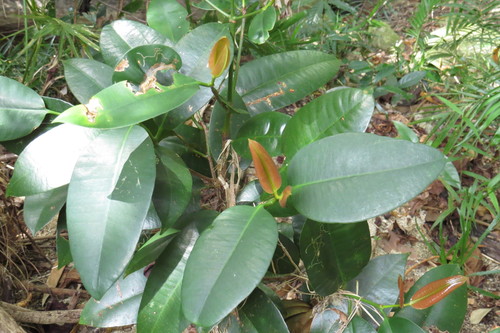
Garcinia celebica
L.
Seashore mangosteen, Celebes mangosteen tree, Kiras tree
iNaturalist· cc-by-nc
(c) olivier-gaubert, some rights reserved (CC BY-NC)
iNaturalist· cc-by-nc
(c) olivier-gaubert, some rights reserved (CC BY-NC)
Summary
Source: WikipediaGarcinia celebica is an accepted name of a tree species in the family Clusiaceae. The Catalogue of Life lists no subspecies.
Description
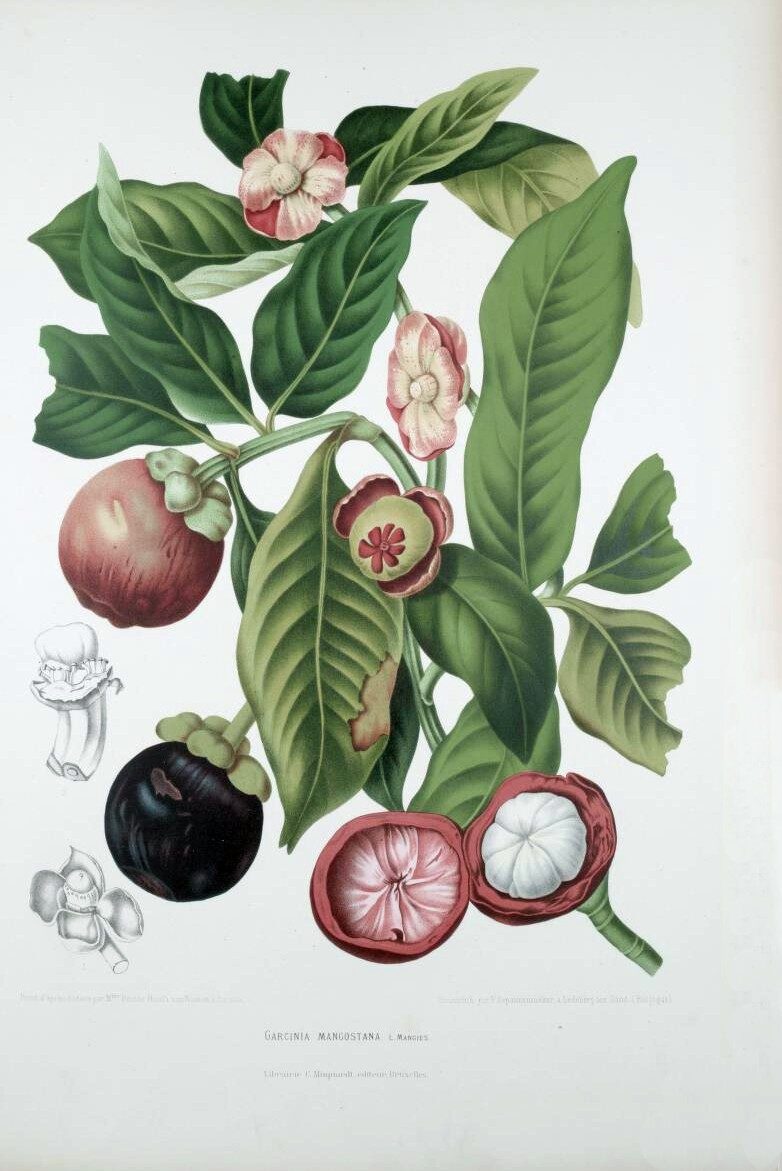
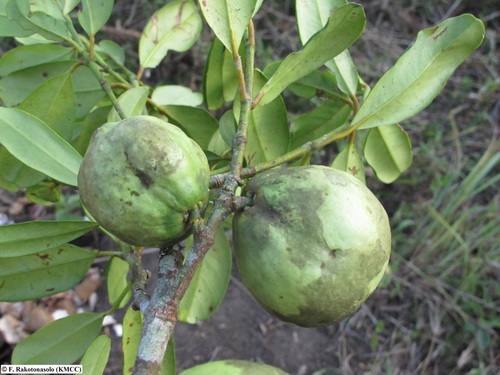
A tree. It grows 9-18 m tall. It can grow 35 m tall. The stems have white or yellow latex. The leaves are opposite and simple. The leaves are narrowly oval and 15 cm long by 8 cm wide. The flowers are of separate sexes. They are red outside and yellow inside. The flowers are 22 mm across. They are in the axils of leaves. The fruit is a round berry. It is 5 cm across. It is green when young and becomes yellow or red when ripe. There are several seeds. The seeds have a fleshy layer or aril around them.
Edible Uses
The fruit is eaten raw or used in preserves. The dried crimson-coloured rind is used as a relish in curries. The pulp can be fermented into vinegar.
Traditional Uses
The dried crimson coloured rind is used as a relish in curries. The pulp can be fermented into vinegar. The fruit are eaten raw or used in preserves.
Medicinal Uses
A decoction of the root may be administered after childbirth as a preventive medicine. The roots and leaves are used to relieve itching. The tree yields an inferior kind of gamboge (a gum-resin), which is used medcinally.
Distribution
A tropical plant. It grows on sandy and rocky coasts. It grows in forests up to 1,400 m above sea level. It can be on limestone.
Where It Grows
Asia, Australia, Cambodia, India (Nicobar), Indochina, Indonesia, Malaysia, Pacific, Papua New Guinea, PNG, Philippines, Puerto Rico, Sarawak, SE Asia, Singapore, Thailand, Vietnam, West Indies,
Cultivation
Plants are grown by seeds.
Propagation
Seed - we have no specific information on this species, but the seed of most members of the genus can be slow to germinate, even if sown fresh, often taking 6 months or more.
Other Uses
The plant has been suggested as a rootstock for the mangosteen (Garcinia mangostana). The reddish-brown wood is close and cross-grained, very hard. Highly esteemed. It is used for general building purposes.
Notes
There are about 300 Garcinia species.
Synonyms
Also Known As
Assam aur aur, Beruas, Bruas, Kalawet, Kandis, Luli, Manggis, Manggis hutan, Manggus hutan, Minjok, Perda-perda, Pohon manggis sulawesi, Proos, Sungkep, Tebar, Waa, Yamurgan
References (25)
- Ambasta, S.P. (Ed.), 2000, The Useful Plants of India. CSIR India. p 230 (As Garcinia hombroniana)
- Arora, R. K., 2014, Diversity in Underutilized Plant Species - An Asia-Pacific Perspective. Bioversity International. p 73 (As Garcinia hombroniana)
- Burkill, I.H., 1966, A Dictionary of the Economic Products of the Malay Peninsula. Ministry of Agriculture and Cooperatives, Kuala Lumpur, Malaysia. Vol 1 (A-H) p 1068 (As Garcinia hombroniana)
- Coronel, R.E., 1982, Fruit Collections in the Philippines. IBPGR Newsletter p 10
- Facciola, S., 1998, Cornucopia 2: a Source Book of Edible Plants. Kampong Publications, p 79 (As Garcinia hombroniana)
Show all 25 references Hide references
- Fl. forest. Cochinch. 1(fasc. 5):12, t. 79, fig. D-J. 1883 (As Garcinia hombroniana)
- Hariyadi, B., 2008, The Entwined Tree: Traditional Natural Resource Management of Serampas, Jambi, Indonesia. Ph. D thesis. Univ. or Hawaii. p 402
- Leach, G. J., 1988, Bush Food Plants of the Blackwater and Karawari Rivers Area, East Sepik Province, Papua New Guinea. Science in New Guinea 14(2). p 102
- Lim, Fruits (As Garcinia hombroniana)
- Milow, P., et al, 2013, Malaysian species of plants with edible fruits or seeds and their evaluation. International Journal of Fruit Science. 14:1, 1-27 (As Garcinia hombroniana)
- Ong, H., et al, 2012, Traditional knowledge and usage of edible plants among the Semai community of Kampung Batu 16, Tapah, Perak, Malaysia. Scientific Research and Essays Vol. 7(4), pp. 441-445, 30 January, 2012 (As Garcinia hombroniana)
- PROSEA (Plant Resources of South East Asia) handbook, Volume 2, 1991, Edible fruits and nut. p 177 (As Garcinia hombroniana)
- Rivero, J. A., y Brunner, B. R., 2007, Arborels frutales exoticas y poco conocidos en Puerto Rico. Universidad de Puerto Rico. p 33 (As Garcinia hombroniana)
- Siong, K. H., 2003, Indigenous Fruits of Sarawak. ITTO & Sarawak Forest Department. p 41 (As Garcinia hombroniana)
- Singh, H.B., Arora R.K.,1978, Wild edible Plants of India. Indian Council of Agricultural Research, New Delhi. p 61 (As Garcinia hombroniana)
- Slik, F., www.asianplant.net
- Sp. pl. ed. 2. 1:635. 1762
- Sukarya, D. G., (Ed.) 2013, 3,500 Plant Species of the Botanic Gardens of Indonesia. LIPI p 298
- Tankard, G., 1990, Tropical fruit. An Australian Guide to Growing and using exotic fruit. Viking p 131 (As Garcinia hombroniana)
- Thitiprasert, W., et al, 2007, Country report on the State of Plant Genetic Resources for Food and Agriculture in Thailand (1997-2004). FAO p 95 (As Garcinia hombroniana)
- Turreira Garcia, N., et al, 2017, Ethnobotanical knowledgeof the Kuy and Khmer people in Prey Lang, Cambodia. Cambodian Journal of Natural History 2017 (1): 76-101
- Uji, T., 2007, Keanekaragaman, Persebaran dan Potensi Jenis-jenis Garcinia. Berk. Penel. Hayati: 12 (129–135), 2007
- van Wyk, B., 2005, Food Plants of the World. An illustrated guide. Timber press. p 199 (As Garcinia hombroniana)
- World Checklist of Useful Plant Species 2020. Royal Botanic Gardens, Kew
- Zawiah, N. & Othaman, H., 2012, 99 Spesies Buah di FRIM. Institut Penyelidikan Perhutanan Malaysia. p 130 (As Garcinia hombroniana)