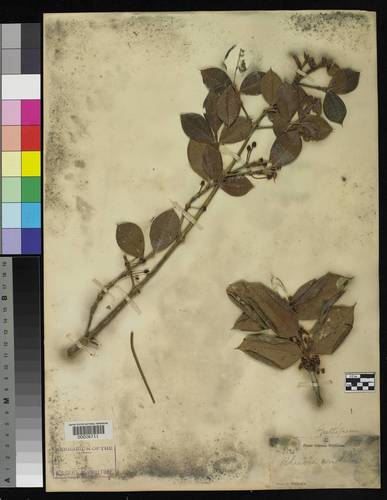
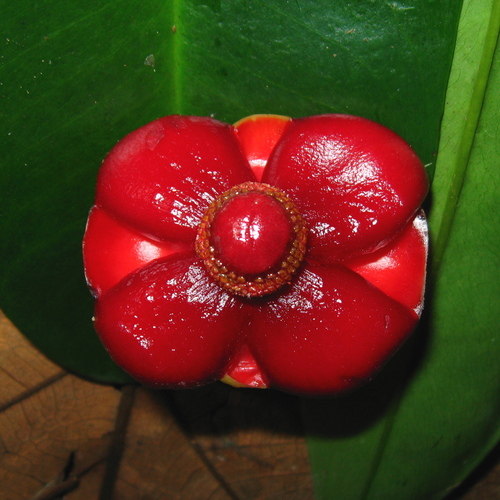
Garcinia morella
(Gaertner) Desr.
Indian gamboge tree
iNaturalist· cc-by
(c) Siddarth Machado, some rights reserved (CC BY), uploaded by Siddarth Machado
iNaturalist· cc-by
(c) T R Shankar Raman, some rights reserved (CC BY)
Summary
Source: WikipediaGarcinia morella is a species of tree in the family Clusiaceae found in India, and Sri Lanka.
Description
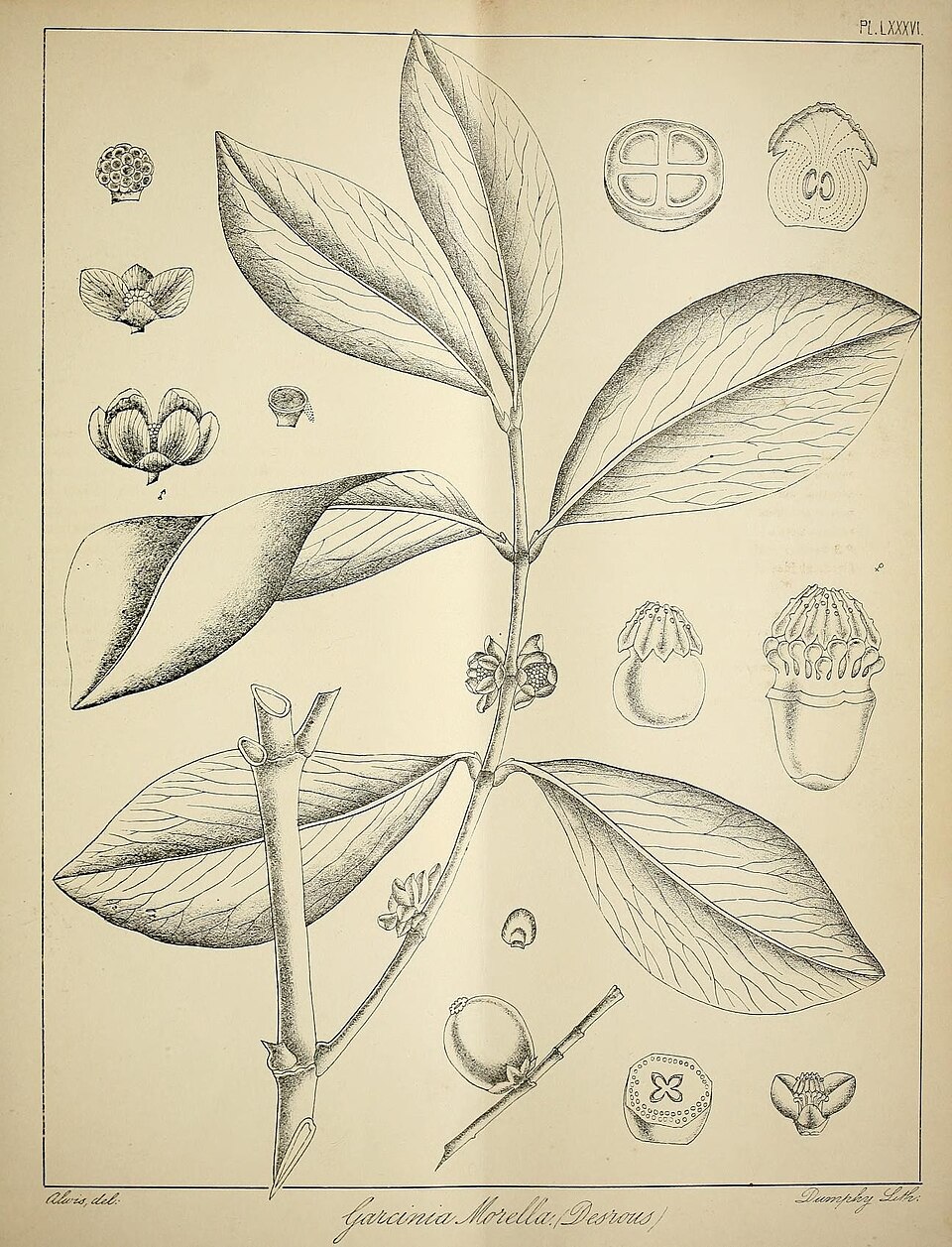
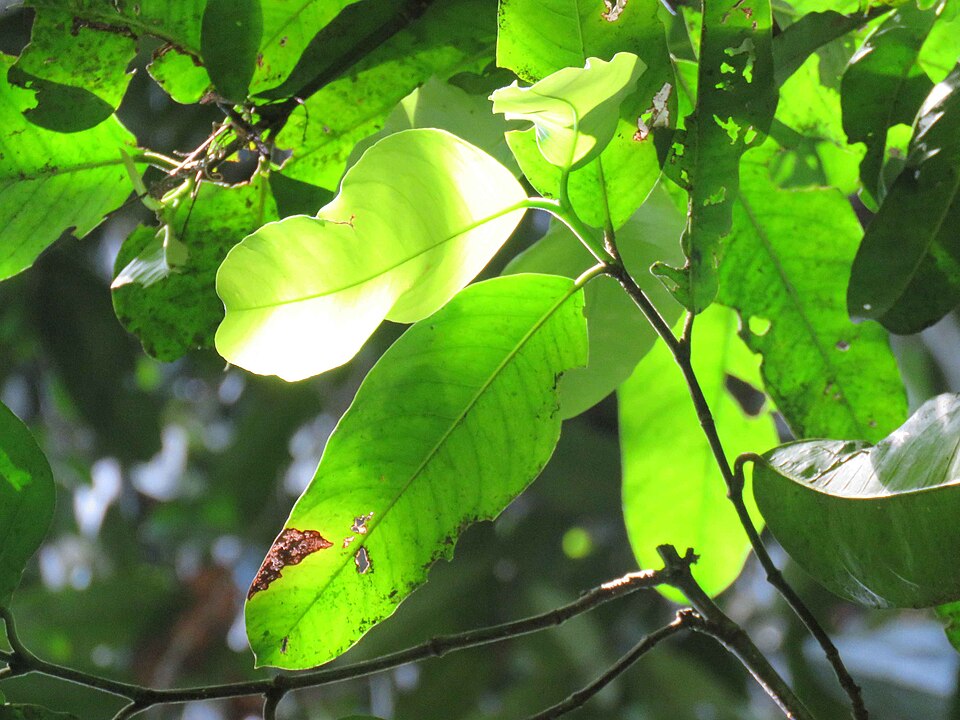
A small tree. It keeps its leaves during the year. The bark is dark grey. The leaves are narrowly oval and 15 cm long by 7 cm wide. They are wedge shaped or rounded at the base. Male and female flowers are separate. Male flowers occur as 1-3 on old wood and female flowers are in the axils of leaves. The fruit are about 5 cm across. The fruit are yellow when ripe. There are 4 seeds.
Edible Uses
The acidic fruit are eaten as a dessert fresh, or can be sliced and sun-dried, made into pickles, or boiled into chutney. Unripe fruit can be cooked as a vegetable. The seeds yield a fat used in cooking and confectionery. The gum resin can be used in food.
Traditional Uses
The seeds yield a fat used in cooking and for confectionary. The fruit are eaten as a dessert. They are acidic. The fruit can be preserved by slicing and sun drying. The fruit can also be used for pickles. The unripe fruit can be cooked as a vegetable. The fruit can be boiled to make chutney. The gum resin can be used in food.
Medicinal Uses
Ripe fruits can be eaten but they are very acidic. Just like other garcinia varieties such as kokum (which is prevalent in the Indian west coast) or garcinia pedunculata, the fruit can be preserved by slicing into thin pieces and then drying under sun. It can be made into pickles. Bodos cook the unripe fruit as vegetable with fish. A chutney can be made by boiling the fruit. In Assam, dried and preserved slices are added to black green pulses to make a popular slightly acidic curry. Dried up fruit slices are valued as a traditional remedy for dysentery. In Ayurveda the fruits are used in the treatment of dysentery, gastritis, etc. and is said to have anti inflammatory properties. When the bark is cut it exudes a yellow resin called gamboge that is used in food, paints and medicines. It can be used as a rootstock for the mangosteen (Garcinia mangostana). In Malnad region of Karnataka, Tirtahalli and Chikkamagalore this is widely used in name of 'odduli', especially in fish recipes. Odduli is prepared by boiling the fruit to get a thick black liquid which can be stored for years without adding preservatives.
Distribution
It is a tropical plant. It grows in the rainforest. It grows between 5-2,700 m above sea level.
Where It Grows
Asia, Cambodia, Central America, India, Indochina, Indonesia, Jamaica, Malaysia, Northeastern India, SE Asia, Sri Lanka, Thailand, West Indies,
Cultivation
Plants resent root disturbance. A dioecious species, both male and female plants usually need to be grown if fruit and seed are required. At least some dioecious Garcinia species, however, are able to produce fertile seed even in the absence of fertilization (asexual reproduction). Such seeds would be expected to be genetically identical to the parent
Propagation
Seed - we have no specific information on this species, but the seed of most members of the genus can be slow to germinate, even if sown fresh, often taking 6 months or more.
Other Uses
Gamboge, a gum-resin that is freely obtained from the bark stems and fruit, is used as a yellow dye, as an illuminant and in varnishes, water colours etc. It is traditionally collected by cutting a thin slice off the bark of the tree about the size of the palm of the hand - the resin collects there and is scraped off when sufficiently dried. Gamboge is a gum-resin which is obtained from the bark, branches and fruits of several species in the genus Garcinia. It contains around 70 - 80% resin with 15 - 25% gum and is used primarily as a pigment, being used to dye cloth (the yellow silken robes of Buddhist monks are often dyed with it), as well as supplying a golden-yellow colouring to varnishes, lacquers, paints, ink, water colours etc. The plant is sometimes used as a rootstock for the mangosteen (Garcinia mangostana). The yellow wood is hard, mottled with numerous, wavy, concentric bands of a soft texture.
Production
In southern India plants fruit in March to April.
Notes
There are about 300 Garcinia species.
Synonyms
Also Known As
Chigiri, Daramba, Devanabuli, Gokatu, Hardala, Jaarige puli, Jarize, Kakukkampuli, Kudi tekera, Kuji-thekera, Makki, Pasupuvarne, Pinnarpuli, Revalchinni, Solaippuli, Tamal, Tamala, Thaika, Undhui thaikha
References (18)
- Ambasta, S.P. (Ed.), 2000, The Useful Plants of India. CSIR India. p 230
- Ashton, M. S., et al 1997, A Field Guide to the Common Trees and Shrubs of Sri Lanka. WHT Publications Ltd. pdf p 148
- Baro, D., Baruah, S. and Borthukar, S. K. 2015, Documentation on wild vegetables of Baksa district, BTAD (Assam). Scholars Research Library. Archives of Applied Science Research, 2015, 7 (9):19-27
- Dobriyal, M. J. R. & Dobriyal, R., 2014, Non Wood Forest Produce an Option for Ethnic Food and Nutritional Security in India. Int. J. of Usuf. Mngt. 15(1):17-37
- Facciola, S., 1998, Cornucopia 2: a Source Book of Edible Plants. Kampong Publications, p 79
Show all 18 references Hide references
- Flowerdew, B., 2000, Complete Fruit Book. Kyle Cathie Ltd., London. p 161
- Giesen, W., 2013, Paludiculture: sustainable alternatives on degraded peat land in Indonesia (revised draft)
- Hazarika, B. et al. (2020). An overview of the unexplored underutilized fruit crops of Assam, India. Journal of Applied and Natural Science, 12(3): 442 - 453. (As orella)
- Hedrick, U.P., 1919, (Ed.), Sturtevant's edible plants of the world. p 324
- J. B. A. P. M. de Lamarck & L. A. J. Desrousseaux, Encycl. 3:701, t. 405, fig. 2. 1792
- Patiri, B. & Borah, A., 2007, Wild Edible Plants of Assam. Geethaki Publishers. p 11
- Pegu, R., et al, 2013, Ethnobotanical study of Wild Edible Plants in Poba Reserved Forest, Assam, India. Research Journal of Agriculture and Forestry Sciences 1(3):1-10
- Ravikrishna, S., 2011, Ethno-medico-botanical survey on Wild Edible fruits of Udupi Taluq, Udupi p 77
- Sarma, H., et al, 2010, Updated Estimates of Wild Edible and Threatened Plants of Assam: A Meta-analysis. International Journal of Botany 6(4): 414-423
- Uji, T., 2007, Keanekaragaman, Persebaran dan Potensi Jenis-jenis Garcinia. Berk. Penel. Hayati: 12 (129–135), 2007
- Ulian, T., et al, 2020, Unlocking plant resources to support food security and promote sustainable agriculture. Plants, People, Planet. 2020;2:421–445.
- Wiersema, J. H. & Leon, B., 2013, World Economic Plants. A Standard Reference CRC Press. 2nd Ed. p 317
- World Checklist of Useful Plant Species 2020. Royal Botanic Gardens, Kew