Ficus variegata
Blume
Variegated Fig
iNaturalist· cc-by-nc
(c) SUNKING, some rights reserved (CC BY-NC)
iNaturalist· cc-by-nc
(c) SUNKING, some rights reserved (CC BY-NC)
iNaturalist· cc-by-nc
(c) SUNKING, some rights reserved (CC BY-NC)
Description
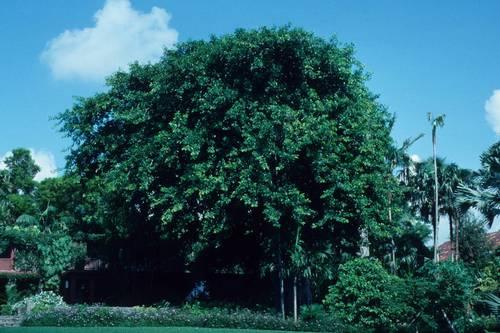
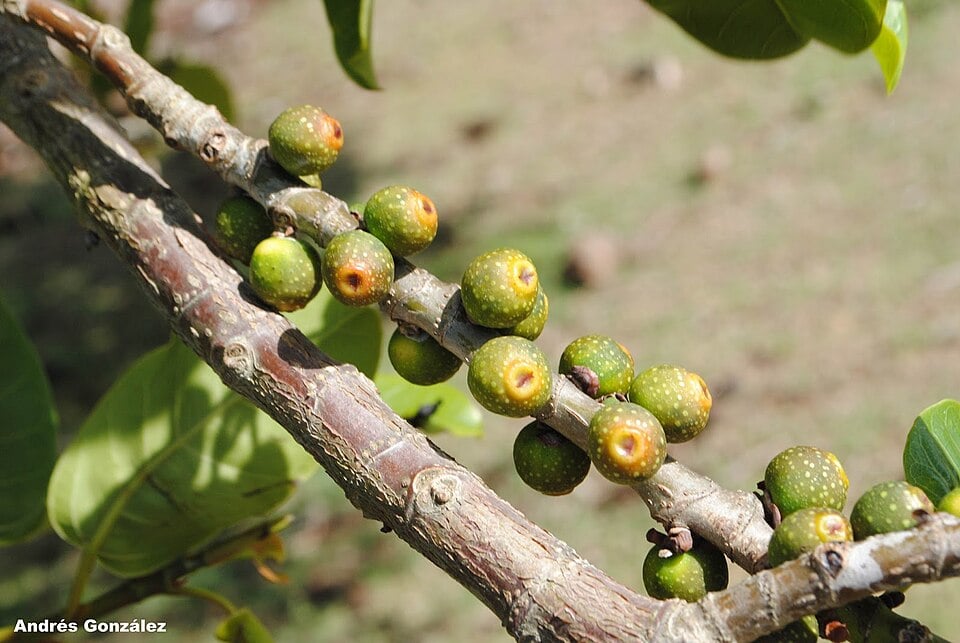
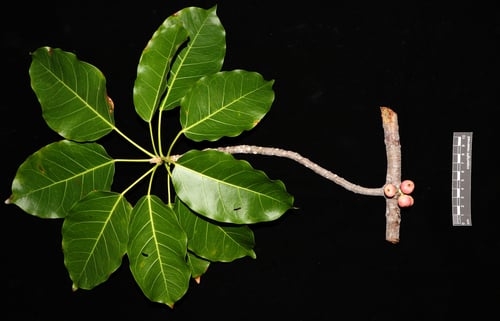
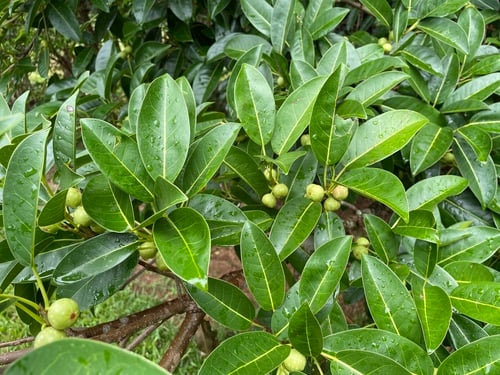
A fig. It is a medium sized buttressed tree up to 7-18 m high. The trunk varies in length and can be 20-30 cm across. Trees can be larger. The bark is characteristically brown and smooth. It is thick with an abundance of latex. The young shoots are pale green. The leaves are broad and oval and leathery, shiny and smooth. They are 14-20 cm long and 8-12 cm wide. The base of the leaves is rounded and heart shaped. The leaf stalks are 3 to 8 cm long and brown. The leaf like structures (stipules) at the base of the leaf stalks are 1-1.5 cm long, smooth and pinkish. Swollen structures are found along the larger limbs. Red figs with white spots are produced on the trunk and larger branches. The fruit is round and smooth and turns deep yellow when mature. The fruit are 3-4 cm across. Trees may bear thousands of fruit which are eaten by birds. Named varieties occur based on the colour of the fruit. The fruit are edible.
Edible Uses
The fruit are edible, though considered unattractive; young fruit can be used cooked. Young leaves are eaten cooked. The sap is used as a food additive in palm starch. Freshly cut stems yield drinking water.
Traditional Uses
The freshly cut stems yield drinking water. The fruit are edible but not attractive. Young fruit can be used cooked. The young leaves are eaten cooked. The sap is used as a food additive in palm starch.
Medicinal Uses
The roots are used as an antidote. The bark is used as a remedy for dysentery The fruit is used as a remedy for dysentery. The latex is applied topically in the treatment of cuts.
Distribution
A tropical plant. They occur in the Philippines in lower forested regions from Luzon to the provinces of Mindanao. In Australia they are in the tropical rainforests and in coastal districts. Trees demand humidity and light. They are often on well drained soils at the edge of the rainforest. It grows in valleys at low and middle altitudes in S China. In Indonesia trees grow up to 1,500 m altitude. In XTBG Yunnan.
Where It Grows
Andaman Islands, Asia, Australia, China, East Timor, India, Indochina, Indonesia, Japan, Laos, Malaysia, Myanmar, Pacific, Papua New Guinea, PNG, Philippines, SE Asia, Singapore, Solomon Islands, Thailand, Timor-Leste, Vietnam, West Timor,
Cultivation
It can probably be grown from seed or by aerial layering. It seeds and grows naturally under the right conditions.
Propagation
Seed - germinates best at a temperature around 20°c. Air layering. Tip cuttings around 4 - 12cm long, taken from lateral branches.
Other Uses
The tree is a source of wax which is used in Batik work. (Is this referring to the latex?). The wood is of low quality, but is used for temporary construction, mouldings, interior work, cladding, drawers, fruit crates, floats and knife sheaths. The wood is used for fuel.
Production
It is a fast growing tree. In the northern hemisphere it flowers in April and May and fruits in July and August.
Notes
There are about 800-1000 Ficus species. They are mostly in the tropics. There are 120 Ficus species in tropical America.
Synonyms
Also Known As
Ara kelepong, Ara kelumpong, Ayak, Common red-stem fig, Ghundhang, Gondang, Kanjilu, Kara, Kendang, Kelo, Kondang, Ngoa rung, Nyawai, Phuuk, Pohon ara merabiasa, Tandilan, Tangisang-bayauak, Tentabau, Va rung, Za se rong
References (23)
- Argent, G et al, nd, Manual of the Larger and More important non Dipterocarp Trees of Central Kalimantan Indonesia. Volume 2 Forest Research Institute, Samarinda, Indonesia. p 439
- Bijdr. 459. 1825
- Borrell, O.W., 1989, An Annotated Checklist of the Flora of Kairiru Island, New Guinea. Marcellin College, Victoria Australia. p 108, 202
- Burkill, I.H., 1966, A Dictionary of the Economic Products of the Malay Peninsula. Ministry of Agriculture and Cooperatives, Kuala Lumpur, Malaysia. Vol 1 (A-H) p 1033
- Cooper, W. and Cooper, W., 2004, Fruits of the Australian Tropical Rainforest. Nokomis Editions, Victoria, Australia. p 328
Show all 23 references Hide references
- Cowie, I, 2006, A Survey of Flora and vegetation of the proposed Jaco-Tutuala-Lore National Park. Timor-Lests (East Timor) www.territorystories.nt/gov.au p 51
- Elliot, W.R., & Jones, D.L., 1992, Encyclopedia of Australian Plants suitable for cultivation. Vol 4. Lothian. p 292
- Flora of Australia, Volume 3, Hamamelidales to Casuarinales, Australian Government Publishing Service, Canberra (1989) p 64, 61
- Flora of China.
- Forest Inventory and Planning Institute, 1996, Vietnam Forest Trees. Agriculture Publishing House p 554
- French, B.R., 2010, Food Plants of Solomon Islands. A Compendium. Food Plants International Inc. p 84
- Hanum, F. I., 1999, Plant Diversity and Conservation Value of Ayer Hitam Forest, Selangor, Peninsula Malaysia. Pertanika J. Trop. Agric. Sci. 22(2):73-83
- Jackes, B.R., 2001, Plants of the Tropics. Rainforest to Heath. An Identification Guide. James Cook University. p 67
- Martin, F.W. & Ruberte, R.M., 1979, Edible Leaves of the Tropics. Antillian College Press, Mayaguez, Puerto Rico. p 206
- Monsalud, M.R., Tongacan, A.L., Lopez, F.R., & Lagrimas, M.Q., 1966, Edible Wild Plants in Philippine Forests. Philippine Journal of Science. p 502
- Ochse, J.J. et al, 1931, Vegetables of the Dutch East Indies. Asher reprint. p 505
- Priyadi, H., et al, Five hundred plant species in Gunung Halimun Salak National Park West Java. A checklist including Sundanese names, distribution and use. CIFOR, FFPRI, SLU p 121
- Slik, F., www.asianplant.net
- Terra, G.J.A., 1973, Tropical Vegetables. Communication 54e Royal Tropical Institute, Amsterdam, p 46
- Townsend, K., 1994, Across the Top. Gardening with Australian Plants in the tropics. Society for Growing Australian Plants, Townsville Branch Inc. p 215
- World Checklist of Useful Plant Species 2020. Royal Botanic Gardens, Kew (As Ficus racemifera)
- World Checklist of Useful Plant Species 2020. Royal Botanic Gardens, Kew
- www.eFloras.org. Flora of China