Ficus coronata
Spin
Creek Sandpaper Fig, Creek Fig
iNaturalist· cc-by-nc
(c) Victor W Fazio III, some rights reserved (CC BY-NC), uploaded by Victor W Fazio III
iNaturalist· cc-by-nc-sa
(c) Nick Lambert, some rights reserved (CC BY-NC-SA), uploaded by Nick Lambert
iNaturalist· cc-by-nc
(c) lizcrane, some rights reserved (CC BY-NC)
Summary
Source: WikipediaFicus coronata, commonly known as the sandpaper fig or creek sandpaper fig, is a cauliflorous species of fig tree, native to Australia. It is found along the east coast from Mackay in Central Queensland, through New South Wales and just into Victoria near Mallacoota. It grows along river banks and gullies in rainforest and open forest. Its common name is derived from its rough sandpapery leaves, which it shares with the other sandpaper figs.
Description
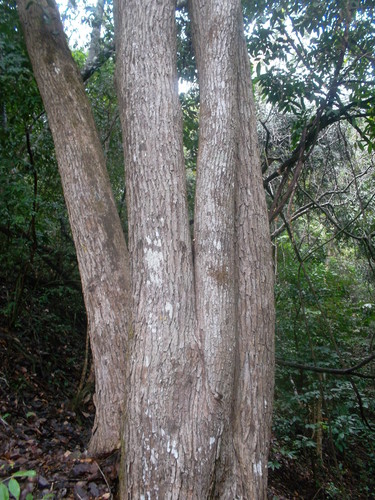
A fig. It is a small tree. It is often bushy. The trunk is short and crooked. The bark is dark brown. The young shoots are rough and hairy. The leaves are 5-15 cm long by 2.5-5 cm wide. They are oblong. The leaves are thin. They have a sandpaper like texture. The leaves are dark green above and paler underneath. They taper to the tip. The leaf stalks are 0.3-1 cm long. They fruit or figs are 1-2 cm across. They are green but turn reddish-black and are fleshy. They grow from the trunk, the older branches and the axils of leaves. They are edible.
Edible Uses
The fruit, about 2cm in size, is edible and palatable. Green when unfertilised, it darkens to purple-black when ripe. Peel away the furry skin before eating fresh, or dry the fruit for later use. It can also be cooked into cakes, pies, biscuits, jellies, jams, or sauces. Fruits ripen between January and June. Said to be the best-tasting Australian fig.
Traditional Uses
The fruit are eaten when fully ripe. They are good flavour but dry and can be stewed with sugar and water. The hairy skin needs to be removed.
This uses section is brief — help expand it
Medicinal Uses
The sap is applied topically to small sores and warts.
Known Hazards
Cut material weeps a milky latex material that can cause irritation.
Distribution
A tropical plant. They grow in subtropical and warm temperate locations. In tropical Queensland it grows between 500-600 m altitude. It needs well drained soils. It can grow in sun or shade. It often grows along creek banks. It suits hardiness zones 9-11. Adelaide Botanical Gardens. Arboretum Tasmania.
Where It Grows
Australia*, Tasmania,
Cultivation
Plants can be grown from seed or cuttings. The seed are removed from the fig and mixed with sand before sowing as they are very small. Take the seed from ripe purple-black fruit. The plant needs a small wasp to fertilise the fruit.
Propagation
Propagate from fresh seeds or from cuttings taken from the growing tip of a live plant.
Other Uses
Leaves can be used as sandpaper. Aboriginal peoples traditionally used the leaves to smooth and polish weaponry and made string from the bark. The fruit supports the caterpillars of the Queensland butterfly the common or purple moonbeam (Philiris innotatus), and provides food for the Australasian figbird (Sphecotheres vieilloti), green catbird (Ailuroedus crassirostris), olive-backed oriole (Oriolus sagittatus), topknot pigeon (Lopholaimus antarcticus), and grey-headed flying fox (Pteropus poliocephalus). The plant tolerates heavy pruning, making it a good hedge plant and a fine canopy shade tree. It works well as a bonsai or small indoor potted tree, and is ideal for stream bank stabilisation.
Notes
There are about 800-1000 Ficus species. They are mostly in the tropics. There are 120 Ficus species in tropical America.
Nutrition
| Part | Moisture | kJ | kcal | Protein | Vit A | Vit C | Iron | Zinc |
|---|---|---|---|---|---|---|---|---|
| Fruit | 67.5 | — | — | 0.4 | — | — | — | — |
Synonyms
Also Known As
Sandpaper fig, Creek sandpaper fig. Ficus - from the Latin ficus, meaning “edible fruit”. coronata - from the Latin coronatus, meaning “crowned”, referring to the crown of bristles at the tip of the fig
References (29)
- Bodkin, F., 1991, Encyclopedia Botanica. Cornstalk publishing, p 472
- Caton, J.M. & Hardwick, R. J., 2016, Field Guide to Useful Native Plants from Temperate Australia. Harbour Publishing House. p 194
- Cherikoff V. & Isaacs, J., The Bush Food Handbook. How to gather, grow, process and cook Australian Wild Foods. Ti Tree Press, Australia p 162, 195
- Cooper, W. and Cooper, W., 2004, Fruits of the Australian Tropical Rainforest. Nokomis Editions, Victoria, Australia. p 323
- Costerman, L., 1981, Native Trees and Shrubs South East Australia, 150, 151
Show all 29 references Hide references
- Cribb, A.B. & J.W., 1976, Wild Food in Australia, Fontana. p 35
- Cronin, L., 1989, The Concise Australian Flora. Reed. p 158
- Elliot, W.R., & Jones, D.L., 1992, Encyclopedia of Australian Plants suitable for cultivation. Vol 4. Lothian. p 282 (Drawing)
- Etherington, K., & Imwold, D., (Eds), 2001, Botanica's Trees & Shrubs. The illustrated A-Z of over 8500 trees and shrubs. Random House, Australia. p 327
- Flora of Australia, Volume 3, Hamamelidales to Casuarinales, Australian Government Publishing Service, Canberra (1989) p 59, 61
- Greig, D., 1996, Flowering Natives for Home Gardens. Angus & Robertson. p 181
- Hardwick, R.J., 2000, Nature's Larder. A Field Guide to the Native Food Plants of the NSW South Coast. Homosapien Books. p 106
- Haslam, S., 2004, Noosa's Native Plants. Noosa Integrated Catchment Assn. Inc. p 337
- Hibbert, M., 2002, The Aussie Plant Finder 2002, Florilegium. p 101
- Hiddins, L., 1999, Explore Wild Australia with the Bush Tucker Man. Penguin Books/ABC Books. p 160
- Jard. St. Sebastien 29. 1818
- Jones D, L, 1986, Ornamental Rainforest Plants in Australia, Reed Books, p 218, 340
- Lazarides, M. & Hince, B., 1993, Handbook of Economic Plants of Australia, CSIRO. p 114
- Low, T., 1991, Wild Food Plants of Australia. Australian Nature FieldGuide, Angus & Robertson. p 83
- Low, T., 1992, Bush Tucker. Australia’s Wild Food Harvest. Angus & Robertson. p 64
- McKerney, M. & White, H., 2011, Bush Tucker, Boomerangs & Bandages. Border River-Gwyder Catchment Management Authority p 53
- Melzer, R. & Plumb, J., 2011, Plants of Capricornia. Belgamba, Rockhampton. p 204
- Nicholson, N & H., 1996, Australian Rainforest Plants 2, Terania Rainforest Publishing. NSW. p 29
- Ratcliffe D & P., 1987, Australian Native Plants for Indoors. Little Hills press. p 89
- Recher, P, 2001, Fruit Spirit Botanical Gardens Plant Index. www.nrg.com.au/~recher/ seedlist.html p 6
- Ryan, M. (Ed.), 2003, Wild Plants of Greater Brisbane. Queensland Museum. p 269
- White, G., 2008, The Bush Tucker Survival Guide. https://www.survival.org.au
- Williams, J.B., Harden, G.J., and McDonald, W.J.F., 1984, Trees and shrubs in rainforests of New South Wales and Southern Queensland. Univ. of New England, Armidale. p 64, 67
- Yallakool Reserve Plant List July 1, 2009 Off internet