Ficus copiosa
Steud.
Plentiful fig, Kumu musong
iNaturalist· cc-by-sa
(c) Steve Fitzgerald, some rights reserved (CC BY-SA), uploaded by Steve Fitzgerald
iNaturalist· cc-by-sa
(c) Steve Fitzgerald, some rights reserved (CC BY-SA), uploaded by Steve Fitzgerald
iNaturalist· cc-by-sa
(c) Steve Fitzgerald, some rights reserved (CC BY-SA), uploaded by Steve Fitzgerald
Summary
Source: WikipediaFicus copiosa, the plentiful fig, is a species of flowering plant in the family Moraceae, native to Sulawesi, the Moluccas, Papuasia, Queensland, and on to some western Pacific islands. The leaves are widely consumed as a vegetable by local peoples.
Description
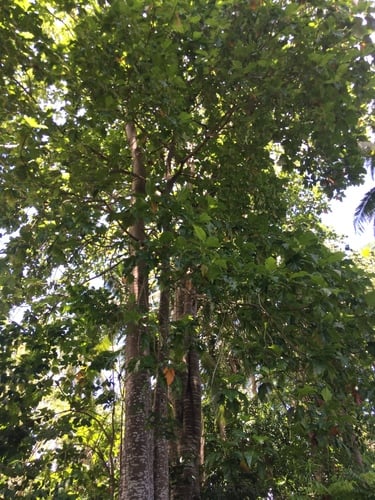
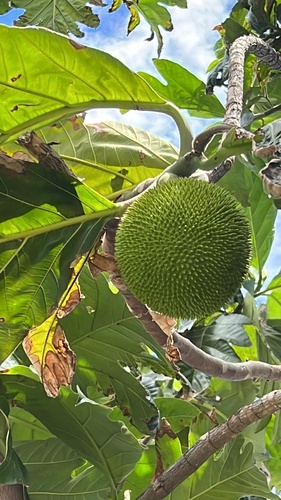
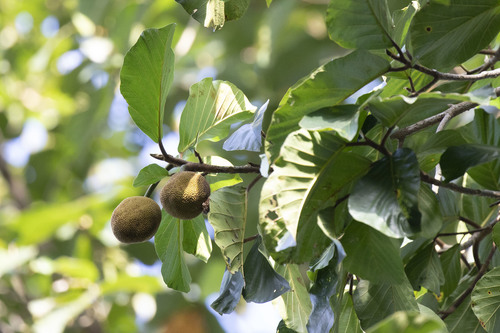
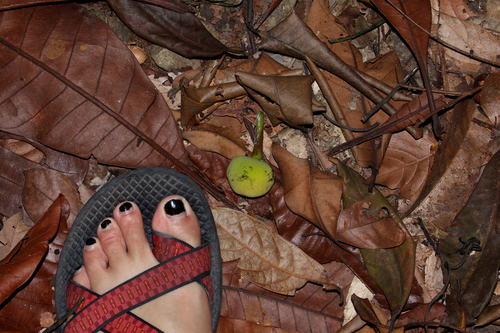
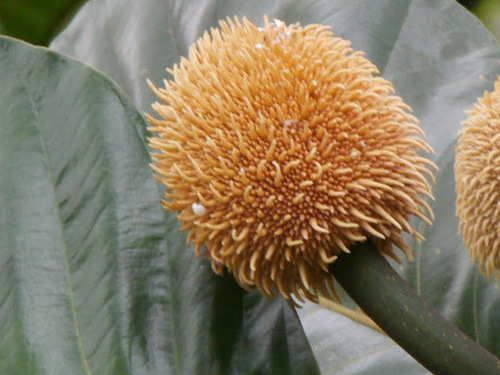
A fig. It is a small tree. It grows up to 10 m high. The trunk is slender and straight. The bark is grey and smooth. Young stems and veins have a purplish colour and the tips have a rough feel due to raised bristles on the leaves and stems. The leaf shape varies. Leaves are 10-25 cm long by 5-12 cm across. They are oval. The leaves are often heart shaped at the base and bluntly pointed at the tip. The edges of the leaves are irregular. The leaf stalks are about 2 cm long. Fruit are 1-2 cm across and often on old twigs in small clusters.
Edible Uses
Young leaves - raw or cooked. Fruit - raw or cooked. Figs axillary to cauliflorous, slightly depressed-globose, 25 - 60mm in diameter.
Traditional Uses
The young leaves are eaten cooked. The fruit are eaten raw.
This uses section is brief — help expand it
Medicinal Uses
The unripe fruits are chewed to relieve stomach-ache. The latex from fresh (unripe?) fruits is applied to boils. Fresh leaves are used as an antidote to poison, helping to excrete the toxins. The roots and leaves are used to treat stomach-ache. Massaging the stomach with crushed leaves is said to relieve stomach-ache.
Distribution
A tropical tree. Trees grow from sea level up to about 1800 m above sea level in Papua New Guinea. It has been recorded up to 2,450 m. They are normally in mixed forest. They are often in seasonally drier areas.
Where It Grows
Asia, Australia, Bougainville, Indonesia, Micronesia, Pacific, Palau, Papua New Guinea, PNG, SE Asia, Solomon Islands, Vanuatu, West Papua,
Cultivation
Trees are often planted by seeds or self sown seedlings are transplanted. Trees can also be grown by cuttings and aerial layering. In some areas trees are grown as a hedge and pruned to increase branching. Plants occur both wild and cultivated.
Propagation
Seed - Cuttings. Air layering.
Other Uses
A fibre obtained from the bark is used for making clothing and ropes. The fibrous branches can be used to clean the teeth. The leaves of some species are used to wrap food for cooking. The leaves of some species are quite rough and can be used as a sandpaper substitute and for scouring pots. The wood of plants in this genus is usually of low quality, light in weight, soft and not very durable. It is sometimes used for purposes such as light construction, digging sticks, yam stakes, etc. The wood is also used for fuel and sometimes for making fire by friction. The trees are sometimes grown as a hedge, being pruned regularly to increase branching. It is used as a dividing hedge between garden plots in new Guinea.
Production
Young tips of 3-5 g are picked.
Other Information
Probably the most widely used fig leaf in Papua New Guinea. It is fairly common throughout the country and important in some areas. It is cultivated.
Notes
There are about 800-1000 Ficus species. They are mostly in the tropics. There are 120 Ficus species in tropical America.
References (26)
- Altschul, S.V.R., 1973, Drugs and Foods from Little-known Plants. Notes in Harvard University Herbaria. Harvard Univ. Press. Massachusetts. no. 715 and no. 733 (As Ficus senfftiana)
- Borrell, O.W., 1989, An Annotated Checklist of the Flora of Kairiru Island, New Guinea. Marcellin College, Victoria Australia. p 105
- Bourke, R. M., Altitudinal limits of 230 economic crop species in Papua New Guinea. Terra australis 32.
- Cooper W & Cooper W T, 1994, Fruits of the Rain Forest. RD Press p 128
- Cooper, W. and Cooper, W., 2004, Fruits of the Australian Tropical Rainforest. Nokomis Editions, Victoria, Australia. p 323
Show all 26 references Hide references
- Elliot, W.R., & Jones, D.L., 1992, Encyclopedia of Australian Plants suitable for cultivation. Vol 4. Lothian. p 282
- Flavelle, A. J., 1991, A Traditional Agroforestry Landscape on Fergusson Island, Papua New Guinea. M. Sc. Univ. of British Columia. p 144
- Flora of Australia, Volume 3, Hamamelidales to Casuarinales, Australian Government Publishing Service, Canberra (1989) p 54, 55
- French, B.R., 1986, Food Plants of Papua New Guinea, A Compendium. Asia Pacific Science Foundation p 61
- French, B.R., 2010, Food Plants of Solomon Islands. A Compendium. Food Plants International Inc. p 77
- Henderson, C.P. and I.R.Hancock, 1988, A Guide to the Useful Plants of the Solomon Islands. Res. Dept. Min of Ag. & Lands. Honiara, Solomon Islands. p 123
- Hide, R., et al, 1979, A checklist of some plants in the territory of the Sinasina Nimai (Simbai Province, Papua New Guinea), with notes on their uses. Department Anthropology, University of Aukland
- Hide, R. L., (Ed.) 1984, Research Report of the Simbu Land Use Project. Vol.V1 South Simbu: Studies in Demography, Nutrition, and Subsistence. p 438
- Jackes, B.R., 2001, Plants of the Tropics. Rainforest to Heath. An Identification Guide. James Cook University. p 66
- Jones D, L, 1986, Ornamental Rainforest Plants in Australia, Reed Books, p 340
- Leach, G. J., 1988, Bush Food Plants of the Blackwater and Karawari Rivers Area, East Sepik Province, Papua New Guinea. Science in New Guinea 14(2). p 102
- Melzer, R. & Plumb, J., 2011, Plants of Capricornia. Belgamba, Rockhampton. p 203
- Milliken, W., 2,000, Ethnobotany of the Yali of West Papua. Royal Botanic Garden, Edinburgh (near Baliem)
- Nomencl. bot. ed. 2, 1:635. 1840
- Peekel, P.G., 1984, (Translation E.E.Henty), Flora of the Bismarck Archipelago for Naturalists, Division of Botany, Lae, PNG. p 141, 140
- Powell, J.M., Ethnobotany. In Paijmans, K., 1976, New Guinea Vegetation. Australian National University Press. p 110
- Reis, S. V. and Lipp, F. L., 1982, New Plant Sources for Drugs and Foods from the New York Botanical Garden herbarium. Harvard. p 42
- Sukarya, D. G., (Ed.) 2013, 3,500 Plant Species of the Botanic Gardens of Indonesia. LIPI p 282
- Thaman, R. and W. Clarke, Paper on Agroforestry on Aneityum and Tanna, Vanuatu from Internet
- Walter, A. & Sam C., 2002, Fruits of Oceania. ACIAR Monograph No. 85. Canberra. p 279
- World Checklist of Useful Plant Species 2020. Royal Botanic Gardens, Kew