Ficus cordata
Thunb.
Namaqua fig
iNaturalist· cc-by-sa
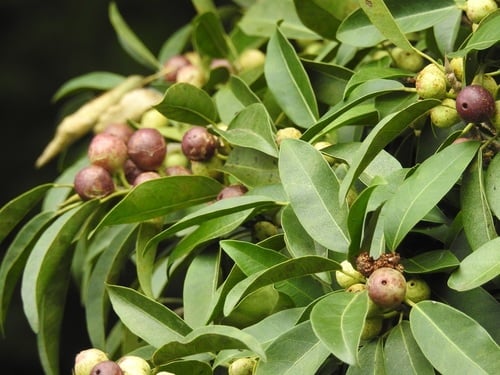
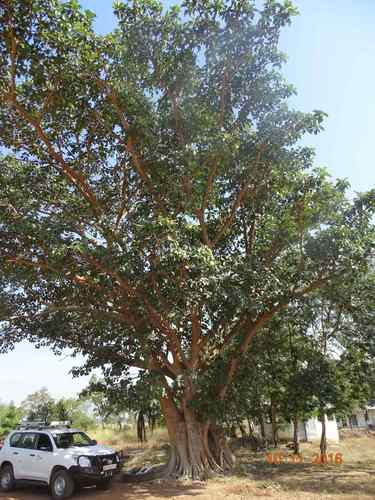
(c) Tony Rebelo, some rights reserved (CC BY-SA), uploaded by Tony Rebelo
iNaturalist· cc-by-nc
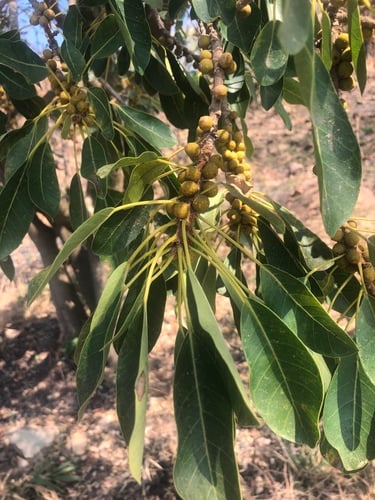
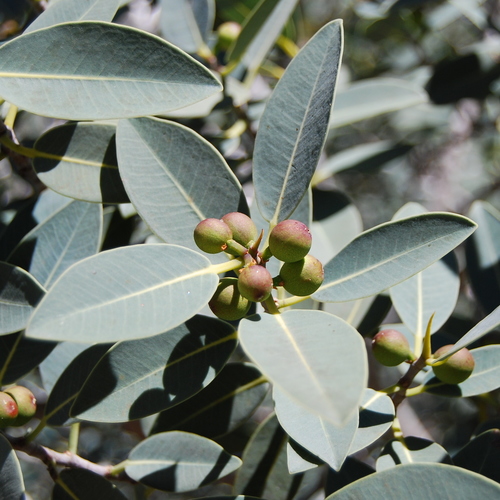
(c) Alexey P. Seregin, some rights reserved (CC BY-NC), uploaded by Alexey P. Seregin
iNaturalist· cc-by-sa
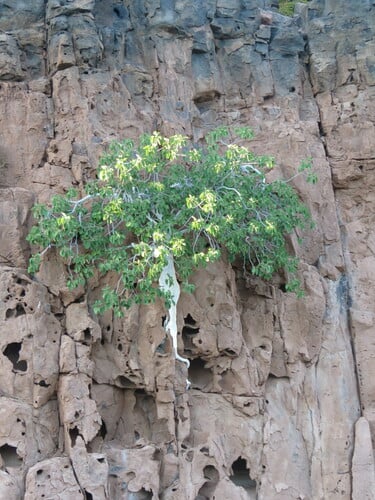
(c) Tony Rebelo, some rights reserved (CC BY-SA), uploaded by Tony Rebelo
Summary
Source: WikipediaFicus cordata, the Namaqua rock fig, or Namaqua fig is a species of fig that occurs in two disjunct populations in Africa, one in the arid southwest of the continent, and a second in the northern subtropics. In the south it is often the largest and most prominent tree, and is virtually restricted to cliff faces and rock outcrops, where it has a rock-splitting habit.
Description
A fig. It is a tree which grows pressed against rocks. It can grow to 18 m high although it is usually much smaller. It can spread 15 m wide. The trunk is slender and smooth. The leaves are smooth and 11 cm long by 5 cm wide. They are oblong with a rounded base which can be heart shaped. They taper to a point. There are 5-7 pairs of easily seen veins. The fruit are small and roundish and purple brown when ripe. They are slightly hairy and have very short stalks. They are mostly in pairs in the axils of leaves. They are edible.
Edible Uses
The fruit are edible and eaten occasionally, especially by children. The leaves are also listed as edible.
Traditional Uses
People eat the fruit occasionally.
This uses section is brief — help expand it
Distribution
A tropical plant. It occurs in rocky places and near cliffs. It is often over limestone material. It grows in areas with a rainfall below 100 mm. It grows between 100-1,850 m above sea level. It can grow in arid places.
Where It Grows
Africa, Algeria, Angola, Asia, Botswana, Burkina Faso, Cameroon, Central Africa, Chad, East Africa, Egypt, Ethiopia, India, Kenya, Mozambique, Namibia, North Africa, Northeastern India, South Africa, Southern Africa, Sudan, West Africa,
Cultivation
The wasp pollinator is Platyscapa desertorum Compton.
Other Uses
The bark is a source of tannins. The bark is used as a dye.
Other Information
The fruit are eaten especially by children.
Notes
There are about 800-1000 Ficus species. They are mostly in the tropics. There are 120 Ficus species in tropical America.
Synonyms
Also Known As
Herzfeige, Melkboom, Namakwavy, Tukuk
References (13)
- Burkill, H. M., 1985, The useful plants of west tropical Africa, Vol. 4. Kew.
- Gangwar, A. K. & Ramakrishnan, P. S., 1990, Ethnobotanical Notes on Some Tribes of Arunachal Pradesh, Northeastern India. Economic Botany, Vol. 44, No. 1 pp. 94-105
- Jardin, C., 1970, List of Foods Used In Africa, FAO Nutrition Information Document Series No 2.p 137
- Mbuvi, M. T. E., et al, 2019, Annonated checklist of plant species of Loita Forest Narok County, Kenya. Int. J. Adv. Res. Biol. Sci. (2019). 6(3): 54-110
- Moksia, F., et al, 2019, Diversity and Socio-Economic Value of Wild Edible Plants in the Mounts Mandara Region, Cameroon. International Journal of Sciences. Vol. 8:10
Show all 13 references Hide references
- Palgrave, K.C., 1996, Trees of Southern Africa. Struik Publishers. p 106
- Palmer, E and Pitman, N., 1972, Trees of Southern Africa. Vol. 1. A.A. Balkema, Cape Town p 471
- Royal Botanic Gardens, Kew (1999). Survey of Economic Plants for Arid and Semi-Arid Lands (SEPASAL) database. Published on the Internet; http://www.rbgkew.org.uk/ceb/sepasal/internet [Accessed 4th May 2011]
- Ruiters-Welcome, A. K., 2019, Food plants of southern Africa. Ph.D. thesis. Univ. of Johannesburg p 79
- Thunb. Ficus 8. 1786
- van Wyk, B, van Wyk, P, and van Wyk B., 2000, Photographic guide to Trees of Southern Africa. Briza. p 151
- Welcome, A. K. & Van Wyk, B.-E., 2019, An inventory and analysis of the food plants of southern Africa. South African Journal of Botany 122 (2019) 136–179
- www.figweb.org