Ficus rubiginosa
Desf. ex Ventenat
Port Jackson Fig, Rusty Leaf Fig
iNaturalist· cc-by-sa
(c) Tony Rebelo, some rights reserved (CC BY-SA), uploaded by Tony Rebelo
iNaturalist· cc-by-sa
(c) Greg Tasney, some rights reserved (CC BY-SA), uploaded by Greg Tasney
iNaturalist· cc-by-nc
(c) pasath, some rights reserved (CC BY-NC)
Summary
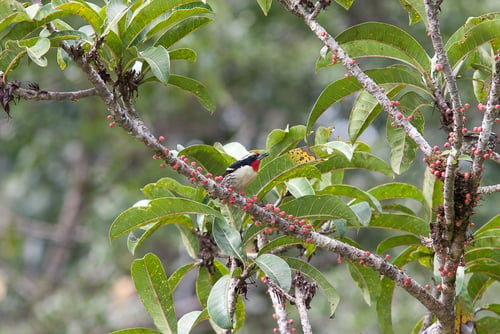
Source: WikipediaFicus rubiginosa, the rusty fig or Port Jackson fig (damun in the Dharug language), is a species of flowering plant native to eastern Australia in the genus Ficus. Beginning as a seedling that grows on other plants (hemiepiphyte) or rocks (lithophyte), F. rubiginosa matures into a tree 30 m (100 ft) high and nearly as wide with a yellow-brown buttressed trunk. The leaves are oval and glossy green and measure from 4 to 19.3 cm (1+1⁄2–7+1⁄2 in) long and 1.25 to 13.2 cm (1⁄2–5+1⁄4 in) wide. The fruits are small, round, and yellow, and can ripen and turn red at any time of year, peaking in spring and summer. Like all figs, the fruit is in the form of a syconium, an inverted inflorescence with the flowers lining an internal cavity. F. rubiginosa is exclusively pollinated by the fig wasp species Pleistodontes imperialis, which may comprise four cryptospecies. The syconia are also home to another fourteen species of wasp, some of which induce galls while others parasitise the pollinator wasps and at least two species of nematode. Many species of bird, including pigeons, parrots, and various passerines, eat the fruit. Ranging along the Australian east coast from Queensland to Bega in southern New South Wales (including the Port Jackson area, leading to its alternative name), F. rubiginosa grows in rainforest margins and rocky outcrops. It is used as a shade tree in parks and public spaces, and when potted is well-suited for use as an indoor plant or in bonsai.
Description
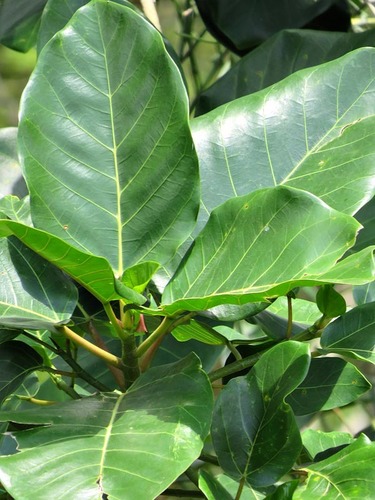
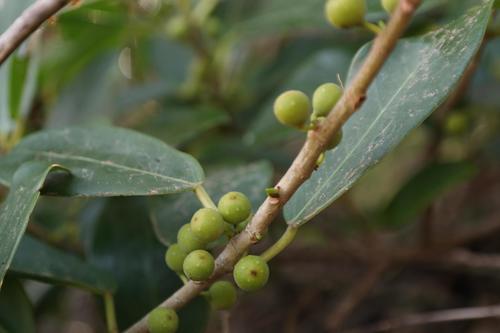
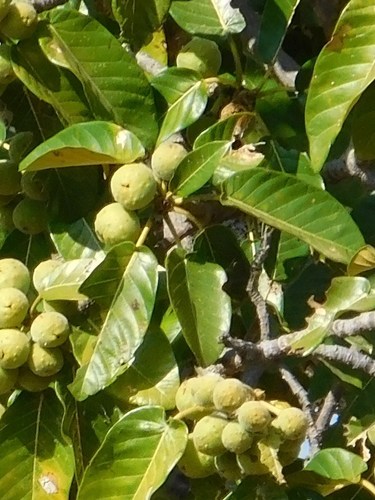
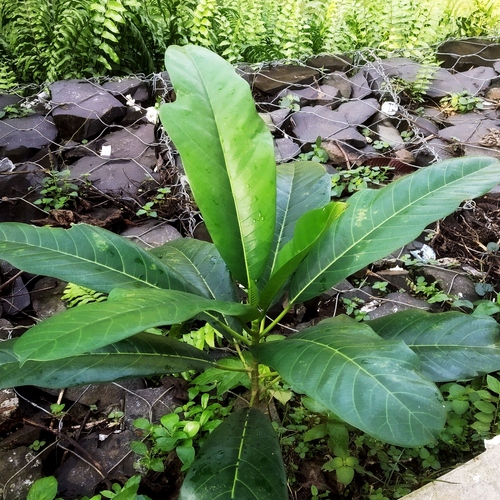
A fig. It is a large bush or small tree. It is evergreen. It grows 9-20 m tall. It spreads almost as wide. The main trunk is buttressed. It can have aerial roots. The bark is pale yellowish-brown. The young shoots are finely hairy. The leaves are shiny deep green on top and downy and rust coloured underneath. They are alternate. The leaves are 6-12 cm long and 3-5 cm wide. The leaf stalks are 2-5 cm long. The fruit occur in pairs in the axils of leaves. They are round and yellow but turn deep red. They are 1.5-2 cm across. White sap comes out of broken twigs and branches,
Edible Uses
The fruit are eaten fresh when fully dry, soft, and pulpy. The young shoot tips can be boiled and eaten.
Traditional Uses
The fruit are eaten fresh when they are dry, soft and pulpy. The young tips can be boiled and eaten.
This uses section is brief — help expand it
Distribution
A subtropical plant. It grows in temperate places but can also grow in the subtropics and tropics. It needs well drained soil. It does best with light shade. It often grows on rocky outcrops. It is salt resistant. It can stand light frost. It suits hardiness zones 9-11. In Townsville Anderson BG.
Where It Grows
Australia*, Hawaii, Pacific, Pakistan, Slovenia, USA,
Cultivation
Plants can be grown from seed, cuttings or aerial layers.
Propagation
Seed - as a hemi-epiphyte or lithophyte, the plant must be able to germinate and initially grow in low nutrient, arid conditions. Cuttings
Other Uses
The light-coloured wood is light in weight, soft, brittle, and spongy ; it is used traditionally to make shields and is sometimes used for packing-cases. Although it sometimes shows a pretty grain, it would be waste of labour to spend much time on it. The plant responds well to trimming and has been grown as a hedge. The powerful root system can seriously damage urban infrastructure in the absence of adequate weed control measures.
Notes
There are about 800-1000 Ficus species. They are mostly in the tropics. There are 120 Ficus species in tropical America.
Synonyms
Also Known As
Avstralski smokvovec, Tam-mun
References (29)
- Anon., 2003, Native Plants for the Fitzroy basin. Society for Growing Australian Plants Inc. (Rockhampton Branch) p 56
- Beasley, J., 2011, Plants of Tropical North Queensland - the compact guide. Footloose publications. p 150
- Bodkin, F., 1991, Encyclopedia Botanica. Cornstalk publishing, p 474
- Brickell, C. (Ed.), 1999, The Royal Horticultural Society A-Z Encyclopedia of Garden Plants. Convent Garden Books. p 439
- Caton, J.M. & Hardwick, R. J., 2016, Field Guide to Useful Native Plants from Temperate Australia. Harbour Publishing House. p 252
Show all 29 references Hide references
- Cooper, W. and Cooper, W., 2004, Fruits of the Australian Tropical Rainforest. Nokomis Editions, Victoria, Australia. p 327
- Cronin, L., 1989, The Concise Australian Flora. Reed. p 147
- Cundall, P., (ed.), 2004, Gardening Australia: flora: the gardener's bible. ABC Books. p 604
- Elliot, W.R., & Jones, D.L., 1992, Encyclopedia of Australian Plants suitable for cultivation. Vol 4. Lothian. p 290
- Etherington, K., & Imwold, D., (Eds), 2001, Botanica's Trees & Shrubs. The illustrated A-Z of over 8500 trees and shrubs. Random House, Australia. p 328
- Flora of Australia, Volume 3, Hamamelidales to Casuarinales, Australian Government Publishing Service, Canberra (1989) p 42
- Flora of Pakistan. www.eFloras.org
- Greig, D., 1996, Flowering Natives for Home Gardens. Angus & Robertson. p 182
- Hardwick, R.J., 2000, Nature's Larder. A Field Guide to the Native Food Plants of the NSW South Coast. Homosapien Books. p 88
- Hall, N. et al, 1972, The Use of Trees and Shrubs in the Dry Country of Australia, AGPS, Canberra. p 207
- Hibbert, M., 2002, The Aussie Plant Finder 2002, Florilegium. p 102
- Holliday, I., 1989, A Field Guide to Australian Trees. Hamlyn. p 200
- Hunter, J. T. & Sheringham, P., 2006, Vegetation and Floristics of Melville Range Nature Reserve. A Report to the New South Wales Parks and Wildlife Service. p 174
- Jard. Malmaison 2: ad t. 114. 1805
- Jones D, L, 1986, Ornamental Rainforest Plants in Australia, Reed Books, p 220
- Lord, E.E., & Willis, J.H., 1999, Shrubs and Trees for Australian gardens. Lothian. p 16
- McKerney, M. & White, H., 2011, Bush Tucker, Boomerangs & Bandages. Border River-Gwyder Catchment Management Authority p 55
- Melzer, R. & Plumb, J., 2011, Plants of Capricornia. Belgamba, Rockhampton. p 209
- Molyneux, B. and Forrester, S., 1997, The Austraflora A-Z of Australian Plants. Reed. p 96
- Ratcliffe D & P., 1987, Australian Native Plants for Indoors. Little Hills press. p 90
- Smith, K & I., 1999, Grow your own bushfoods. New Holland. Australia. p 34
- Staples, G.W. and Herbst, D.R., 2005, A tropical Garden Flora. Bishop Museum Press, Honolulu, Hawaii. p 410
- Williams, J.B., Harden, G.J., and McDonald, W.J.F., 1984, Trees and shrubs in rainforests of New South Wales and Southern Queensland. Univ. of New England, Armidale. p 66
- Young, J., (Ed.), 2001, Botanica's Pocket Trees and Shrubs. Random House. p 387