Ficus religiosa
L.
Bo Tree, Peepul Tree
iNaturalist· cc-by-nc
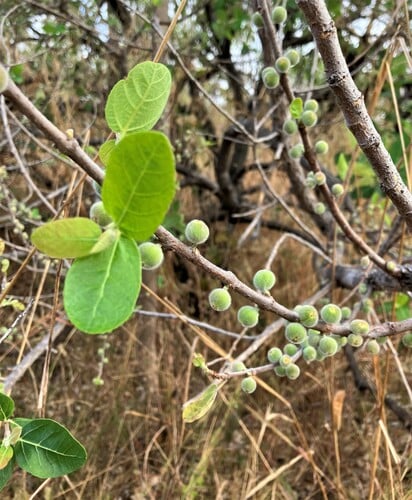
(c) Hua Wan, some rights reserved (CC BY-NC), uploaded by Hua Wan
iNaturalist· cc-by-nc
(c) queentut1, some rights reserved (CC BY-NC)
Summary
Source: WikipediaFicus religiosa or sacred fig is a species of fig native to the Indian subcontinent and Indochina that belongs to Moraceae, the fig or mulberry family. It is also known as the bodhi tree, bo tree, peepul tree, peepal tree, pipala tree or ashvattha tree (in India and Nepal). The sacred fig is considered to have a religious significance in four major religions that originated on the Indian subcontinent: Hinduism, Buddhism, Sikhism and Jainism. Hindu and Jain ascetics consider the species to be sacred and often meditate under it. Gautama Buddha is believed to have attained enlightenment under a tree of this species. The sacred fig is the state tree of the Indian states of Odisha, Bihar and Haryana.
Description
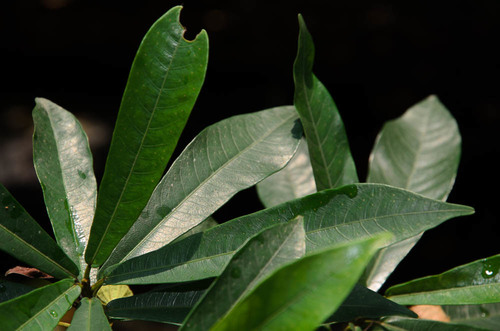
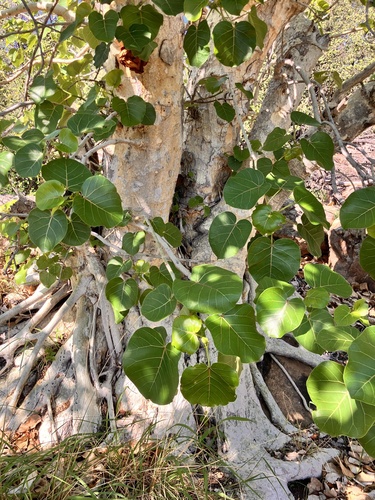
A fig. It is a deciduous tree. It grows to 35 m tall. The crown is one. It has fibrous aerial rots. The trunk can be 30-40 cm across. When young it grows living on and attached to other plants. The bark is grey and smooth with cracks along it. The young branches has some hairs. The leaf stalk is thin and up to 15 cm long. The leaves are alternate. The leaf blade is triangle shaped or oval and 9-17 cm long by 8-12 cm wide. They are wavy and thinly leathery. They are shiny above. They are reddish when young. They have 5-7 main veins. The base is heart shaped. The tip of the leaf is long and thread like. There are 5-7 secondary veins on each side of the midrib. Flowers are borne inside the figs. Both male and female flowers occur and the male flowers are few and near the opening. The figs are round but flattened. They do not have stalks and occur in pairs. They are dark purple when ripe.
Edible Uses
Fruits. Edible though not tasty. The small figs are used mainly as a famine food, eaten when nothing better is available. Leaf buds. Edible though not tasty. Eaten in times of scarcity.
Traditional Uses
The ripe fruit are eaten raw. The young leaves are cooked as a vegetable.
This uses section is brief — help expand it
Medicinal Uses
Ficus religiosa is used in traditional medicine for about fifty types of disorders including asthma, diabetes, diarrhea, epilepsy, gastric problems, inflammatory disorders, infectious and sexual disorders. The trunk of this tree is used by farmers as a soil leveller. After seed harvesting, the rectangular trunk is connected to tractors and levels the soil.
Distribution
A tropical and subtropical plant. It often grows attached to other plants on rock walls and steep slopes. They are common all over India. It is a tropical and subtropical plant. It suits hardiness zones 10-12. In XTBG Yunnan.
Where It Grows
Africa, Andamans, Asia, Australia, Bangladesh, Bhutan, British Indian Ocean Terr., BIOT, China, Dominican Republic, East Africa, East Timor, Egypt, Fiji, Haiti, Hawaii, Himalayas, India, Indochina, Indonesia, Israel, Laos, Libya, Madagascar, Malaysia, Mediterranean, Middle East, Mozambique, Myanmar, Nepal, North Africa, North America, Northeastern India, Pacific, Pakistan, SE Asia, Sikkim, Sri Lanka, Thailand, Timor-Leste, United Arab Emirates, UAE, USA, Vietnam, West Indies, Zimbabwe,
Cultivation
Plants can be grown from seed or cuttings. They can also be grown from layers.
Propagation
Seed - germinates best at a temperature around 20°c. Air layering. Tip cuttings around 4 - 12cm long, taken from lateral branches.
Other Uses
The bark contains tannins and is used as a dye for cloth. A latex obtained from the plant is used for making varnishes. A gum (is this the latex?) obtained from the tree is used as a sealing wax. It is used by artificers for filling up the cavities of ornaments. The fibrous bark is used to make paper. The greyish-white wood is very light in weight and very soft. It is moderately durable under cover and quite durable under water. The low-quality wood may be used for packing cases and matches. The wood is used for fuel.
Production
It is a fast growing tree. Trees can live for hundreds or thousands of years.
Other Information
A famine food. It is cultivated.
Notes
It is the sacred tree of the Hindus. There are about 800-1000 Ficus species. They are mostly in the tropics. There are 120 Ficus species in tropical America.
Synonyms
Also Known As
Ali, Ara budi, Arasa marum, Arasamaram, Arasu, Asatha, Asatthwa, Ashawatha, Ashuvatham, Bawdi-nyaung, Bodhi tree, Bodi, Bunut kaloja, De, Lagat, Lesan al-asfor, Mai-nyawng, Nyaung bawdi, Pakri tussa, Peepal, Pho-sii-ma-haa-pho, Pimpal, Pipal, Pipar, Pipari, Pipri, Po ton, Pu ti shu, Raghie, Rai, Ray, Sacred fig, Sali, Thon-pho
References (61)
- Acharya K. P. and Acharya, R., 2010, Eating from the Wild: Indigenous knowledge on wild edible plants in Parroha VDC of Rupandehi District, Central Nepal. International Journal of Social Forestry. 3(1):28-48
- Arinathan, V., et al, 2007, Wild edibles used by Palliyars of the western Ghats, Tamil Nadu. Indian Journal of Traditional Knowledge. 6(1) pp 163-168
- Barwick, M., 2004, Tropical and Subtropical Trees. A Worldwide Encyclopedic Guide. Thames and Hudson p 187
- Basha, S. K. M., Ethnobotanical Trees of Sri Lanka Malleswara Wildlife Sanctuary; Eastern Ghats, Andhra Pradesh.
- Bhogaonkar, P. Y. & Devarkar, V. D., 2018, Inventory for ethnovegetable knowledge of the tribals of Satpura hill area-Melghat, Dist. Amravati (India), Plantae Scientia, 2018; Vol. 01 Issue 01: 01-08
Show all 61 references Hide references
- Bodkin, F., 1991, Encyclopedia Botanica. Cornstalk publishing, p 473
- Bole, P.V., & Yaghani, Y., 1985, Field Guide to the Common Trees of India. OUP p 87
- Bremness, L., 1994, Herbs. Collins Eyewitness Handbooks. Harper Collins. p 56
- Brickell, C. (Ed.), 1999, The Royal Horticultural Society A-Z Encyclopedia of Garden Plants. Convent Garden Books. p 439
- Burkill, I.H., 1966, A Dictionary of the Economic Products of the Malay Peninsula. Ministry of Agriculture and Cooperatives, Kuala Lumpur, Malaysia. Vol 1 (A-H) p 1030
- Chowdhury, M. & Mukherjee, R., 2012, Wild Edible Plants Consumed by Local Communities of Maldah of West Bengal, India. Indian J.Sci.Res.3(2) : 163-170
- Cundall, P., (ed.), 2004, Gardening Australia: flora: the gardener's bible. ABC Books. p 604
- Dangol, D. R. et al, 2017, Wild Edible Plants in Nepal. Proceedings of 2nd National Workshop on CUAOGR, 2017.
- Engel, D.H., & Phummai, S., 2000, A Field Guide to Tropical Plants of Asia. Timber Press. p 10, 83
- Etherington, K., & Imwold, D., (Eds), 2001, Botanica's Trees & Shrubs. The illustrated A-Z of over 8500 trees and shrubs. Random House, Australia. p 328
- Flora of China @ efloras.org Volume 5
- Flora of Pakistan. www.eFloras.org
- Gautam, R. S., et al, 2020, Wild Edible Fruits of Nepal. Int. J. Appl. Sci. Biotechnol. Vol 8(3): 289-304
- Ghosh, C. & Das A. P., 2011, Some useful and poisonous tea garden weeds from the Darjiling District of West Bengal, India. Pleione 5(1): 91 - 114
- GUPTA,
- Hamayun, M., Ethnobotanical Studies of some Useful Shrubs and Trees of District Buner, NWFP, Pakistan
- Hearne, D.A., & Rance, S.J., 1975, Trees for Darwin and Northern Australia. AGPS, Canberra p 71
- Hedrick, U.P., 1919, (Ed.), Sturtevant's edible plants of the world. p 308
- Heywood, V.H., Brummitt, R.K., Culham, A., and Seberg, O. 2007, Flowering Plant Families of the World. Royal Botanical Gardens, Kew. p 218
- Jabeen, A., et al, 2009, Indigenous uses of economically important flora of Margallah Hills National Park, Islamabad, Pakistan. African Journal of Biotechnology Vol. 8 (5), pp. 763-784
- Jadhav, R., et al, 2015, Forest Foods of Northern Western Ghats: Mode of Consumption, Nutrition and Availability. Asian Agri-History Vol. 19, No. 4: 293-317
- Karim, F. M. & Dakheel, A, J., 2006, Salt-tolerant plants of the United Arab Emirates. 2006. International Center for Biosaline Agriculture, Dubai, UAE. p 128
- Kiran, K. C., et al, 2019, Diversity and Seasonal Availability of Potential Wild Edible Plants from Vidarbha Region of Maharashtra State, India. Int.J.Curr.Microbiol.App.Sci (2019) 8(2): 1434-1446
- Krishen P., 2006, Trees of Delhi, A Field Guide. DK Books. p 96
- Kunwar, R.M. & Bussmann, R. W., 2006, Ficus (Fig) species in Nepal: a review of diversity and indigenous uses. Lyonia 11(1)
- Llamas, K.A., 2003, Tropical Flowering Plants. Timber Press. p 278
- Lord, E.E., & Willis, J.H., 1999, Shrubs and Trees for Australian gardens. Lothian. p 55
- Manandhar, N.P., 2002, Plants and People of Nepal. Timber Press. Portland, Oregon. p 234
- Manju, S., and Sundriyal, R. C., 2001, Wild Edible Plants of the Sikkim Himalaya: Nutritive Values of Selected Species. Economic Botany 55(3): 377-390
- Marandi, R. R. & Britto, S. J., 2015, Medicinal Properties of Edible Weeds of Crop Fields and Wild plants Eaten by Oraon Tribals of Latehar District, Jharkhand. International Journal of Life Science and Pharma Research. Vo. 5. (2) April 2015
- Masoodi, H. U. R. & Sundriyal, R. C., 2020, Richness of non-timber forest products in Himalayan communities—diversity, distribution, use pattern and conservation status. Journal of Ethnobiology and Ethnomedicine 16:56
- McMakin, P.D., 2000, Flowering Plants of Thailand. A Field Guide. White Lotus. p 30
- Mon, A. M., 2020, The uses of fig (Ficus) by five ethnic minority communities in Southern Shan State, Myanmar. Journal of Ethnobiology and Ethnomedicine (2020) 16:55
- Plants of Haiti Smithsonian Institute http://botany.si.edu/antilles/West Indies
- Prabha, Y. P., et al, 2010, Documentation of Wild Edible Plants of Melghat Forest, Dist. Amravati, Maharashtra State, India. Ethnobotanical Leaflets 14: 751-58, 2010.
- Prachi, K., et al, 2012, Underutilized wild fruits of North Maharashtra. Journal of Research in Plant Sciences. (2012) 1:071-076
- PROSEA (Plant Resources of South East Asia) handbook, Volume 12 (1), 1999, Medicinal and poisonous
- Purseglove, J.W., 1968, Tropical Crops Dicotyledons, Longmans. p 389
- Rajkalkshmi, P. et al, 2001, Total carotenoid and beta-carotene contents of forest green leafy vegetables consumed by tribals of south India. Plant Foods for Human Nutrition 56:225-238
- Recher, P, 2001, Fruit Spirit Botanical Gardens Plant Index. www.nrg.com.au/~recher/ seedlist.html p 6
- Sahni, K.C., 2000, The Book of Indian Trees. Bombay Natural History Society. Oxford. p 155
- Sarvalingam, A., et al, 2014, Wild edible plant resources used by the Irulas of the Maruthamalai Hills, Southern Western Ghats, Coimbatore, Tamil Nadu. Indian Journal of Natural Products and Resources 5(2):198-201
- Schuler, S., (Ed.), 1977, Simon & Schuster's Guide to Trees. Simon & Schuster. No. 115
- SHANKARNARAYAN & SAXENA,
- SHORTT,
- Singh, H.B., Arora R.K.,1978, Wild edible Plants of India. Indian Council of Agricultural Research, New Delhi. p 78
- Smith, A.C., 1981, Flora Vitiensis Nova, Lawaii, Kuai, Hawaii, Volume 2 p 174
- Sp. pl. 2:1059. 1753
- Swaminathan, M.S., and Kochnar, S.L., 2007, An Atlas of major Flowering Trees in India. Macmillan. p 251
- Topp, J. M. W., 1988, An Annotated Check List of the Flora of Diego Garcia, British Ocean Territory. Atoll Research Bulletin No. 313
- Toppo, P. et al, 2016, Wild edible plants of Dhamtari district of Chhattisgarh, India. Van Sangyan Vol. 3, No. 4
- Valder, P., 1999, The Garden Plants of China. Florilegium. p 285
- World Checklist of Useful Plant Species 2020. Royal Botanic Gardens, Kew
- www.worldagroforestrycentre.org/treedb/
- Young, J., (Ed.), 2001, Botanica's Pocket Trees and Shrubs. Random House. p 387
- Zeven, A. C. & de West, J. M. J., 1982, Dictionary of cultivated plants and their regions of diversity. Wageningen. p 76