Ficus dammaropsis
Diels
Highlands kapiak, Dinnerplate fig
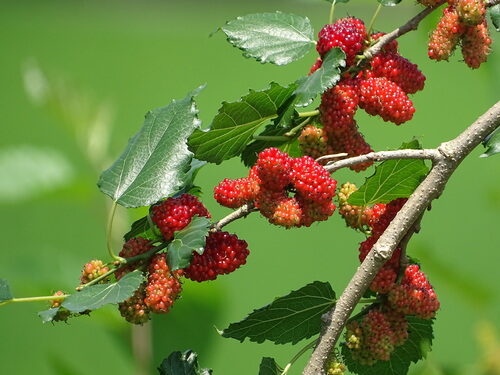
iNaturalist· cc-by-nc
(c) chalcidjyr, some rights reserved (CC BY-NC)
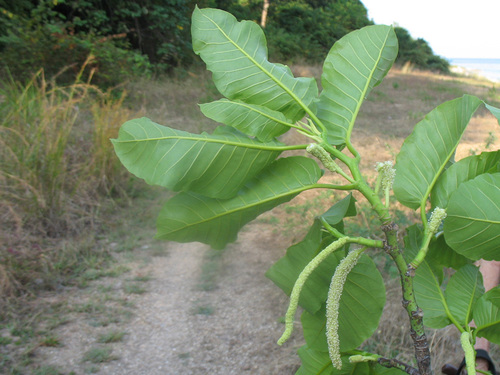
iNaturalist· cc-by-nc
(c) Jay Pruett, some rights reserved (CC BY-NC), uploaded by Jay Pruett
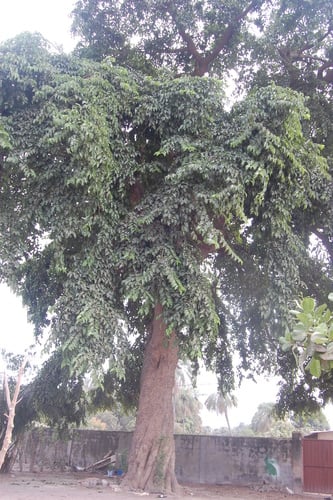
iNaturalist· cc-by-nc
(c) tiffany_beachy, some rights reserved (CC BY-NC), uploaded by tiffany_beachy
Summary
Source: WikipediaFicus dammaropsis, the highland breadfruit, locally called kapiak in Tok Pisin, is a tropical dioecious evergreen fig (subgenus Sycamorus), of the family Moraceae, with huge pleated leaves 60 cm (24 in) across and up to 90 cm (3 ft) in length. on petioles as much as 32 cm (13 in) long and 2.5 cm (0.98 in) thick. These emerge from a stipular sheath up to 38 cm (15 in) long, the largest of any dicot. It is native to the highlands and highland fringe of New Guinea. It generally grows at altitudes of between 850 and 2,750 metres (2,790 and 9,020 ft). Its fruit, the world's largest fig (syconium), up to 18 cm (7 in) in diameter are edible but rarely eaten except as an emergency food. There are two fruit colour variants in Ficus dammaropsis, red and green. They are pollinated by the tiny fig wasp Ceratosolen abnormis. The young leaves are pickled or cooked and eaten as a vegetable with pig meat by highlanders. The lowland form of this species, with different and smaller flower form and less pleated leaves than Ficus dammaropsis, found commonly below 900 metres (2,950 ft) is recognized as a distinct species, Ficus brusii. The species can be found at the Melbourne Botanic Gardens, located in the 'Yucca Bed'.
Description
A fig tree. It grows to 9-13 m high. The large young leaves are eaten. The branches are strong and flexible and contain a milky juice. The tree has a single trunk without buttresses or aerial roots. It is often straggling. Seedling trees vary considerably in size of leaves and colour of young leaves and veins. The leaves are large. They can be 60-100 cm long. They are deeply corrugated with veins. The veins can be red or yellow. The fruit is large (15 cm across) and made up of large overlapping scale leaves. It ripens to a deep purple.
Edible Uses
The young leaves are eaten with meat. The outer layer of the fruit is edible, and young fruit are boiled and eaten as a vegetable.
Traditional Uses
The young leaves are eaten with meat. The outside layer of the fruit is edible. The young fruit are boiled and eaten as a vegetable.
This uses section is brief — help expand it
Medicinal Uses
A daily drink of stem latex is said to relieve a severe cough.
Distribution
A tropical plant. Trees occur from 900 m to 2700 m but it is most common between 1600 and 1750 m altitude. It suits hardiness zones 9-11.
Where It Grows
Asia, Australia, Indonesia, New Zealand, Pacific, Papua New Guinea, PNG, SE Asia, West Papua,
Cultivation
Trees grow from seeds and are transplanted. Cuttings of branches do not normally establish. It can be grown by air-layering.
Propagation
Seed - Cuttings do not normally establish.
Other Uses
A fibre is obtained from the bark. It is used to make rope and clothing. The fibrous branches can be used to clean the teeth. The leaves of some species are used to wrap food for cooking. The leaves of some species are quite rough and can be used as a sandpaper substitute and for scouring pots. The wood of plants in this genus is usually of low quality, light in weight, soft and not very durable. It is sometimes used for purposes such as light construction, digging sticks, yam stakes, etc. The wood is also used for fuel and sometimes for making fire by friction.
Other Information
In Papua New Guinea, leaves are fairly widely used at pig kills and for mumus in the highlands. Fruit are less widely eaten.
Notes
There are about 800-1000 Ficus species. They are mostly in the tropics. There are 120 Ficus species in tropical America.
Synonyms
Also Known As
Anugu, Elu, Emi, Hok, Mail, Minibi, Pohon ara pakiak, Pohon ara rotigunung, Shuwat, Suar, Suar sur
References (20)
- Barwick, M., 2004, Tropical and Subtropical Trees. A Worldwide Encyclopedic Guide. Thames and Hudson p 184
- Batet, K., Koil, U., and Hertel, H., 1998, Traditional Plant Use by the Didipa Clan, Baitabag, Papua New Guinea. GDS. p 25
- Borrell, O.W., 1989, An Annotated Checklist of the Flora of Kairiru Island, New Guinea. Marcellin College, Victoria Australia. p 100+12, 105, 200
- Bot. Jahrb. Syst. 57:204. 1935
- Bourke, R. M., Altitudinal limits of 230 economic crop species in Papua New Guinea. Terra australis 32.
Show all 20 references Hide references
- CURREY,
- Etherington, K., & Imwold, D., (Eds), 2001, Botanica's Trees & Shrubs. The illustrated A-Z of over 8500 trees and shrubs. Random House, Australia. p 327
- French, B.R., 1986, Food Plants of Papua New Guinea, A Compendium. Asia Pacific Science Foundation p 62
- Hide, R., et al, 1979, A checklist of some plants in the territory of the Sinasina Nimai (Simbai Province, Papua New Guinea), with notes on their uses. Department Anthropology, University of Aukland
- Martin, F.W. & Ruberte, R.M., 1979, Edible Leaves of the Tropics. Antillian College Press, Mayaguez, Puerto Rico. p 206
- Milliken, W., 2,000, Ethnobotany of the Yali of West Papua. Royal Botanic Garden, Edinburgh (near Baliem)
- Powell, J.M., Ethnobotany. In Paijmans, K., 1976, New Guinea Vegetation. Australian National University Press. p 110
- PROSEA (Plant Resources of South East Asia) handbook, Volume 12 (1), 1999, Medicinal and poisonous.
- Sillitoe, P. 1995, An Ethnobotanical Account of the Plant Resources of the Wola Region, Southern Highlands Province, Papua New Guinea. J. Ethnobiol. 15(2): 201-235
- Sukarya, D. G., (Ed.) 2013, 3,500 Plant Species of the Botanic Gardens of Indonesia. LIPI p 282
- Terra, G.J.A., 1973, Tropical Vegetables. Communication 54e Royal Tropical Institute, Amsterdam, p 46
- Walter, A. & Sam C., 2002, Fruits of Oceania. ACIAR Monograph No. 85. Canberra. p 279
- Wiriadinata, H., 1995, Ethnobotany of Economic Plants in the Baliem Valley, Jayawijaya, Irian Jaya, Indonesian Institute of Science, Bogor, Indonesia
- World Checklist of Useful Plant Species 2020. Royal Botanic Gardens, Kew
- Young, J., (Ed.), 2001, Botanica's Pocket Trees and Shrubs. Random House. p 384