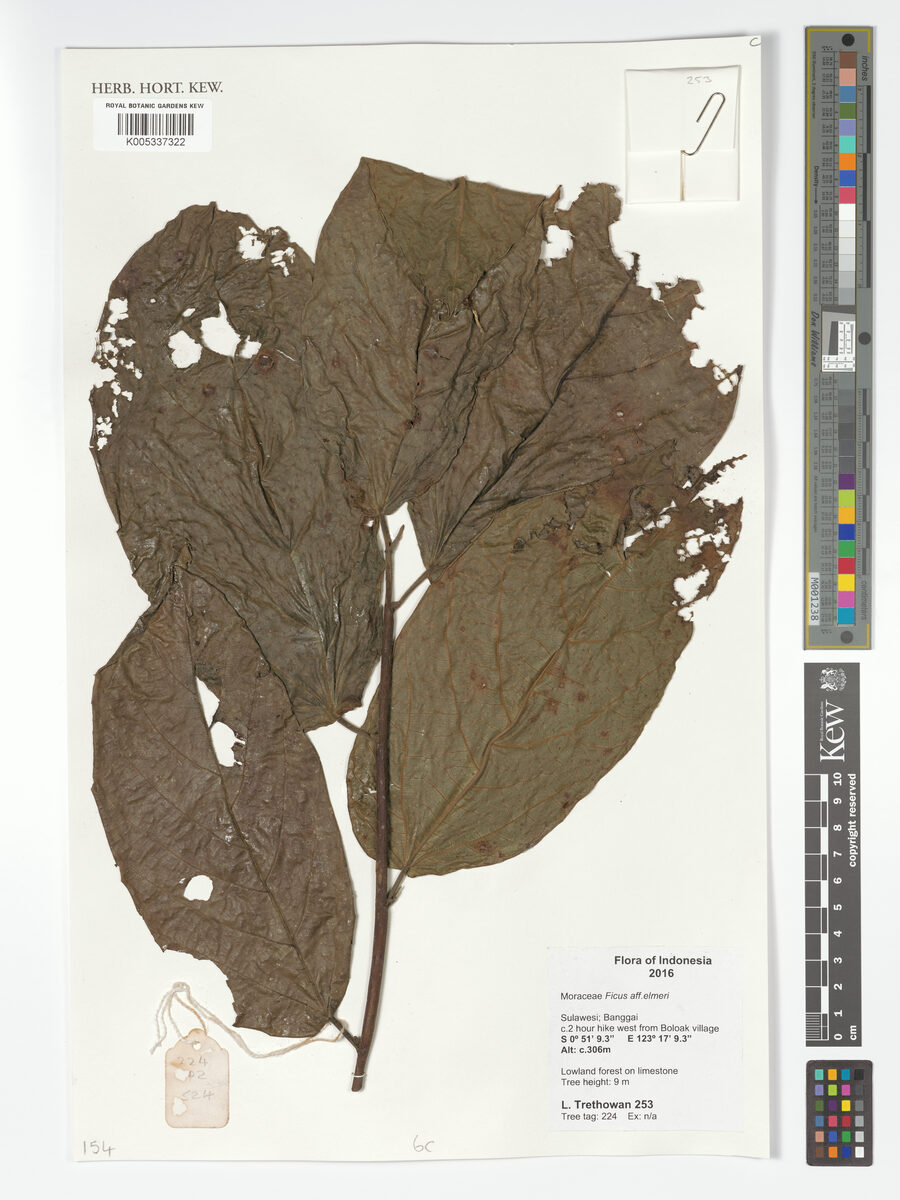
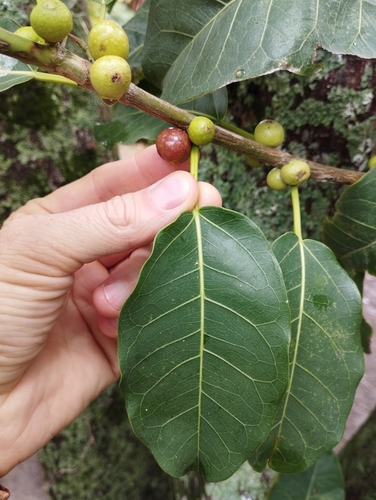
Ficus wassa
Roxburgh
Wasa fig tree
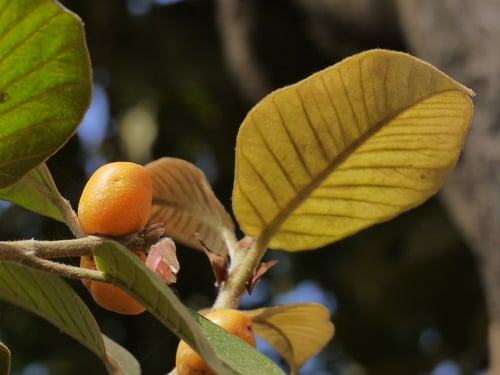
iNaturalist· cc-by
(c) Dominik Maximilián Ramík, some rights reserved (CC BY), uploaded by Dominik Maximilián Ramík
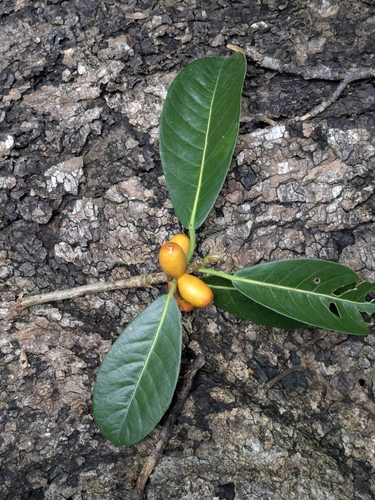
iNaturalist· cc-by-nc
(c) davibule, some rights reserved (CC BY-NC)
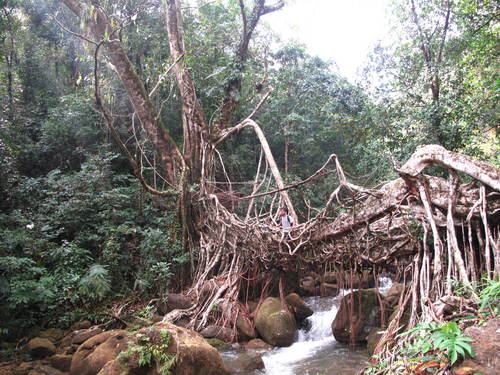
iNaturalist· cc-by-nc
(c) davibule, some rights reserved (CC BY-NC)
Summary
Source: WikipediaFicus wassa is a species of fig in the family Moraceae found in Malesia.
Description
A fig. It is a shrubby tree up to 4 m tall. The bark is grey, flaky and scaly. The young leaf parts have grey hairs underneath them. The leafy twigs are reddish brown. The leaves are produced opposite one another. The leaf is rough to the touch. The edges of the leaves are wavy and slightly toothed. The tip of the leaf is pointed and the base is wedge shaped. There is a gland at the base of the leaf veins. Fruit are produced in clusters on the leafless stems. They are red to purple when ripe. Ficus copiosa and Ficus wassa are very similar. Ficus wassa is usually smaller and has darker bark. Ficus copiosa has larger more angular leaves and the figs are normally less red and more green and on longer stalks. The fruit of Ficus wassa are smaller and harder.
Edible Uses
Young leaves - raw or cooked. Fruits - raw or cooked. The fruits are cooked and eaten with the young leaves. Figs axillary, ramiflorous or cauliflorous, subglobose, 12 - 16mm in diameter, scabridulous, ripening yellow to red and purple
Traditional Uses
The leaves are eaten cooked. The fruit are also cooked with the young leaves.
This uses section is brief — help expand it
Medicinal Uses
The leaves stimulate milk production.
Distribution
A tropical plant. It occurs in areas of re-growth. In Papua New Guinea it grows in lowland areas and up to 1,300 m altitude or higher. In PNG it has been recorded to 2,500 m. In Solomon Islands it grows up to 1,400 m altitude. In Vanuatu it grows up to 800 m altitude.
Where It Grows
Asia, East Timor, Indonesia, Pacific, Papua New Guinea, PNG, SE Asia, Solomon Islands, Timor-Leste, Vanuatu,
Cultivation
Plants can be grown from seed or cuttings.
Propagation
Seed - Cuttings
Other Uses
The leaves have a rough surface and are used as a substitute for sandpaper and as a scourer for pots and pans. The fibrous bark is used to make men's head covering. The bark is also used to make rope. The fibrous branches used to clean teeth. The leaves of some species are used to wrap food for cooking. The wood of plants in this genus is usually of low quality, light in weight, soft and not very durable. It is sometimes used for purposes such as light construction, digging sticks, yam stakes, etc. The wood is also used for fuel and sometimes for making fire by friction.
Other Information
A commonly used edible leaf in Papua New Guinea.
Notes
There are about 800-1000 Ficus species. They are mostly in the tropics. There are 120 Ficus species in tropical America. The leaves stimulate milk production.
Synonyms
Also Known As
Amiki, Amusi kilikacha, Gaegale, Ghaapoli mongi, Huhula, Igula, Kamwa kamwa, Mimo, Ngo'ongo'o, Nonali mato, Pakopako, Pohon ara nangananga, Pohon ara wasa, Tivanono
References (12)
- Borrell, O.W., 1989, An Annotated Checklist of the Flora of Kairiru Island, New Guinea. Marcellin College, Victoria Australia. p 108
- Cowie, I, 2006, A Survey of Flora and vegetation of the proposed Jaco-Tutuala-Lore National Park. Timor-Lests (East Timor) www.territorystories.nt/gov.au p 51
- French, B.R., 2010, Food Plants of Solomon Islands. A Compendium. Food Plants International Inc. p 87
- Henderson, C.P. and I.R.Hancock, 1988, A Guide to the Useful Plants of the Solomon Islands. Res. Dept. Min of Ag. & Lands. Honiara, Solomon Islands. p 125
- Lebot, V. & Sam, C., Green desert or ‘all you can eat’? How diverse and edible was the flora of Vanuatu before human introductions?. Terra australis 52 p 408
Show all 12 references Hide references
- Powell, J.M., Ethnobotany. In Paijmans, K., 1976, New Guinea Vegetation. Australian National University Press. p 110
- Reis, S. V. and Lipp, F. L., 1982, New Plant Sources for Drugs and Foods from the New York Botanical Garden herbarium. Harvard. p 44
- Sukarya, D. G., (Ed.) 2013, 3,500 Plant Species of the Botanic Gardens of Indonesia. LIPI p 292
- Thaman, R. and W. Clarke, Paper on Agroforestry on Aneityum and Tanna, Vanuatu from Internet
- Walter, A. & Sam C., 2002, Fruits of Oceania. ACIAR Monograph No. 85. Canberra. p 165
- Wiriadinata, H., 1995, Ethnobotany of Economic Plants in the Baliem Valley, Jayawijaya, Irian Jaya, Indonesian Institute of Science, Bogor, Indonesia
- World Checklist of Useful Plant Species 2020. Royal Botanic Gardens, Kew