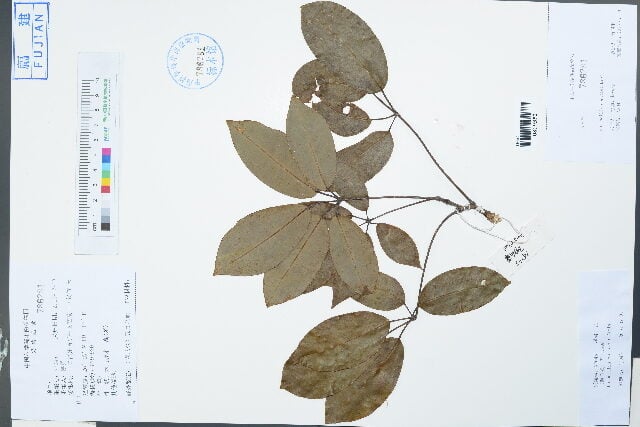
Akebia quinata
(Houtt.) Decne.
Five leaf akebia, Chocolate Vine
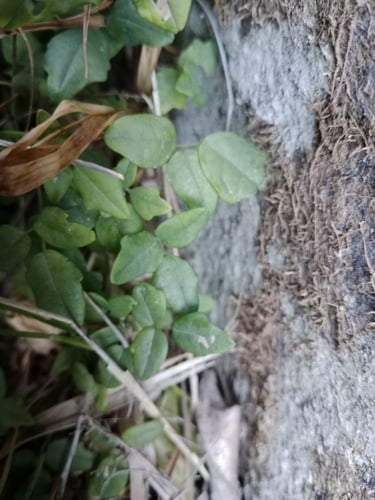
iNaturalist· cc-by-nc
(c) plantyplant, some rights reserved (CC BY-NC)
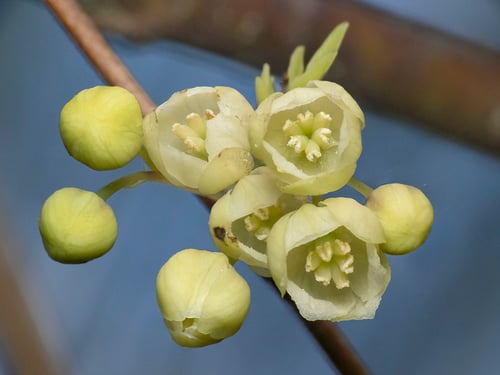
iNaturalist· cc-by
(c) ashley CHILE baz, some rights reserved (CC BY)
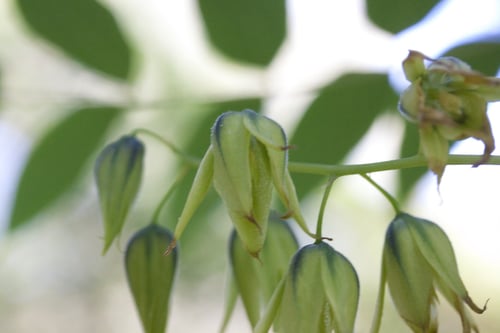
iNaturalist· cc-by-nc
(c) 2013 Zoya Akulova, some rights reserved (CC BY-NC)
Summary
Source: WikipediaAkebia quinata –commonly known as akebi (木通), chocolate vine, five-leaf chocolate vine, or five-leaf akebia– is a vine that is native to Japan, China and Korea, commonly used as an ornamental or edible plant in the United States and Europe. In its native habitat, it is often found on hills, in hedges, on trees, along forest edges and streams, and on mountainous slopes.
Description
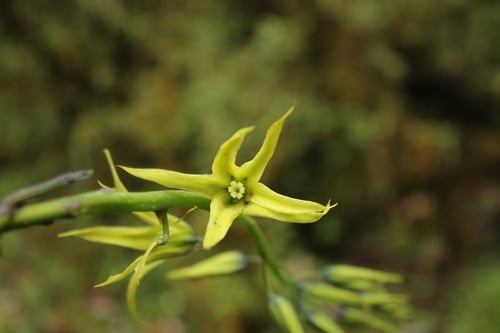
A climber which grows 12 m long. It twines around objects and climbs. The stems are dark purple-red. Where winters are mild they keep their leaves year round. The leaves are made up of 5 oval leaflets. Each leaflet is about 5 cm long. Male and female flowers are separate. The flowers have a sweet smell and appear in clusters. Female flowers are purplish-brown and 2-3 cm across. They are cup-shaped. The male flowers are smaller and rose-purple. The fruit is 5-10 cm long and 5 cm wide. It is sausage shaped and grey-violet. The seeds are black in a white pulp. There are 40-50 seeds. The pulp is edible.
Edible Uses
The fruit is eaten raw. It is sweet but insipid, with a delicate flavour and soft, juicy texture; lemon juice is sometimes added to enhance the flavour. The fruit measures 5–10cm long and up to 4cm wide. The bitter skin of the fruit is fried and eaten. Soft young shoots are used in salads or pickled. The leaves can be used as a tea substitute.
Traditional Uses
The fruit is eaten raw. The skin of the fruit is bitter but it is fried and eaten. The fruit can also be pureed and made into a drink. The soft young shoots are used in salads. They are also pickled in salt. The leaves can be used for tea.
Medicinal Uses
The stems are anodyne, antifungal, antiphlogistic, bitter, diaphoretic, diuretic, emmenagogue, febrifuge, laxative, galactogogue, resolvent, stimulant, stomachic, and vulnerary. Taken internally, they help control bacterial and fungal infections and are used to treat urinary tract infections, absent menstruation, and to improve lactation. Stems are harvested in autumn and dried for later use. The fruit is antirheumatic, depurative, diuretic, febrifuge, stomachic, and tonic, and is a popular remedy for cancer. The root is febrifuge. In a survey of 250 potential antifertility plants in China, this plant ranked 13th.
Distribution
It is a temperate plant. It grows naturally in mountainous areas in Japan and Korea. It needs well drained moist soil. It can grow in acid or alkaline soils. It can grow in shade but does better in sunlight. Plants are hardy to -20°C, when dormant but damaged by frost when in shoot. In mild winters they keep their leaves. It suits hardiness zones 5-10. It grows in Sichuan.
Where It Grows
Asia, Australia, Britain, Canada, China*, Europe, Japan, Korea, North America, Pakistan, USA,
Cultivation
Plants can be grown from seed. If possible use fresh seed or for stored seed give it one months cold treatment. Seed should be sown on the surface of the soil. The seed usually germinates in 1 - 3 months at 15°C. Plants do not transplant easily. Hand pollination helps fruit bearing. Male pollen from a separate plant should be used. As plants are probably self sterile 2 plants from different sources should be grown together. Plants can be grown from cuttings of the vine or root. Plants can also be grown by layering. In warm climates plants need to be pruned back heavily.
Propagation
Seed is best sown in a cold frame as soon as it is ripe, surface-sown in a light position. Germination typically takes 1–3 months at 15°C. Stored seed should be given one month of cold stratification and can be very difficult to germinate. Prick seedlings into individual pots when large enough to handle and grow on in light shade in a greenhouse for at least their first winter. Plant out in late spring or early summer after the last expected frosts. Half-ripe cuttings can be taken in July or August in a frame, though they can be slow to root. Softwood cuttings can also be taken in spring. Root cuttings taken in December should be placed in a warm greenhouse. Layering in early spring is very easy — plants often self-layer, so new plants can simply be dug up and planted directly into permanent positions.
Other Uses
The peeled stems are very pliable and well suited to basket making. Plants have sometimes been used as ground cover, though their growth habit does not lend itself well to this purpose. The seeds produce an oil used in traditional soap making in China. The plant is also grown as an ornamental specimen in gardens and managed landscapes.
Production
Plants are fast growing. In central China plants flower in April and May and fruit in June to August.
Other Information
It is a cultivated food plant.
Notes
There are about 4-5 Akebia species.
Nutrition
| Part | Moisture | kJ | kcal | Protein | Vit A | Vit C | Iron | Zinc |
|---|---|---|---|---|---|---|---|---|
| Fruit | 77.1 | 343 | 82 | 0.5 | — | — | 0.3 | 0.1 |
| Leaves | — | — | — | — | — | — | — | — |
Synonyms
Also Known As
Akebi, Eureumdeonggul, Mu tong fruit, Urum
References (31)
- Ann. Sci. Nat. Bot. 12:107. 1839
- Bircher, A. G. & Bircher, W. H., 2000, Encyclopedia of Fruit Trees and Edible Flowering Plants in Egypt and the Subtropics. AUC Press. p 15
- Bodkin, F., 1991, Encyclopedia Botanica. Cornstalk publishing, p 62
- Bremness, L., 1994, Herbs. Collins Eyewitness Handbooks. Harper Collins. p 276
- Brickell, C. (Ed.), 1999, The Royal Horticultural Society A-Z Encyclopedia of Garden Plants. Convent Garden Books. p 92
Show all 31 references Hide references
- Chen, B. & Qiu, Z., Consumer's Attitudes towards Edible Wild Plants, Ishikawa Prefecture, Japan. p 22 www.hindawi.com/journals/ijfr/aip/872413.pdf
- Crandall, C & Crandall, B., 1996, Flowering Fruiting and Foliage vines. Sterling. p 89
- Cundall, P., (ed.), 2004, Gardening Australia: flora: the gardener's bible. ABC Books. p 121
- Facciola, S., 1998, Cornucopia 2: a Source Book of Edible Plants. Kampong Publications, p 138
- Flora of North America. www.eFloras.org
- Flora of Pakistan. www.eFloras.org
- Flowerdew, B., 2000, Complete Fruit Book. Kyle Cathie Ltd., London. p 188
- Global Plants JSTOR
- Hedrick, U.P., 1919, (Ed.), Sturtevant's edible plants of the world. p 31
- Heywood, V.H., Brummitt, R.K., Culham, A., and Seberg, O. 2007, Flowering Plant Families of the World. Royal Botanical Gardens, Kew. p 182
- Hu, Shiu-ying, 2005, Food Plants of China. The Chinese University Press. p 391
- John, L., & Stevenson, V., 1979, The Complete Book of Fruit. Angus & Robertson p 46
- Joyce, D., 1998, The Garden Plant Selector. Ryland, Peters and Small. p 176
- Khan, D. & Shaukat, S.S., 2006, The Fruits of Pakistan: Diversity, Distribution, Trends of Production and Use. Int. J. Biol. Biotech., 3(3):463-499
- Kim, H. & Song, M., 2013, Ethnobotanical analysis for traditional knowledge of wild edible plants in North Jeolla Province (Korea). Genetic. Resour. Crop Evol. (2013) 60:1571-1585
- Lamberton, K (Ed.), 2004, The Australian gardening encyclodepia. Murdoch Books, NSW Australia. p 154
- Levy-Yamamori, R., & Taaffe, G., 2004, Garden Plants of Japan. Timber Press. p 266
- Lord, E.E., & Willis, J.H., 1999, Shrubs and Trees for Australian gardens. Lothian. p 326
- Lyle, S., 2006, Discovering fruit and nuts. Land Links. p 54
- Morley, B. & Everard, B., 1970, Wild Flowers of the World. Ebury press. Plate 90
- Pemberton, R. W. & Lee, N. S., 1996, Wild Food Plants in South Korea: Market Presence, New Crops, and Exports to the United States. Economic Botany, Vol. 50, No. 1, pp. 57-70
- Plants for a Future database, The Field, Penpol, Lostwithiel, Cornwall, PL22 0NG, UK. http://www.scs.leeds.ac.uk/pfaf/
- Song, M., et al, 2013, Traditional knowledge of wild edible plants in Jeju Island, Korea. Indian Journal of Traditional Knowledge. 12(2) pp 177-194
- Tozer, F., 2007, The Uses of Wild Plants. Green Man Publishing. p 21
- Valder, P., 1999, The Garden Plants of China. Florilegium. p 186
- Woo, Y., et al, 2017, Antioxidant Potential of Selected Korean Edible Plant Extracts. Hindawi BioMed Research International Volume 2017, Article ID 7695606