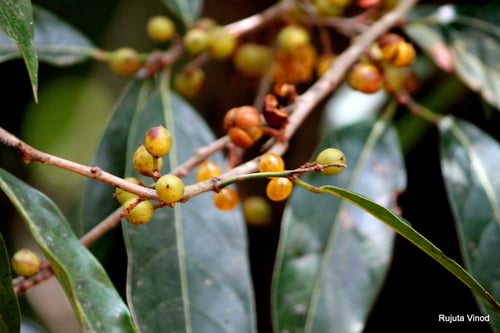
Ficus botryocarpa
Miq.
Musur, Basikong
iNaturalist· cc-by-nc-sa
(c) Smithsonian Institution, National Museum of Natural History, Department of Botany, some rights reserved (CC BY-NC-SA)
iNaturalist· cc-by-nc
(c) astronorm, some rights reserved (CC BY-NC)
iNaturalist· cc-by-nc
(c) astronorm, some rights reserved (CC BY-NC)
Description
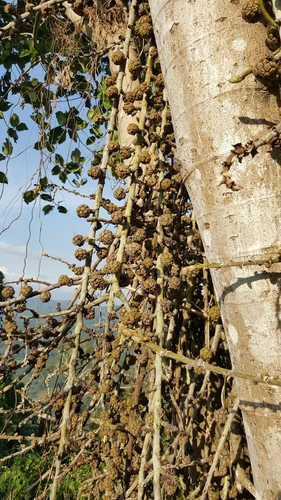
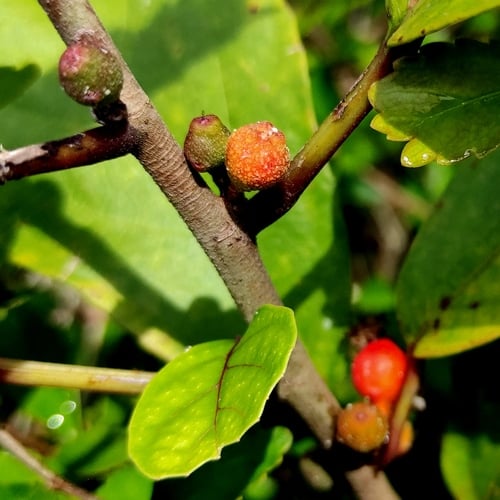
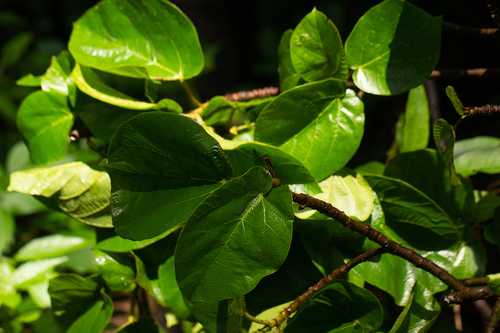
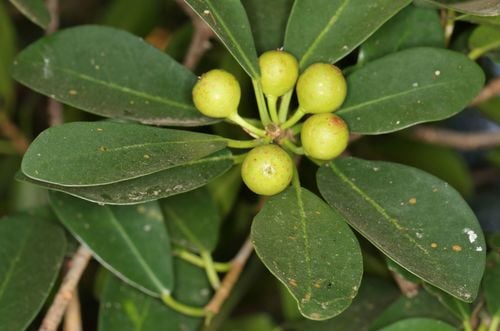
A fig. It is a small tree about 6-14 m high. It has narrow, oval, leaves which taper to a point. The common base to the flower parts is light green and smooth. They are produced with one to three flowers together from the same small branch. These branches are long hang down and are slender. Leafless branches also arise from the trunk and the larger branches. The young branch is rusty brown and with stiff reddish hairs. The leaves are 13 to 20 cm long and 5 to 8 cm wide. They become narrow towards the base and are whitish.
Edible Uses
The ripe fruit are eaten, and freshly cut stems yield drinking water.
Traditional Uses
The freshly cut stems give drinking water. The ripe fruit are eaten.
This uses section is brief — help expand it
Medicinal Uses
The fruit latex is placed on a boil to effect healing.
Distribution
A tropical plant. They are found in the hills and forests of the Philippines along river banks at 200 m altitude in Bataan and Zambales. It grows along streams and can be up to 1,700 m above sea level.
Where It Grows
Asia, Indonesia, Pacific, Papua New Guinea, Philippines, PNG, SE Asia,
Cultivation
The varieties Ficus botryocarpa linearifolia and subalbidoramea have larger fruits than the type species. Fig trees have a unique form of fertilization, each species relying on a single, highly specialized species of wasp that is itself totaly dependant upon that fig species in order to breed. The trees produce three types of flower; male, a long-styled female and a short-styled female flower, often called the gall flower. All three types of flower are contained within the structure we usually think of as the fruit. The female fig wasp enters a fig and lays its eggs on the short styled female flowers while pollinating the long styled female flowers. Wingless male fig wasps emerge first, inseminate the emerging females and then bore exit tunnels out of the fig for the winged females. Females emerge, collect pollen from the male flowers and fly off in search of figs whose female flowers are receptive. In order to support a population of its pollinator, individuals of a Ficus spp. must flower asynchronously. A population must exceed a critical minimum size to ensure that at any time of the year at least some plants have overlap of emmission and reception of fig wasps. Without this temporal overlap the short-lived pollinator wasps will go locally extinct.
Notes
There are about 800-1000 Ficus species. They are mostly in the tropics. There are 120 Ficus species in tropical America.
Synonyms
Also Known As
Bali susuk, Daing-daing, Delah, Hawa, Simbahu, Tarera intalun
References (9)
- Ann. Mus. Bot. Lugduno-Batavum 3:233. 1867-1868 ("1867")
- Borrell, O.W., 1989, An Annotated Checklist of the Flora of Kairiru Island, New Guinea. Marcellin College, Victoria Australia. p 105, 200
- Hide, R. L., (Ed.) 1984, Research Report of the Simbu Land Use Project. Vol.V1 South Simbu: Studies in Demography, Nutrition, and Subsistence. p 434
- Monsalud, M.R., Tongacan, A.L., Lopez, F.R., & Lagrimas, M.Q., 1966, Edible Wild Plants in Philippine Forests. Philippine Journal of Science. p 497
- Plants of Papua New Guinea LAE herbarium record
Show all 9 references Hide references
- PROSEA (Plant Resources of South East Asia) handbook, Volume 12 (1), 1992, Medicinal and poisonous.
- Reis, S. V. and Lipp, F. L., 1982, New Plant Sources for Drugs and Foods from the New York Botanical Garden herbarium. Harvard. p 42 (As Ficus barnesii)
- Walter, A. & Sam C., 2002, Fruits of Oceania. ACIAR Monograph No. 85. Canberra. p 279
- World Checklist of Useful Plant Species 2020. Royal Botanic Gardens, Kew