Artocarpus altilis
(Parkinson) Fosberg
Breadfruit
iNaturalist· cc-by-nc
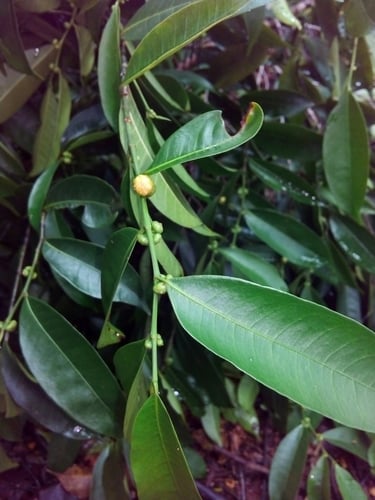
(c) Merav Vonshak, some rights reserved (CC BY-NC), uploaded by Merav Vonshak
gbif· cc-by-nc
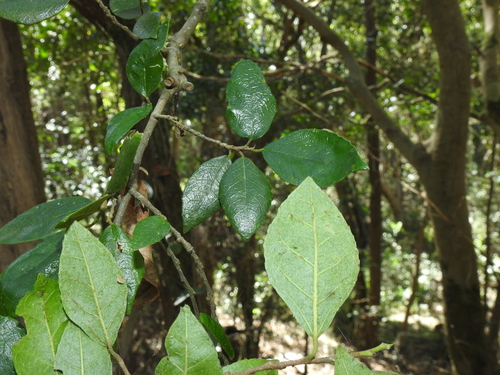
riemi
iNaturalist· cc-by-nc
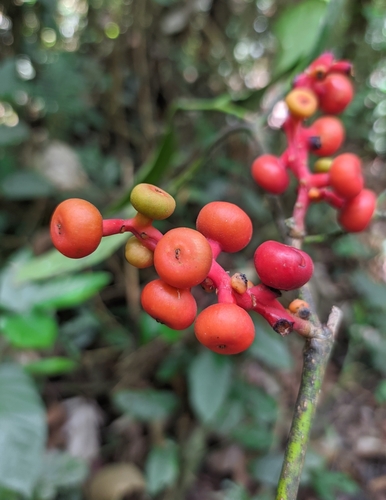
(c) mmkimberly, some rights reserved (CC BY-NC), uploaded by mmkimberly
iNaturalist· cc-by-nc
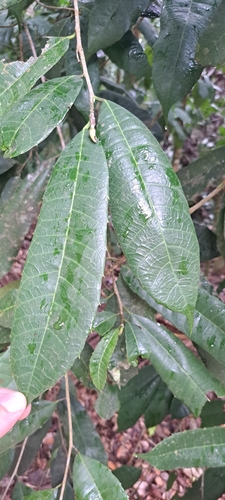
(c) tavita_togia2016, some rights reserved (CC BY-NC)
Summary
Source: WikipediaA fast-growing evergreen tree reaching 18 m (59 ft) in height and spread. Hardy to UK zone 10 and frost-tender. Pollinated by bees; not self-fertile. Adapts to light sandy, medium loamy, and heavy clay soils with good drainage, tolerating poor nutrition and saline conditions. Requires full sun, prefers moist soil, and tolerates strong winds but not maritime exposure.
Description
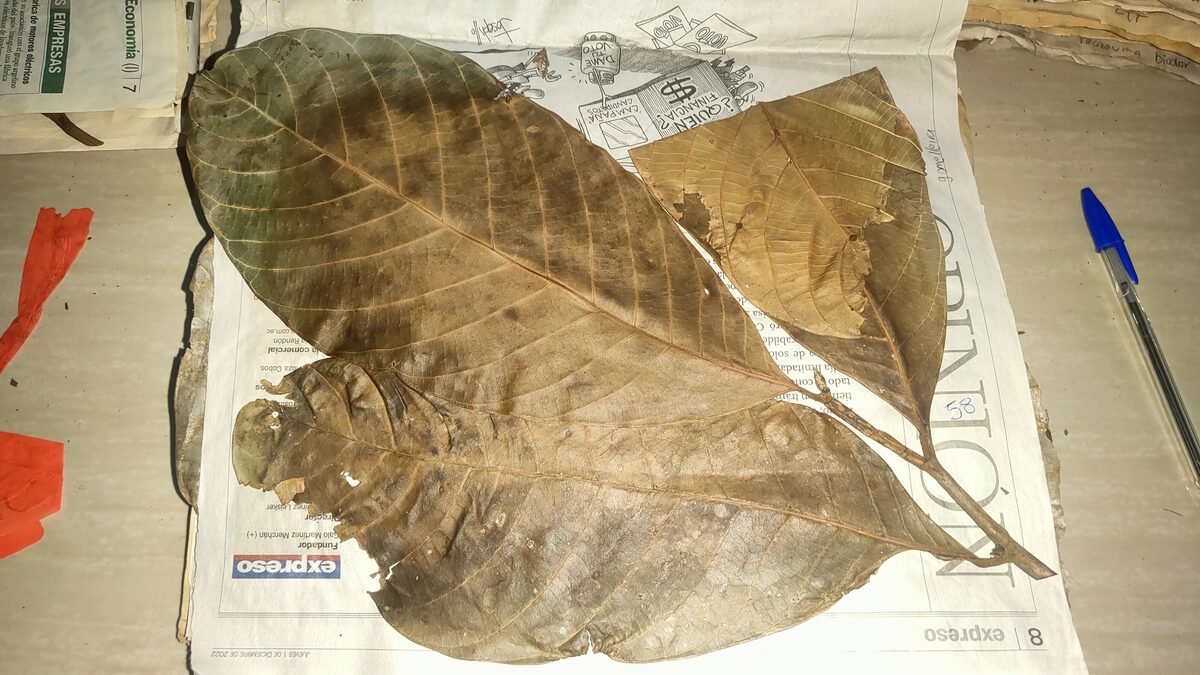
A large tree up to 20-26 m in height. The trunk can be 6 m tall before branching. The trunk can be up to 1 m across. It is an evergreen tree but can lose its leaves in dry weather. The leaves are large and vary in the amount the leaves are divided. They can be entire or divided into 5 to 11 lobes. The leaves are bright green on the upper surface with yellow veins and are pale and dull on the under surface. They have very small stiff hairs underneath. Male and female flowers occur on the same tree. The male flowers are cylindrical spikes which droop and are 12-30 cm long. The female flowers are grouped in a round head. The flower head develops into the compound fruit. The fruit are large and green. They can be 20 cm across. Seeded kinds have spines, and seedless kinds have a more smooth surface. Seeded, small seeded, and non seeded types occur. There are a number of cultivars of each. Seed can be 2 cm across and with darker lines.
Edible Uses
Edible Parts: Flowers Fruit Leaves Seed Edible Uses: Gum Edible portion: Fruit, Seeds, Leaves, Flowers, Vegetable. Breadfruit is a versatile food that can be cooked and eaten at all stages of its development. The fruit can be eaten raw or cooked. The unripe fruit, as small as 2 - 6cm in diameter, is eaten as a starchy vegetable with a flavour similar to that of artichoke hearts. It can be prepared in various ways including boiling, baking, added to soups, pickling etc. Ripe fruits are somewhat sweet and are occasionally eaten raw, but are more often cooked as a starchy vegetable or fermented into a cheese-like food. The mature fruit can be dried and ground into a flour. The mature fruit is about 20cm long. Compared with other staple starch crops, breadfruit is a better source of protein than is cassava; it is comparable to sweet potato and banana. It is a relatively good source of iron, calcium, potassium and riboflavin. Seed - cooked. Firm and close-textured, they are very nutritious, with a flavour somewhat reminiscent of chestnuts. They can be cooked with the raw breadfruit or removed and boiled or roasted. They are usually peeled before being eaten. Both fresh and cooked seeds contain about 8% protein. The seeds are low in fat compared with tree nuts such as almond, brazil nut and macadamia nut, which contain 50 - 70% fat. The seeds are a good source of minerals and contain more niacin than cashews, almonds, macadamia nuts, brazil nuts, pecans, black walnuts or chestnuts. Male inflorescence - cooked and used as a vegetable or used in the preparation of a sweetmeat.
Traditional Uses
The large seeds are roasted and eaten. The flesh of the fruit is eaten cooked. It can be boiled, baked, steamed, mashed, or turned into soups, puddings, cakes and pies. Dried fruit are made into flour. The young leaves are edible. The male and female flowers are edible.
Medicinal Uses
Anticonvulsant Antifungal Antispasmodic Astringent Cancer Digestive Dysentery Purgative Skin Breadfruit has a very wide range of applications in traditional medicine with all parts of the plant being utilised in the treatment of a range of conditions. Research has shown the presence of a number of active compounds in the plant:- The fruit contains artocarpine and the enzyme papayotine. The leaf contains the phenols quercetin and camphorol, plus gamma-aminobutyric acid, which lowers the blood pressure. The stem-bark and fruit contain cyclopropane sterols. The toasted flowers are rubbed on the gums around aching teeth to ease pain. An extract from the flowers is effective in treating ear oedema. Latex is massaged into the skin to treat broken bones, bruises, sprains, abscesses etc, and is bandaged on the spine to relieve sciatica. It is commonly used to treat puncture wounds in the eyes, skin ailments and fungal diseases such as thrush. The latter is also treated with crushed leaves. Diluted latex is taken internally to treat diarrhoea, stomach-ache and dysentery. Latex and juice from the crushed leaves are both traditionally used to treat ear infections. A filtrate of new, unfolded leaves is employed as a remedy for fish poisoning and as a muscle relaxant in cases of convulsive spasms. The yellowing leaf is brewed into a tea and taken to reduce high blood pressure. The tea is also thought to control diabetes. Hypertension and diabetes medications are prepared from a mixture of the boiled leaves of this species combined with Persea americana, Carica papaya and Annona muricata. The leaves are used in Taiwan to treat liver diseases and fevers. The root is an astringent and is used as a purgative. Pressed fluid of the root is used in the treatment of respiratory ailments which include difficult, painful breathing. When macerated it is used as a poultice for skin ailments. The bark is used to treat headache. Bark extracts exhibited strong cytotoxic activities against leukaemia cells in tissue culture, and extracts from roots and stem barks showed some antimicrobial activity against Gram-positive bacteria and may have potential in treating tumours. Liquid squeezed from the bark or leaves is given to remedy chest pains and vomiting resulting from heart trouble. Pressed liquid from the stem bark is employed in the treatment of pain in the bones and maternal postpartum infections. The bark is also used to treat stomach aches and digestive tract problems. Fluid pressed from young fruit is given to treat an illness which causes pain in the lungs and vomiting of blood.
Distribution
A tropical plant. It occurs in the hot, humid, tropical lowlands. The plant is purely tropical and normally below about 650m altitude, but trees grow from sea level up to about 1150 m. Seeded types are more dominant in the west of Papua New Guinea. Trees are killed by temperatures below 5°C. It probably requires an average temperature over 22°C to grow well. It tends to grow in the temperature range 16°C to 38°C. It grows on a range of soils providing they are well drained. It grows on atolls. There is some cultivar difference in drought tolerance and salt tolerance. Uniformly warm humid climates suit it best. An annual rainfall of 200-250 cm and a relative humidity of 70-80% suits. It suits hardiness zone 11-12.
Where It Grows
Africa, Amazon, American Samoa, Andamans, Angola, Antigua and Barbuda, Asia, Australia, Bahamas, Bangladesh, Barbados, Belarus, Belize, Bougainville, Brazil, British Indian Ocean Terr., BIOT, Cambodia, Cameroon, Cape Verde, Caroline Islands, Central Africa, Central America, China, Chuuk, Colombia, Congo DR, Cook Islands, Costa Rica, Cuba, Dominica, Dominican Republic, East Africa, East Timor, Ecuador, Europe, Fiji, French Guiana, French Polynesia, FSM, Gambia, Ghana, Grenada, Guadeloupe, Guam, Guatemala, Guinea, Guinée, Guyana, Haiti, Hawaii, India, Indochina, Indonesia, Jamaica, Japan, Kiribati, Kosrae, Laos, Madagascar, Malaysia*, Maldives, Mariana Islands, Marquesas, Marshall Islands, Martinique, Mauritius, Mexico, Micronesia, Montserrat, Mozambique, Myanmar, Nauru, Netherlands Antilles, New Caledonia, New Zealand, Nicaragua, Nigeria, North America, Niue, Pacific, Palau, Panama, Papua New Guinea*, PNG, Peru, Philippines, Pohnpei, Puerto Rico, Rotuma, Samoa, Sao Tome and Principe, SE Asia, Seychelles, Singapore, Society Islands, Solomon Islands, South America, Sri Lanka, St Kitts and Nevis, St Lucia, St. Vincent and Grenadines, Suriname, Tahiti, Taiwan, Tanzania, Thailand, Timor-Leste, Tokelau, Tonga, Trinidad, Truk, Tuvalu, USA, Vanuatu, Vietnam, Virgin Islands, Wallis & Futuna, West Africa, West Indies, West Papua, Yap,
Cultivation
Seeded forms are self sown by birds or bats, and also grown from seed. The presence or absence of seeds significantly affects the production. Seeded trees are mostly propagated by seed which needs to be sown fresh, without seed drying out. Seedless trees are propagated by root cuttings. Cuttings of roots 1.5 cm to 4 cm across and 25 cm long are suitable. Cuttings can be rooted during the wet season, in sand. They should be placed horizontally. They need to be kept moist and shaded. Using intermittent mist improves root formation and cutting establishment. Rooting hormones also assists. This process takes 10 weeks or more and then rooted cuttings should be hardened off in a sunny position for up to 3 more months before planting out into the field. Young plants do best with adequate sun and not shade. Root suckers produced naturally, or by damaging the roots, are a common method of production of new material. Marcottage or budding can also be used for propagation. The vegetatively propagated trees are therefore clones and the variation is presumably therefore somatic. Fruit set can be improved by dusting male flowers onto female flowers 3 days after they emerge. Because trees often occur from natural seed dispersal by fruit bats and marsupials trees are often randomly spaced and common in secondary forest. A spacing of 10-13m is suitable between trees. Fruit can be 12-22 cm long and 9 - 17 cm wide. The fruit shape varies from round to oblong. Leaves vary from entire to deeply lobed and from rough to smooth and shiny. The central core and the skin are not eaten. Seeded fruit have projecting tuberances on the surface of the fruit. Seedless fruit have rounded or 5 to 6 sided processes on the surface. Male and female flowers grow separately on the same tree. Male flowers form an oblong catkin while female flowers form a globular head. The flowers are in the axils of leaves. Both flowers normally appear at the same time. Artificial pollination has resulted in increased yields in some places. This is both an increase in fruit size and more fruit retained on the tree to maturity. The pollen in the male flower is available 10 to 15 days after emergence. It is about 3 months from flowering to fruit maturity. Seeded fruit have 30 to 90 seeds per fruit. Trees rarely receive much attention after establishment but pruning of branches to allow easier access to fruit is sometimes undertaken. Seedless fruit are picked before maturity when the fruit is eaten by boiling. Harvesting mature fruit can be sweeter fruit but they need to be cooked by baking or roasting. Seeded fruit are normally allowed to drop and are then harvested. Seeds are boiled in salted water or roasted. A mature tree can yield up to 700 fruit per year. The seeds are about 20 % of dry matter as protein with a good nutritional balance. The essential amino acid levels are high for vegetable protein. Fresh fruit are highly perishable and need to be handled carefully and efficiently. Pit preservation of breadfruit involves lactic acid fermentation. The fermentation needs to be undergone for 2 to 3 months to produce a palatable product. Breadfruit slices can be stored under refrigeration in a fresh marketable state at 14°C for up to 10 days. Segments can be boiled for 2 to 5 minutes then frozen at minus 15°C for at least 11 weeks.
Propagation
Seed - best extracted from ripe fruits and sown immediately as they lose viability within a few weeks. They are planted about 5 cm apart and 1 cm deep. The seed germinates best at a temperature of 24 - 27c. Some 85% germinate about 2 weeks after sowing. The germination bed should be kept moist. Seedlings can be transplanted into individual containers as soon as they sprout. They grow quickly and are ready for planting in the field when they are about 1 year old. Root cuttings. These are best collected during the dormant season immediately preceding the renewal of growth, or at the beginning of that period, when carbohydrate stores in roots are highest. The dormant period (2-3 months) begins immediately after the crop ripens. Cuttings of roots 1.5 cm to 4 cm across and 25 cm long are suitable. Cuttings can be rooted during the wet season, in sand. They should be placed horizontally. They need to be kept moist and shaded. Using intermittent mist improves root formation and cutting establishment. Rooting hormones also assists. This process takes 10 weeks or more and then rooted cuttings should be hardened off in a sunny position for up to 3 more months before planting out into the field. Young plants do best with adequate sun and not shade. Root suckers produced naturally, or by damaging the roots, are a common method of production of new material. Marcottage or budding can also be used for propagation. Air layering.
Other Uses
Adhesive Bedding Containers Dye Fibre Fodder Fuel Gum Insecticide Shelterbelt String Waterproofing Weaving Wood Other uses rating: High (4/5). Seaside; shade tree, backyard tree, specimen. Agroforestry Uses: The breadfruit is an important component of traditional agroforestry systems in the Pacific Islands. The trees are integrated into mixed cropping systems with yams and other root crops, Piper methysticum, bananas and some cash crops, especially black pepper and coffee. The tree is sometimes used as a wind-break or shade tree for coffee plantations. Other Uses The male flower spikes are blended with fibre of paper mulberry (Broussonetia papyrifera) to make elegant loincloths. The inner layer of bark, or bast, was used to make bark cloth (tapa). Traditionally it had ceremonial and ritual uses, was also used for beddings and items of clothing such as cloaks, loincloths and robes. Breadfruit bast makes good cordage with a diverse range of uses such as harnesses for water buffalo and nets for catching sharks. The sticky, milky sap is a gum that is used to caulk canoes to make them watertight and can be used as an adhesive to seal and prepare wooden surfaces for painting. A sticky latex is present in all parts of the tree and has many uses. It is used as a chewing gum in the Caribbean and elsewhere. Can be used as an adhesive for bark cloth and for caulking canoes. The latex can be mixed with coconut oil for trapping houseflies. The inflorescence has been used to make a yellow tan to brown dye. The fat extracted from the seed is a light yellow liquid, viscous at room temperature, with a characteristic odour similar to that of peanuts. It has a chemical number and physical properties similar to those of olive oil. The dried, hard flowers can be burned as a mosquito repellent. The leaves are widely used as plates and also to wrap food for cooking and serving. The dried stipules or senescent leaves are slightly rough, and in Hawaii they were used to polish and smooth bowls and nuts strung for decorative purposes. The heartwood is golden speckled with orange, differentiated from the yellow or brownish-yellow sapwood. The golden yellow colour darkens with age. The wood is very light, durable, soft, but quite resistant in spite of its low specific gravity. Traditionally it was widely used for the construction of houses and canoes because of its resistance to termites and marine worms. The wood is also used to make bowls, carvings, furniture and even surfboards. The trees are an important source of firewood in some areas. Special Uses Carbon Farming Food Forest
Production
Trees begin to bear after 3-6 years. Growth of the trees is vigorous, with fruiting starting after about 3 years. Trees grow to 10-15 m in 10-12 years. Mature trees can be 30 m high. Fruiting can occur over 5-8 months in some locations and this is partly due to varieties with overlapping fruit seasons. A tree can produce 50-150 fruit per year. A fruit can weigh 1-1.6 kg each. Large trees can give 700 fruit per year of 1-4 kg each. An average seed weighs 5 g. Fruit are harvested 65-95 days after flowering.
Other Information
A quite important supplementary seasonal food in many coastal areas. The seeded forms are more common in the western part of Papua New Guinea. It is cultivated.
Notes
There are about 50 Artocarpus species. They are in the tropics and subtropics of Asia and the Pacific.
Nutrition
| Part | Moisture | kJ | kcal | Protein | Vit A | Vit C | Iron | Zinc |
|---|---|---|---|---|---|---|---|---|
| Fruit | 74.4 | 506 | 121 | 1.5 | 4 | 25 | 0.4 | 0.2 |
| Leaves | 75.5 | 314 | 75 | 5 | — | — | 17.5 | — |
| Fruit and Seeds | 87.1 | 192 | 46 | 2 | — | — | — | — |
| Seed | — | — | — | — | — | — | — | — |
| Flowers | — | — | — | — | — | — | — | — |
Synonyms
Also Known As
Aire, Arbol del pan, Balape, Baleo, Ban bukeyo, Beregrie, Beta, Bezai, Bia, Bulo, Daewa, Dhel, Era pla, Fruta-pao, Fruta de pan, Frutipan, Guapen, Iirapilakai, Imbuluku, Kamansi, Kapamu, Kapiak, Kastanje, Kekene, Kelewih, Kelor, Kelur, Khanun-sampalor, Khnaor samloo, Kikwa ki santu Petelo, Kula, Kulor, Kulu, Kulu kisa, Kulur, Kuru, Lemae, Lemai, Leme, Lemmai, Ma, Maata, Madar, Mahi, Mai, Mapen, Mbeta, Mbze, Me, Meduu, Mei, Mian bao guo, Mian-boo-kuo, Mshelisheli, Muzuh, Nimbalu, Pakak, Pan del arbol, Pananote, Panapen, Pan de pobre, Pandicho, Pan-no-ki, Pan-no-mi, Paparu, Patai, Paung-mok-thi, Petaa, Petelo, Pitiu nere, Pohon sukun, Rata del, Rauai, Rimas, Rok-rok, Sa-ke, Saa-keh, Saake, Sake, Sakee, Seema panasa, Seema pila, Sika, Silem, Siliman, Sinima, Sirama, Soanambo, Sombee, Sou, Sukun, Te mai, Thou, Timbul, Tubak, Tufah, Ugi, Ulu, Uru, Uto, Uto sori, Vilayati phanas, Xa ke, Yaca
References (316)
- Breadfruit references
- Aalbergsberg,W.G.L., Lovelace,C.E.A.,Madhojik.and Parkinson,S.V., 1988, Davuke, the traditional Fijian method of pit preservation of staple carbohydrate foods. Ecology of Food and Nutrition(USA), 21(3) 173-180.
- Abbiw, D.K., 1990, Useful Plants of Ghana. West African uses of wild and cultivated plants. Intermediate Technology Publications and the Royal Botanic Gardens, Kew. p 42
- Achinewhu, S.C. & Akpapunam, M.A.,1985, Physical and chemical characteristics and refined vegetable oils from rubber seed (Hevea brasiliensis) and breadfruit (Artocarpus altilis). Qualitas Plantarum. Plant Foods for Human Nutrition(Netherlands) 35(2):103-107.
- Ambasta S.P. (Ed.), 2000, The Useful Plants of India. CSIR India. p 56
Show all 316 references Hide references
- Ananthanarayanan, S.,1964, A new leaf blotch of breadfruit from India. Plant Dis. Repty. 48:292-293.
- Arora, R. K., 2014, Diversity in Underutilized Plant Species - An Asia-Pacific Perspective. Bioversity International. p 58
- Ashton, M. S., et al 1997, A Field Guide to the Common Trees and Shrubs of Sri Lanka. WHT Publications Ltd. pdf p 276
- Atchley, J.,& Cox, P.A., 1985, Breadfruit fermentation in Micronesia. Econ. Bot. 39(3):326-335.
- Backer, C.A.& Brink, B van den, 1968, Flora of Java p18
- Barrau, J., 1957, J. Agr. Trop. Bot. Appli. 4:119
- Barrau, J., 1958, Subsistence Agriculture in Melanesia. Bishop Mus. Bull., 219:59.
- Barrau, J., 1976, Subsistence Agriculture in Polynesia and Micronesia. Bernice P. Bishop Museu, Bulletin 223 Honolulu Hawaii. Kraus reprint. p 51
- Barrau, J., 1962, Les plantes alimentaires de l’Oceanie, Origines, distribution et usages. Marseille.
- Barrau, J., 1979, Breadfruit and relatives, in Simmonds N.W.,(ed), Crop Plant Evolution. Longmans. London. p 201
- Barrow, J., 1831, The Mutiny of the Bounty. Reprinted London:Blackie.
- Barwick, M., 2004, Tropical and Subtropical Trees. A Worldwide Encyclopedic Guide. Thames and Hudson p 34
- Batet, K., Koil, U., and Hertel, H., 1998, Traditional Plant Use by the Didipa Clan, Baitabag, Papua New Guinea. GDS. p 19
- Baum, 1904, The Breadfruit reprinted from The Plant World Vols. 6 & 7. Washington.
- Bennett, B. C., 1990, Useful Plants of Amazonian Ecuador. US Agency for International Development. Fifth Progress Report. New York Botanical Gardens. p 39
- Bennett, F.D. & Nozzolillo, C., 1987, How many Seeds in a Seeded Breadfruit, Artocarpus altilis (Moraceae)? Econ.Bot 41:370-374.
- Bennett, G., 1860, Gatherings of a Naturalist in Australasia. p 396.
- Berven, J.M., 1966, Dieback of breadfruit trees in the Gilbert Is., South Pacific Commission Plant & Animal Quarantine Rept. Service Circular No 25 June 16, 1966.
- Bircher, A. G. & Bircher, W. H., 2000, Encyclopedia of Fruit Trees and Edible Flowering Plants in Egypt and the Subtropics. AUC Press. p 42
- Blanco, 1837, Arctocarpus camansi & A.rima Fl.Filip.670,671.
- Blench, R., 2004, Fruits and Arboriculture in the Indo-Pacific Region. Indo-Pacific Prehistory Association Bulletin 24. (Taipei Papers Volume 2) p 34
- Bligh, , Voyage to the South Sea.
- Bodkin, F., 1991, Encyclopedia Botanica. Cornstalk publishing, p 105
- Bodner, C. C. and Gereau, R. E., 1988, A Contribution to Bontoc Ethnobotany. Economic Botany, 43(2): 307-369
- Bois, ,1927, Les Plantes Alimentaires, 1:449-452.
- Borrell, O.W., 1989, An Annotated Checklist of the Flora of Kairiru Island, New Guinea. Marcellin College, Victoria Australia. p 104
- Bourke, R. M., Altitudinal limits of 230 economic crop species in Papua New Guinea. Terra australis 32.
- Bourret, D., 1981, Bonnes-Plantes de Nouvelle-Caledonie et des Loyaute. ORSTOM. p 14
- Bowers, R.D., 1981, Breadfruit: a low energy requirement source of carbohydrate for the wet tropics. Entwicklung und Landlicher Raum (Germany F.R.) 15(2):11-13.
- Bradacs, G., 2008, Ethnobotanical Survey and Biological Screening of Medicinal Plants from Vanuatu. PhD thesis Frankurt University. p 101
- Brandis, D., 1874, Forest Flora of North West and Central India. p426.Kew Herb., London.
- Brass, , 1956, Bull.Am.Mus. Nat.Hist. 111:97
- Bravo, E.N.de, Graham, H.D., & Padovani,M., 1983, Composition of the breadnut (seeded breadfruit). Caribbean Journ. Sci. (PuertoRico) 19(3/4):27-32
- Brouk, B., 1975, Plants Consumed by Man. Academic Press, London. p 87
- Brown, F.B.H.,1933, Flora of SouthEastern Polynesia 111, Dicots.p37. Bishop Museum Bulletin 128.
- Brown, W.H., 1920, Wild Food Plants of the Philippines. Bureau of Forestry Bulletin No. 21 Manila. p 40
- Brown, W.H., 1941, Artocarpus communis Forst. in Useful plants of the Philippines. Department of Agriculture and Natural Resources. Vol 1 Manila. p 457-459.
- Bruyere, A and Ergo, A.B., 1986,[ An analytical bibliography of breadfruit(Artocarpus altiles ) ]L’arbre a pain Artocarpus altilis Fosb.: bibliographe analytique. CIDAT, Musee Royal de l’Afrique Centrale, Tervuren, Belgium. Abstr.Trop.Ag. 59779
- Burkill, H. M., 1985, The useful plants of west tropical Africa, Vol. 4. Kew.
- Burkill, I.H., 1935, A Dictionary of the Economic Products of the Malay Peninsula. p 251-253
- Cabalion, P. and Morat, P., 1983, Introduction le vegetation, la flore et aux noms vernaculaires de l'ile de Pentcoste (Vanuatu), In: Journal d'agriculture traditionnelle et de botanique appliquee JATBA Vol. 30, 3-4
- Call, C. A., et al, 2004, Participatory Rural Appraisal in the Upland Ecosystem of Mt Malindang, Misamis Occidental, Philippines. Biodiversity Research Programme for Development in Mindanao. p 57
- Carig, Elizabeth T., 2020, Guidebook on Native Trees within the Quirino Forest Landscape. Plaridel, Bulacan, St. Andrew Publishing House. p 101
- Chai, P. P. K. (Ed), et al, 2000, A checklist of Flora, Fauna, Food and Medicinal Plants. Lanjak Entimau Wildlife Sanctuary, Sarawak. Forestry Malaysia & ITTO. p 168
- Chandler, W.H., 1950, Evergreen Orchards. Lea & Febinger, Philadelphia.
- Chandrashekara, U. M., 2009, Tree species yielding edible fruit in the coffee-based homegardens of Kerala, India: their diversity, uses and management. Food Sec. 1:361-370 (As Artocarpus incisa)
- Cheifetz, A., (ed), 1999, 500 popular vegetables, herbs, fruits and nuts for Australian Gardeners. Random House p 171
- Chevalier, A.,1940, L’arbre a Pain et ses Congeneres. Revue Bot.Appl. Agr. Trop. 20:29.
- Chin, H.F., & Yong, H.S., 1996, Malaysian Fruits in Colour. Tropical press, Kuala Lumpur p 28
- Christian, ,1897, Journ. Polynes. Soc. 6:127.
- Christian, F.W.,1899, The Caroline Islands. 386.
- Christian, F.W., Eastern Pacific Islands. 208.
- Christopherson, E.,1935, Flowering Plants of Samoa. Bishop Mus.Bull. 128:72.
- Clarke, W.C. & Thaman, R.R., 1993, Agroforestry in the Pacific Islands: Systems for sustainability. United Nations University Press. New York. p 223
- Conn, B. & Damas, K.. Guide to trees of Papua New Guinea. http:/www.pngplants.org/PNGtrees
- Cobley, L.S.(rev.W.M.Steele), 1976, An Introduction to the Botany of Tropical Crops. Longmans. p188
- Coe, F. G. & Anderson, G. J., 1997, Ethnobotany of the Miskitu of Eastern Nicaragua. Journal of Ethnobiology 17(2): 171-214
- Coe, F. G. and Anderson, G. J., 1999, Ethnobotany of the Sumu (Ulwa) of Southeastern Nicaragua and Comparisons with Miskitu Plant Lore. Economic Botany Vol. 53. No. 4. pp. 363-386
- Coenan, J. & Barrau, J., 1961, The Breadfruit Tree in Micronesia. South Pacific Bulletin, Oct,37-39.
- Cook, A.A.,1975, Diseases of Tropical and Subtropical fruits and nuts. Hafner Press p93.
- Cook, , 1773, Voyage 3:207.
- Corner, E.J.H., 1939, Gard. Bull, Singapore. 10:280.
- Corner, E.J.H., 1962, The Classification of Moraceae. Gardens Bull. Singapore 19:187-252
- Coronel, R.E., 1982, Fruit Collections in the Philippines. IBPGR Newsletter p 6, 9 (As Artocarpus communis)
- Cox, P.A., 1980a, Two Samoan technologies for breadfruit and banana preservation. Econ.Bot. 34(2):121-185.
- Cox, P.A., 1980b, Masi and Tanu’eli: ancient Polynesian technologies for the preservation and concealment of food. The Bulletin, Pacific Tropical Botanical Garden 10(4):81-93.
- Crawfurd, 1820, History Ind.Archipel. 1 p413.
- CURREY
- Dalziel, J., 1955, Artocarpus communis Forst. in Useful Plants of West Africa.
- D'Ambrosio, U., & Puri, R. K., 2016, Foodways in transition: food plants, diet and local perceptions of change in a Costa Rican Ngäbe community. Journal of Ethnobiology and Ethnomedicine (2016) 12:3 p 26
- Darley, J.J., 1993, Know and Enjoy Tropical Fruit. P & S Publishers. p 75
- Darwin, C.,1893, The Variation of Animals and Plants under Domestication. 2 vols. 2:256.
- De Candolle, A.P., 1840, Vegetable Organography 2:174 New York 2 Vols
- De Candolle, A.P. 1882, Orig. Pl. Cult. 238.
- Diels, 1935, Artocarpus leeuwenii Bor. Jahrb. 67:175
- Duarte, M. C., et al, 2022, Diversity of Useful Plants in Cabo Verde Islands: A Biogeographic and Conservation Perspective. Plants 2022, 11, 1313 p 14
- Elevitch, C.R.(ed.), 2006, Traditional Trees of the Pacific Islands: Their Culture, Environment and Use. Permanent Agriculture Resources, Holualoa, Hawaii. p 89
- Engel, D.H., & Phummai, S., 2000, A Field Guide to Tropical Plants of Asia. Timber Press. p 70
- Englberger, L., et al, 2006, Documentation of the traditional food system of Pohnpei. Indigenous People's food systems. Chp 6 p 119
- Engler, , 1886, Bot.Jahrb. 7:451.
- Etherington, K., & Imwold, D., (Eds), 2001, Botanica's Trees & Shrubs. The illustrated A-Z of over 8500 trees and shrubs. Random House, Australia. p 106
- Fabello., 1934, Propagation of certain species of Artocarpus by marcottage. Abstr. in Philipp. Agric., 1934,23:162-3.
- Facciola, S., 1998, Cornucopia 2: a Source Book of Edible Plants. Kampong Publications, p 153
- Figuera, 1595, In Mendana’s Voyage to the Marquesas Islands.
- Flavelle, A. J., 1991, A Traditional Agroforestry Landscape on Fergusson Island, Papua New Guinea. M. Sc. Univ. of British Columia. p 146
- Flora of Taiwan p118.
- Flowerdew, B., 2000, Complete Fruit Book. Kyle Cathie Ltd., London. p 155
- Focho, D. A., et al, 2009, Ethnobotanical survey of Trees in Fundong, Northwest Region, Cameroon. Journal of Ethnobiology and Ethnomedicine, 5:17
- Forster, J.R.& G., 1776, Artocarpus communis Char.Gen.101.t.51,51a.
- Forster, J.R.,1778, Observations made during a voyage around the world, on Physical Geography, Natural History, and Ethic Philosophy p 179. London.
- Fosberg, F.R., 1939, Nomenclature Proposals for the 1940 Botanical Congress. Am.Journ. Bot. 26:229-231.
- Fosberg, F.R., 1941, Names in Amaranthus, Artocarpus and Inocarpus. Jour. Wash.Acad. Sci. 31:95.
- Fosberg, F.R.,1946, Botanical Report on Micronesia. U.S. Commercial Company Economic Survey of Micronesia.
- Fosberg, F.R., 1960 Brittonia 12,101-113.
- Franklin, J., Keppel, G., & Whistler, W., 2008, The vegetation and flora of Lakeba, Nayau and Aiwa Islands, Central Lau Group, Fiji. Micronesica 40(1/2): 169–225, 2008
- French, B., 1986, Food Plants of Papua New Guinea, Asia Pacific Science Foundation p 28
- French, B.R., 2010, Food Plants of Solomon Islands. A Compendium. Food Plants International Inc. p 172
- Friday, J. B., 2005, Forestry and Agroforestry Trees of East Timor. http://www.ctahr.hawaii.edu/forestry/data/Timor/Timor trees.html
- Garner, R.J., and Chaudhri, S.A., (Ed.) 1976, The Propagation of Tropical fruit Trees. FAO/CAB. p 248
- Gerlach, W.W.P., Salevao, F., 1984, Fruit rot of breadfruit,Artocarpus altilis, caused by Phytophthora palmivora in Western Samoa. Alafua Agricultural Bulletin 9(2)21-26.
- Glassman, , 1952, Bishop Museum Bull. 209:11.
- Gohre, A., et al, 2016, Plants from disturbed savannah vegetation and their usage by Bakongo tribes in Uíge, Northern Angola. Journal of Ethnobiology and Ethnomedicine (2016) 12:42
- Hamilton, R.A., Criley, R.A.,Chia, C., 1982, Rooting of stem cuttings of breadfruit (Artocarpus altilis [Parkins.] Fosb.) under intermittent mist. Combined Proceedings, International Plant Propagators’ Society 32,347-350. Hawaii University. (Hort.Abstr.84 no 4137)
- Harrison, , 1916, Rep. Dep. Sci., and Agric. Brit. Guiana p51.
- Hartley, T.G., A Survey of New Guinea Plants for Alkaloids. Lloydia 36(3):240.
- Havel, J.J., 1975, Forest Botany, Volume 3 Part 2 Botanical taxonomy. Papua New Guinea Department of Forests, p 49
- Hazarika, B. et al. (2020). An overview of the unexplored underutilized fruit crops of Assam, India. Journal of Applied and Natural Science, 12(3): 442 - 453
- Hearne, D.A., & Rance, S.J., 1975, Trees for Darwin and Northern Australia. AGPS, Canberra p 25, Pl 6
- Hedrick, U.P.(ed), 1919, Sturtevant’s Edible Plants of the World p 67. (Also as Artocarpus incisa)
- Henderson, C.P. and I.R.Hancock, 1988, A Guide to the Useful Plants of the Solomon Islands. Res. Dept. Min of Ag. & Lands. Honiara, Solomon Islands. p 36
- Henry, T., 1928, Ancient Tahiti. Bishop Mus. Bull. 48:39.
- Hermano, A.J., & Sepulveda, G. (Jr.), 1934, The vitamin contents of Philippine foods 111, Vit B in various fruits & vegs.. Philipp.J.Sci., 54:61-73.
- Heyne, , 1950, Nutt. Pl. Indonesia ed 3.555.
- Holloway, W.D., Monro, J.A., Gurnsey, J.C., Pomare, E.W. & Stace, N.H., 1985, Dietary fibre and other constituents of some Tongan foods. Journal of Food Science. 50(6) 1756-1757.
- Hooker, W.J.,1828, Bot.Mag. 55:t2869.71.
- Howard, 1953, Scientific American 188:88.
- Hunter, , , Journ. Roy. As. Soc. Straits Branch 53 p113.
- Hu, Shiu-ying, 2005, Food Plants of China. The Chinese University Press. p 355
- Huxley, A. (Ed.), 1977, The Encyclopedia of the Plant Kingdom. Chartweil Books. p 63
- Ibanez, M.L.,1968, The effect of cold on tropical seeds. Turrialba 18:73-4.
- IBPGR Genetic Resources of Tropical and Sub-tropical fruits and nuts. p58-62, Artocarpus altilis & A.heterophyllus.
- Janaki-Ammal, 1945, Darlington and Janaki-Ammal, Chromosome Atlas, 184.
- Jardin, C., 1970, List of Foods Used In Africa, FAO Nutrition Information Document Series No 2.p 11
- Jarrett, F.M.,1959, Studies in Artocarpus and allied genera 111. A revision of Artocarpus subgenus Artocarpus. J.Arn.Arbor.XL(2):113-363.
- Jarrett, F.M.,1977, The syncarp of Artocarpus. A unique biological Phenomenon. Gardens Bulletin (Singapore) 29:35-39.
- Johns, L. & Stevenson,V., 1979, The Complete Book of Fruit. p 90. Angus and Robertson. Julien, J.H., 1945, Propagation of breadfruit (Artocarpus incisa) by the “solar propagator” Rev. agric. Maurice 24:31-3.
- J. Wash. Acad. Sci. 31:95. 1941
- Kamel, G.J., 1704, Rhymay Marianorum in Ray, Hist.Pl.3:App.52.
- Kanehira, , 1935, Journ.Dept.Agric.Kyushu Univ. 4:306
- Khan, J.F., 1945, Propagation of seedless breadfruit. Indian J.Hort. 3(1):44
- Kiple, K.F. & Ornelas, K.C., (eds), 2000, The Cambridge World History of Food. CUP p 1737
- Koroiveibau, 1967, Dept. of Agric., Fiji, Bull.46.
- Koshihara, Y., Fujimoto,Y., Inoue, H., 1988, A new 5-lipoxygenase selective inhibitor derived from Artocarpus communis strongly inhibits arachidonic acid-induced ear edema. Biochemical Pharmacology 37(11) 2161-2165.
- Kuete, V. et al, 2011, Antimicrobial activities of the methanol extract and compounds from Artocarpus communis (Moraceae). Complementary and Alternative Medicine, 11:42
- Kuhnlein, H. V., et al, 2009, Indigenous Peoples' food systems. FAO Rome p 119
- Kuo, W. H. J., (Ed.) Taiwan's Ethnobotanical Database (1900-2000), http://tk.agron.ntu.edu.tw/ethnobot/DB1.htm (As Artocarpus incisa)
- Lam, , 1934, Blumea 1:120 map
- Lane-Poole, 1925, Forest Resources of Papua & New Guinea, 81.
- Latham, P., 2004, Useful Plants of Bas-Congo province. Latham & DFID p 41
- Latham, P. & Mbuta, A. K., 2014, Useful Plants of Bas-Congo Province, Democratic Republic of Congo. Volume 1. Salvation Army. p 60
- Latham, P. & Mbuta, A. K., 2017, Plants of Kongo Central Province, Democratic Republic of Congo. Volume 1. 3rd ed p 66
- Lauterbach, 1930, Bot.Jahrb. 63:421, 438, 444, 447.
- Lautenschläger, T., et al, 2018, First large-scale ethnobotanical survey in the province of Uíge, northern Angola. Journal of Ethnobiology and Ethnomedicine (2018) 14:51
- Lawrence, P., 19 , Breadfruit Cultivation Practices and Beliefs in Ponape.
- Lazarides, M. & Hince, B., 1993, Handbook of Economic Plants of Australia, CSIRO. p 26
- Lembogi Biologi Nasional, 1980, Sayur-sayuran. Balai Pustaka, Jakarta. p 70
- Leon, J., 1968, Fundamentos Botanicos de Los Cultivos Tropicales p 290
- Lepofsky, D., 1992, Arboriculture in the Mussau Islands, Bismarck Archipelago. Economic Botany, Vol 46, No. 2, pp. 192-211
- Liefting, A., et al, Samoan plant names. http://en.wikipedia.org
- LIPI ,1977, Sayur-Sayuran p 70 Lembaga Biologi Nasional LIPI
- Little, E. L. & Wadsworth, F. H., 1964, Common Trees of Puerto Rico and the Virgin Islands. USDA Agriculture Handbook No. 249
- Loh, D.W., 1977, in Hale, P.R.(ed), 1977, Liklik buk p31. Melanesian Council of Churches.
- Lopez, C.R. & Rodriguez, S.J., 1974, A Mehtod to Obtain Relatively Uniform Breadfruit Trees from a Stockplant. J.Agric.Univ. Puerto Rico.
- Lorenzi, H., Bacher, L., Lacerda, M. & Sartori, S., 2006, Brazilian Fruits & Cultivated Exotics. Sao Paulo, Instituto Plantarum de Estuados da Flora Ltda. p 434
- Low, , 1836, Soil and Agric. Penang. p225.
- Lunan, J., 1814, Hortus Jamaicensis 1:113 2 vols Jamaica
- MacCaughey, ,1917, Torreya 17:37
- MacKenzie J.B. & Bikjle, T., 1960, Breadfruit Cultivation Practices and Beliefs in the Marshall Islands. Anthropology Working Papers (Guam).
- McKnight, R.K., Obak, A and Emesiochl, M., 1960, Breadfruit Cultivation Practices and Beliefs in Palau. Anthropology Working Papers (Guam).
- Macmillan, H.F. (Revised Barlow, H.S., et al) 1991, Tropical Planting and Gardening. Sixth edition. Malayan Nature Society. Kuala Lumpur. p 291
- Marriott, J., Perkins, C., & Been B.O., 1979, Some factors affecting the storage of fresh breadfruit. Scientia Horticulturae (Neths.) 10(2):177-181.
- Martin, F. W., et al, 1987, Perennial Edible Fruits of the Tropics. USDA Handbook 642 p 37
- Massal, E and Barrau, J., 1973, Food Plants of the South Sea Islands. SPC Technical Paper No 94. Nounea, New Caledonia. p18-21.
- Maxwell, A, et al, 2012, Morphological diversity in breadfruit (Artocarpus, Moraceae): insights into domestication, conservation, and cultivar identification. Genetic Resources and Crop Evolution. Published on line 22 May, 2012.
- McMakin, P.D., 2000, Flowering Plants of Thailand. A Field Guide. White Lotus. p 107
- Menninger, E.A., 1977, Edible Nuts of the World p 72 Horticultural Books.
- Merrill, 1912, Fl. Manilla, 176.
- Merrill, , 1923, Enum. Philipp. Pl. 2:40.
- Merrill, ,1954,Chron. Bot. 14:359.
- Miguel, E., et al, 1989, A checklist of the cultivated plants of Cuba. Kulturpflanze 37. 1989, 211-357
- Miklouho-Maclay, , 1885, Proc. Linn.Soc. New South Wales 10:348.
- Miller, C.D., 1929, Food value and chemical composition of Breadfruit, Taro leaves, coconuts and sugarcane. Bernice P Bishop Museum Bulletin 64.
- Milliken, W., 2,000, Ethnobotany of the Yali of West Papua. Royal Botanic Garden, Edinburgh (near Baliem)
- Miquel, , 1859, Artocarpus incisa L.f. B.Laevis. Fl. Ind. Bat. 1(2):285
- Monro, J.A., Holloway, W..D., & Lee, J., 1986, Elemental analysis of fruit and vegetables in Tonga. Journal of Food Science 51(2) 522-523.
- Moreira, R de A.;Oliveira J.T.A.de, 1983, Lectins from the genus Artocarpus. Biologia Plantarum 25(5) 343-348
- Moreira, R. de A.; Oliveira, J.T.A.de, 1983, Comparative studies of seed proteins of the genus Artocarpus with respect to lectins. Biologia Plantarum 25(5),336-342.
- Morriss, N., 1960, Report on the breadfruit malady at Pingalap Islet Jaluit Atoll, Maya, 1960. Office of High Commissioner, Trust Territory of the Pacific Islands, Saipan.
- Morton, J. F., 1987, Fruits of Warm Climates. Wipf & Stock Publishers p 50
- Muzik, T.J., 1948, Effects of Hormones on Root Formation in Artocarpus communis. Science 167:225.
- Naik, K.C., 1949, South Indian Fruits and their culture, p 438. Vanadachary, Madras.
- Neal, C.M., 1965, In Gardens of Hawaii. p302 Bishop Museum Press.
- Negron de Bravo, E., Graham, H.D., & Padovani, M., 1983, Composition of the breadnut (seeded breadfruit). Carib. J.Sci.19:27-32
- Nishiyama and Kondo, , 1942, Seiken Ziha 1:26.
- Nombo, P. & Leach, J. 2010, Reite Plants: An Ethnobotanical Study in Tok Pisin and English. ANU press. p 111
- Nyadanu, D., et al, 2015, Agro-biodiversity and challenges of on-farm conservation: the case of plant genetic resources of neglected and underutilized crop species in Ghana. Genet. Resourc. Crop Evol. 62(7):
- Ochse, J.J. et al, 1931, Vegetables of the Dutch East Indies. Asher reprint. p 488
- Ochse, J.J., 1931, Fruits and Fruit Culture in the Dutch East Indies.p67.
- Ochse, J.J., Dijkman, M.J., Soule, M.J. & Wehlburg, C., 1961, Breadfruit. in Tropical and Subtropical Agriculture. p 647-649.
- O’Connor, B.A., 1969, Exotic plant pests and diseases SPC Noumea, New Caledonia.
- Omawale, 1973, Guyana's edible plants. Guyana University, Georgetown p 85
- Otanes, R.T. & Ruiz, T.P., 1956, Propagation of rimas (breadfruit) by root cuttings. Araneta J.Agric., 3(2):56-66.
- Parham, , , Plants of the Fiji Is..
- Parham, B. E. V., 1971, The Vegetation of the Tokelau Islands with special reference to the Plants of Nukunonu Atoll. New Zealand Journal of Botany. 9:4, 576-609
- Parham, B. E. V., 1972, Plants of Samoa. New Zealand Department of Scientific and Industrial Research. Information Series. No. 85 p 137
- Parkinson, S., 1773, Sitodium-altile in A Journal of the Voyage to the South Seas, in His Majesty’s Ship, The Endeavour.45.
- Parsons, , 1933 Food Crops of the Tropics. Tropical Agriculturalist, 285-287.
- Passam, H.C., Maharaj, D.S. & Passam, S., 1981, A note on freezing as a method of storage of breadfruit slices. Tropical Science(UK) 23(1):67-74.
- Paul, A., 2013, Minor and uncultivated fruits of Eastern India, 2nd International Symposium on Minor Fruits and Medicinal Plants
- Pawera, L., et al, 2020, Wild Food Plants and Trends in Their Use: From Knowledge and Perceptions to Drivers of Change in West Sumatra, Indonesia, Foods. 2020, 9, 1240
- Payne, S., & W.J.A., 1979, Cooking with Exotic Fruit p19 Batsford, London
- Paz, F. S., et al, 2021, Edible Fruit Plant Species in the Amazon Forest Rely Mostly on Bees and Beetles as Pollinators. Journal of Economic Entomology, XX(XX), 2021, 1–13
- Peekel, P.G., 1984, (Translation E.E.Henty), Flora of the Bismarck Archipelago for Naturalists, Division of Botany, Lae, PNG. p 132
- Penafield Anchundia, D. D., 2017, Traditional food consumption and its nutritional contribution in Guasaganda, Central Ecuador. PhD Ghent University p 72
- Penrose, 1952, Travel and Discovery in the Renaissance, 1420-1620. p165.
- Peralta,de, ,1928, Philipp. Agric. 17:334.
- Perry, F., and Hay, R., 1982, Guide to Tropical and Subtropical Plants. Sun Books p 12
- Peschel, O., 1876, The Races of Man and Their Geographical Distribution. p 156. New York.
- Phon, P., 2000, Plants used in Cambodia. © Pauline Dy Phon, Phnom Penh, Cambodia. p 50
- Pieraerts, , 1923, A propos de l’Arbre a pain. L’Agron.Colon. 66,1923:172-179.
- Pitojo, S., 1992, Sukun, Penerbit Kanisius, Jogyakarta
- Plants of Haiti Smithsonian Institute http://botany.si.edu/antilles/West Indies
- Poponoe, W., 1920, Manual of Tropical and Subtropical Fruits. Macmillan. p 406.
- Primack, R.B.,1985, Comparative studies of fruits in wild and cultivated trees of chempedak (Artocarpus integer) and terap (Artocarpus odoratissimus) in Sarawak, East Malaysia with additional information on the reproductive biology of the Moraceae in Southeast Asia. Malayan Nature Journal 39(1):1- 39.
- Priyadi, H., et al, Five hundred plant species in Gunung Halimun Salak National Park West Java. A checklist including Sundanese names, distribution and use. CIFOR, FFPRI, SLU p 158
- PROSEA (Plant Resources of South East Asia) handbook, Volume 2, 1991, Edible fruits and nut. p 80
- Purseglove, J.W., 1968, Tropical Crops:Dicotyledons p 379.
- Quijano, J., & Arango, G.J., 1979, The breadfruit from Colombia - A detailed chemical analysis. Economic Botany 33(2):199-202.
- Quisumbing, , 1940, Philipp. Journ. Sci. 70:331.
- Rajapaksha, U., 1998, Traditional Food Plants in Sri Lanka. HARTI, Sri Lanka. p 298
- Rand, and Brass, ,1940, Bull.Am.Mus. Nat. Hist. 77:366,376.
- Rand, and Brass, ,1942, Bull. Am. Mus. Nat. Hist. 79:233,235.
- Robley, , 1802, Trans. Soc. Arts 20:357.
- Roa, J. A. G. & Boada, D. S. G., 2018, Fundación para el Fortalecimiento de la Fruticultura y Plantas Alimenticias no Convencionales en Colombia.
- Rosero-Toro, et al, 2018, Cultural significance of the flora of a tropical dry forest in the Doche vereda (Villavieja, Huila, Colombia). Journal of Ethnobiology and Ethnomedicine (2018) 14:22 p 12
- Rowe-Dutton, P., 1976, in Garner,R.J.et al, The Propagation of Tropical Fruit Trees. p248 FAO/CAB
- Roy, A.N., Sharma, R.B., Sinha, H.P., 1984, Post harvest decay of fruits. Indian Journal of Mycology and Plant Pathology, 13(1) 66.
- Rumphius, , 1741, Soccus lanosus Herbarium Amboinense 1:110t.32
- Safford, W.E., 1905, Useful Plants of Guam. Contr. U.S. Nat. Herb. 9:55,190
- Sagot et Raoul, 1893, Manuel des Cultures tropicales p 233 Paris.
- Sanchez Lopez, L.A., Torres Mondedero,R., Salazar Castro, R. Rios Castano D., 1985, Performance of forty tropical fruit species not cultivated commercially in Colombia. Revista Instituto Colombiano Agropecuario 20(1),1-12. Hort Abstr. ‘87 No.9011
- Schuler, S., (Ed.), 1977, Simon & Schuster's Guide to Trees. Simon & Schuster. No. 185
- Schneider, E., 2001, Vegetables from Amaranth to Zucchini: The essential reference. HarperCollins. p 112
- Seeman, B., 1868, Flora Vitiensis, 255.
- Segura, S., et al, 2018, The edible fruit species in Mexico. Genet Resour Crop Evol (2018) 65:1767–1793
- Selvam, V., 2007, Trees and shrubs of the Maldives. RAP Publication No. 2007/12 p 30
- Seurat, , 1903, Le Popoi en Oceania. Bull.de la Societe de Pharmacologie, 7:315
- Sharma, B.B., 2005, Growing fruits and vegetables. Publications Division. Ministry of Information and broadcasting. India. p 29 (As Artocarpus incisa)
- Simmonds, N.W., 1976, Evolution of Crop Plants.p201 Longman.
- Singh,S., Krishnamurthi, S., & Katyal, S.L., 1963, Fruit Culture in India. New Delhi: Ind.Counc.Agric. Res.
- Smith, K., 1998. Growing Uncommon Fruits and Vegetables. New Holland. p 75
- Sonnerat, , 1776, rima.Voy. Nouv.Guin. 99,t 57-60
- Solomon, C., 2001, Encyclopedia of Asian Food. New Holland. p 46 (As Artocarpus communis) - Good recipes.
- Standley & Steyermark, , 1946, Fieldiana Bot. 24(4):12
- Staples, G.W. and Herbst, D.R., 2005, A tropical Garden Flora. Bishop Museum Press, Honolulu, Hawaii. p 403
- Stephens, S.E., 1935, Some Tropical fruits. 4 The breadfruit. Qld.agric.J. 44:778-80
- St John, , 1948, Pacific Sci. 2:109
- St John, 1972, The scientific names in the German edition of Parkinson’s plants of use for food, medicine etc. in Otaheite Biol.J.Linn.Soc.,4:305-310.
- Stone, B., 1959, Pacific Sci. 13:89, 90, 100.
- Sujanapal, P., & Sankaran, K. V., 2016, Common Plants of Maldives. FAO & Kerala FRI, p 43
- Sukarya, D. G., (Ed.) 2013, 3,500 Plant Species of the Botanic Gardens of Indonesia. LIPI p 136
- Surya Nath Misae. 1988, Storage of farm products in rural Papua New Guinea. Agr.Mech. in Asia, Afr. and Latin Am. 19(3),58-64.
- Suwardi, A. B., et al, 2020, Ethnobotany and conservation of indigenous edible fruit plants in South Aceh, Indonesia. Biodiversitas Vol. 21, No. 5, pp 1850-1860
- Tanaka, T., 1976, Tanaka’s Cyclopedia of Edible Plants of the World p66
- Tankard, G., 1990, Tropical fruit. An Australian Guide to Growing and using exotic fruit. Viking p 28
- Tate, D., 1999, Tropical Fruit. Archipelago Press. Singapore. p 26
- Tavares, ,1915, Broteria, Ser.Vulg.Sci. 13:25
- Terashima, H., et al, 1992, Ethnobotany of the Lega in the Tropical Rainforest of Eastern Zaire (Congo): Part Two, Zone de Walikale, African Study Monographs, Suppl. 19:1-60
- Terra, G.J.A., 1973, Tropical Vegetables. Communication 54e Royal Tropical Institute, Amsterdam, p 26
- Terra, G.J.A., 1973, Tropical Vegetables. Communication 54e Royal Tropical Institute, Amsterdam, p 26 (As Artocarpus camansi)
- Thaman, R.R., 1976, The Tongan Agricultural System, University of the South Pacific, Suva, Fiji. p 381
- Thaman, R. R., 1987, Plants of Kiribati: A listing and analysis of vernacular names. Atoll Research Bulletin No. 296
- Thaman, R. R., et al, 1994, The Flora of Nauru. Atoll Research Bulletin No. 392. Smithsonian Institute p 170
- Thaman, R. R, 2016, The flora of Tuvalu. Atoll Research Bulletin No. 611. Smithsonian Institute p 100
- Thomas,C.A.,1969, You can grow breadfruit in your garden. Indian Hort. 13(4):27
- Thunberg, , 1779, Sitodium incisum Philos.Trans.Roy.Soc.London 69:470
- Tindall,H.D.,1965, Fruits and Vegetables in West Africa p171 FAO Rome.
- Togun,R.A.,Animashaun,T., Kay,J.E., 1987,A lectin from Artocarpus communis mitogenic for T lymphocytes. Biochemical Society Transactions 15(5) 843-844. ( Hort Abstr.’85 no.681)
- Topp, J. M. W., 1988, An Annotated Check List of the Flora of Diego Garcia, British Ocean Territory. Atoll Research Bulletin No. 313 (Rare)
- Torre, de la, L., et al, 2008, Enciclopedia de las Plantas Útiles del Ecuador. Herbario QCA. Pontificia Universidad Católica del Ecuador. p 446
- Trewren,K.,1984, Review of Agricultural research in Tuvalu 1979-81. Alafua Agricultural Bulletin 9(3):42-50.
- Trujillo,E.E.,1970, A Phytophthora fruit rot of breadfruit. Phytopathology 60:1542.
- Udo,H., Evaluation of breadfruit as a possible energy source for poultry diets in W.Samoa Alafua Agric.Bull.(W.Samoa) 6(3):49-54.
- Ulian, T., et al, 2020, Unlocking plant resources to support food security and promote sustainable agriculture. Plants, People, Planet. 2020;2:421–445.
- United Nations University. Appendix One hundred Pacific Island agroforestry trees (2)
- Uphof,J.C.Th.,1968, Dictionary of Economic Plants p51 Cramer
- USDA, ARS, National Genetic Resources Program. Germplasm Resources Information Network - (GRIN). [Online Database] National Germplasm Resources Laboratory, Beltsville, Maryland. Available: www.ars-grin.gov/cgi-bin/npgs/html/econ.pl (10 April 2000)
- Vael, L., 2015, Ethnobotanical study of the plant use in the natural landscape of two mestizo communities in the Ucayali region of the Peruvian Amazon. Universiteit Gent.
- van Wyk, B., 2005, Food Plants of the World. An illustrated guide. Timber press. p 75
- Versteegh,C., 1971, Key to the most important native trees of Irian Barat(Indonesia) Based on Field Characters p21 Med.Landb.Wag. Warburg, 1891, Bot.Jahrb. 13:295
- Vickery, M.L. and Vickery, B., 1979, Plant Products of Tropical Africa, Macmillan. p 39
- Vivien, J., & Faure, J.J., 1996, Fruitiers Sauvages d'Afrique. Especes du Cameroun. CTA p 226
- Vasquez, R. and Gentry, A. H., 1989, Use and Misuse of Forest-harvested Fruits in the Iquitos Area. Conservation Biology 3(4): 350f
- Walter, A. & Sam C., 2002, Fruits of Oceania. ACIAR Monograph No. 85. Canberra. p 107
- Walter, A. & Lebot, V., 2007, Gardens of Oceania. ACIAR Monograph No. 122. p 118
- Wealth of India, 1948, p123.
- Wester, ,1920, Philipp. Agric.Rev. 13:225.
- Wester,P.J.1924, Philipp.Agric.Rev. 17:24.
- Wiersema, J. H. & Leon, B., 2013, World Economic Plants. A Standard Reference CRC Press. 2nd Ed. p 73
- Whistler, W. A., 1988, Ethnobotany of Tokelau: The Plants, Their Tokelau Names, and Their Uses. Economic Botany 42(2): 155-176
- White, , 1922, Proc.Roy.Soc. Queensland 24:23
- Whitney, P.J., 1988, The microbiology of breadfruit and cassava preservation by pit fermentation. Trop. Sci. 28:43-50.
- Wickens, G.E., 1995, Edible Nuts. FAO Non-wood forest products. FAO, Rome. p 144
- Wilder, G.P.,1928, The breadfruit of Tahiti. Bishop Museum Bull 50
- Wilder, G.P.,1934, The flora of Makatea p20 Bishop Mus.Bull.120.
- Wilkes,C.,1845, U.S.N.:Narrative of United States Exploring Expedition during the years 1838-42 5 vols & atlas 3:332 & 2:121. Philadelphia
- Williams, C.N.,& Chew, W.Y., 1979, Tree and Field Crops of the Wetter Regions of the Tropics. p119
- Williams, C.N., Chew, W.Y., and Rajartnam, J.A., 1989, Tree and Field Crops of the Wetter Regions of the Tropics. Longman, p 119
- World Checklist of Useful Plant Species 2020. Royal Botanic Gardens, Kew
- www.eFloras.org Flora of China (As Artocarpus communis)
- www.hawaii.edu Plants & Environments of the Marshall Islands
- www.worldagroforestrycentre.org/sea/products/afdbases/af/asp/SpeciesInfo.asp?SpID=1734
- Yong, H.S., 1979, Sukun, nangka and cempedak:from Mutiny on the Bounty to the fruit with the strongest and richest smell. Malaysian Panorama (Malaysia) 9(2):18-23
- Young, J., (Ed.), 2001, Botanica's Pocket Trees and Shrubs. Random House. p 108
- Yuncker, T. G., 1943, The Flora of Niue Island. Bernice P. Bishop Museum Bulletin 178 p 46
- Yuncker, T.G., 1959, Plants of Tonga, Bernice P. Bishop Museum, Hawaii, Bulletin 220. p 97
- Zaldivar, M. E., et al, 2002, Species Diversity of Edible Plants Grown in Homegardens of Chibehan Amerindians from Costa Rica. Human Ecology, Vol. 30, No. 3, pp. 301-316
- Zaiger,D., & Zentmyer, C.A.,1966, A new lethal disease of breadfruit in the Pacific Islands. Plant Dis. Reptr.50:892-896.
- Zaiger,D., & Zentmyer, C.A.,1967, Epidemic decline of breadfruit in the Pacific Islands. FAO Plant Protection Bull. 15:25-29.
- Zawiah, N. & Othaman, H., 2012, 99 Spesies Buah di FRIM. Institut Penyelidikan Perhutanan Malaysia. p 30
- Zuchowski W., 2007, Tropical Plants of Costa Rica. A Zona Tropical Publication, Comstock Publishing. p 142