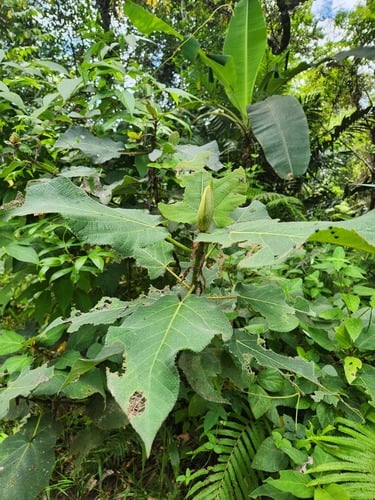
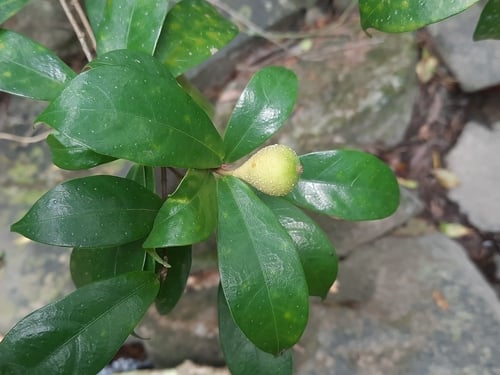
Artocarpus anisophyllus
Miq.
Keledang babi
iNaturalist· cc-by-nc
(c) CHUNG CHANG-LIN, some rights reserved (CC BY-NC), uploaded by CHUNG CHANG-LIN
iNaturalist· cc-by-sa
(c) W.A. Djatmiko (Wie146), some rights reserved (CC BY-SA)
iNaturalist· cc-by-sa
(c) Bernard DUPONT, some rights reserved (CC BY-SA)
Summary
Source: WikipediaArtocarpus anisophyllus, the entawak or mentawa, is a tropical tree in the Moraceae. It is native to the central parts of Southeast Asia, and is present in Peninsular Malaysia, Sumatra, Borneo and the intervening islands. It is called popwan in Palawan, Philippines. Rarely cultivated in its native range, it is a large rainforest tree growing up to 45 m (148 ft). It bears round, 3–4 in (76–102 mm) long, brownish yellow fruit. The entawak's flesh is orange-red and may taste like a pumpkin in flavor, while it also has edible seeds which are commonly roasted and salted to be eaten. The fruit is eaten fresh. It is a distant relative to the well known jackfruit and breadfruit, and the genus Artocarpus comprises several other species known for their tasty fruits, such as tarap. It is propagated by seeds, grafting and cuttings besides other viable methods. While it grows exceedingly well in tropical climates, it is not as well-adapted to subtropical climates. When grown from seed the germination may take 1–3 months and it will probably bear fruit within 8–9 years. It cannot survive temperatures below 50 °F (10 °C) and requires temperatures higher than 70 °F (21 °C) to flourish.
Description
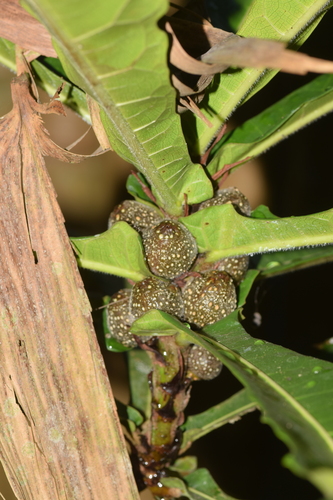
A medium to large tree. It grows to 24-45 m tall. The trunk can be 60 cm across. There can be buttresses 2.5 m high and 0.5 m wide. The bark is grey. The twigs are 10-20 mm thick. They have brown hairs and ring like scars. The leaves are large and deeply lobed. There are 5-12 alternate pairs of leaflets with a large then a small one. The leaflets are thickly leathery. The flowers occur on leafy twigs. Male and female flower heads are usually in pairs in the same leaf axil. The male heads are finger like and 3-7.5 cm long by 2 cm wide. The stalk is 50-60 mm long. The fruit are round and brown-yellow. They are 11-12.5 cm long by 8-10 cm wide. They are covered with closely set spines. The flesh is orange red in colour. It is sweet and edible. The seeds are oval and 17 mm long by 10 mm wide. They are covered with a thick orange coat. The fruit pulp and seeds are edible.
Edible Uses
Fruit - delicious eaten out of hand, it has a bright orange flesh. A sweet flavour. The yellowish-brown, globose fruits are about 11cm long and 8cm in diameter, the spiny shell being filled with many seeds in a yellow orange flesh. Seeds.
Traditional Uses
The fruit are eaten fresh.
This uses section is brief — help expand it
Medicinal Uses
The leaves are burned, mixed with coconut oil and applied externally as a treatment for boils and itch.
Distribution
A tropical plant. In Malaysia it grows up to 650 m altitude. In Indonesia it can grow up to 1300 m altitude.
Where It Grows
Asia, Australia, Brunei, Indonesia, Malaysia, Philippines, SE Asia,
Cultivation
A plant of the humid tropics. Prefers a deep, well-drained soil. Plants are found in the wild on sandy to clay soils, also on limestone. Young plants need some shade, but need increasing light levels as they mature.
Propagation
Seed - best sown as soon as it is ripe. The seed germinates best at a temperature of 24 - 27c. Root cuttings. Air layering.
Other Uses
The bark is locally used as rope for backpacks. The yellow-brown wood is soft, coarse-grained, easily worked and durable. It is used for construction. The wood is a source of keledang timber. We have no further information for this species, but the general description of keledang is as follows:- The heartwood is yellow-brown to orange-red, darkinging to golden brown; it is clearly demarcated from the 5 - 7cm wide band of sapwood. The texture is coarse; the grain straight or interlocked; there is a lustrous, ribbon-like aspect. The wood is fairly heavy, fairly hard, durable, being moderately resistant to fungi and resistant to termites and dry wood borers. It seasons somewhat slowly with a high risk of distortion and a slight risk of checking; once dry it is moderately stable to stable in service. It has a fairly high blunting effect upon tools, stellite-tipped and tungsten carbide are recommended; the surface is fibrous and filling is recommended; it takes screws and nails poorly; glues correctly. The wood is used for furniture, house building, turnery, light carpentry, interior joinery and panelling, boxes and crates, boats etc. It is used for making high class coffins in Malaysia.
Notes
There are about 50 Artocarpus species. They are in the tropics and subtropics of Asia and the Pacific.
Synonyms
Also Known As
Bakil, Bintau, Bintawak, Denging, Entawa, Entawak, Kayo bakek, Kayo bibungan, Kelidang, Mentawa, Puan, Pupuan, Terap ikal
References (10)
- Argent, G et al, nd, Manual of the Larger and More important non Dipterocarp Trees of Central Kalimantan Indonesia. Volume 2 Forest Research Institute, Samarinda, Indonesia. p 432
- Facciola, S., 1998, Cornucopia 2: a Source Book of Edible Plants. Kampong Publications, p 154
- http://sarawakfacts.sarawak.gov.my
- PROSEA (Plant Resources of South East Asia) handbook, Volume 2, 1991, Edible fruits and nut. p 80
- Saw, L.G., LaFrankie, J. V. Kochummen, K. M., Yap S. K., 1991, Fruit Trees in a Malaysian Rain Forest. Economic Botany, Vol. 45, No. 1, pp. 120-136
Show all 10 references Hide references
- Siong, K. H., 2003, Indigenous Fruits of Sarawak. Forest Department Sarawak. p 91
- Slik, F., www.asianplant.net
- Soepadmo, E. and Saw, L. G., 2000, Tree Flora of Sabah and Sarawak. Forestry Malaysia. Volume Three. p 191
- Tankard, G., 1990, Tropical fruit. An Australian Guide to Growing and using exotic fruit. Viking p 121
- World Checklist of Useful Plant Species 2020. Royal Botanic Gardens, Kew