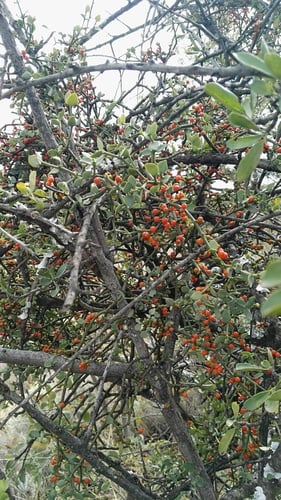
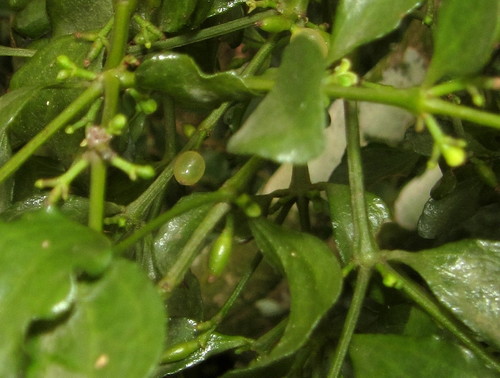
Exocarpos strictus
R. Br.
Palefruit native-cherry, Pale-fruit Ballart, Dwarf Cherry
iNaturalist· cc-by
(c) John Tann, some rights reserved (CC BY)
iNaturalist· cc-by-nc
(c) Ken Harris EntSocVic, some rights reserved (CC BY-NC), uploaded by Ken Harris EntSocVic
iNaturalist· cc-by-nc-sa
(c) Nick Lambert, some rights reserved (CC BY-NC-SA), uploaded by Nick Lambert
Summary
Source: WikipediaExocarpos strictus, with common names pale-fruit ballart, pale ballart, and dwarf cherry, is an adaptably versatile erect shrub bearing cherry-like fruit, that forms dense thickets, that is native to parts of Australia (including Tasmania). E. strictus was described by botanist Robert Brown in 1810.
Description
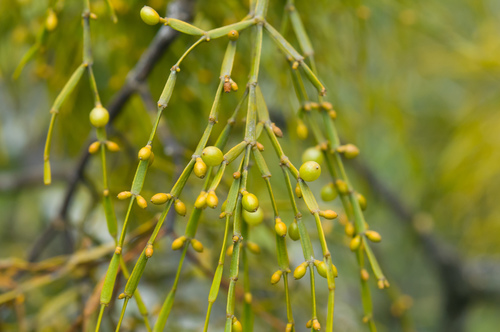
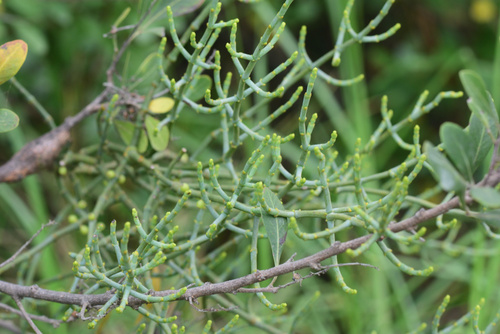
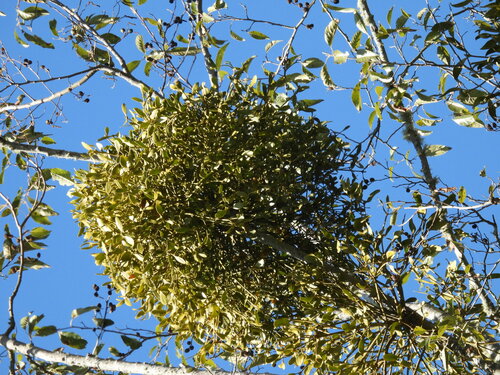
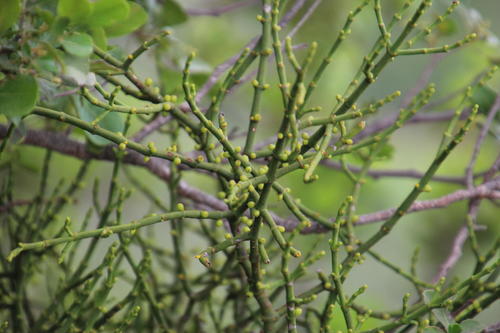
A shrub. It is bluish-green and has many branches. It grows 1-1.5 m high. The branches are usually rigid and erect. They have sharp ridges along them which are also rough. They are almost leafless. The leaves are small. They are 1-3 mm long and only on young shoots. The flowers are very small. They occur in clusters along the branches. They are greenish-yellow. The fruit are pale red. They have a succulent base and a round green 'seed' on top. This is about 5 mm long.
Edible Uses
The pale red fruit are eaten fresh.
Traditional Uses
The fruit are eaten.
This uses section is brief — help expand it
Distribution
It is a temperate plant. It grows in sand in scrub and heath near shores. Tasmania Herbarium.
Where It Grows
Australia*, Tasmania*,
Cultivation
Plants can be grown from seed. Seed do not grow easily.
Production
In Victoria it flowers August to November.
Notes
There are about 26 Exocarpus species.
Also Known As
Ballat, Bulliyang, Bullyang, Mirrii, Nyora, Pallert
References (17)
- Bodkin, F., 1991, Encyclopedia Botanica. Cornstalk publishing, p 467
- Caton, J.M. & Hardwick, R. J., 2016, Field Guide to Useful Native Plants from Temperate Australia. Harbour Publishing House. p 356
- Cherikoff V. & Isaacs, J., The Bush Food Handbook. How to gather, grow, process and cook Australian Wild Foods. Ti Tree Press, Australia p 195
- Cribb, A.B. & J.W., 1976, Wild Food in Australia, Fontana. p 75
- Curtis, W.M., 1993, The Student's Flora of Tasmania. Part 3 St David's Park Publishing, Tasmania, p 628
Show all 17 references Hide references
- De Angelis, D., 2005, Aboriginal Plant Use of the Greater Melbourne Area. La Trobe University Environment Collective
- Elliot, W.R., & Jones, D.L., 1992, Encyclopedia of Australian Plants suitable for cultivation. Vol 4. Lothian. p 271
- Harris, S., Buchanan, A., Connolly, A., 2001, One Hundred Islands: The Flora of the Outer Furneaux. Tas Govt. p 155
- Hastings Advance Community College, 2017, Uses for Native Plants of the Mornington Peninsula. 86pp. p 45
- Lazarides, M. & Hince, B., 1993, Handbook of Economic Plants of Australia, CSIRO. p 113
- Low, T., 1991, Wild Food Plants of Australia. Australian Nature FieldGuide, Angus & Robertson. p 137
- Low, T., 1992, Bush Tucker. Australia’s Wild Food Harvest. Angus & Robertson. p 49
- McKerney, M. & White, H., 2011, Bush Tucker, Boomerangs & Bandages. Border River-Gwyder Catchment Management Authority p 117
- Plants for a Future database, The Field, Penpol, Lostwithiel, Cornwall, PL22 0NG, UK. http://www.scs.leeds.ac.uk/pfaf/
- Smith, K & I., 1999, Grow your own bushfoods. New Holland. Australia. p 29
- Tasmanian Herbarium Vascular Plants list p 53
- Whiting, J. et al, 2004, Tasmania's Natural Flora. Tasmania's Natural Flora Editorial Committee PO Box 194, Ulverstone, Tasmania, Australia 7315 p 309