Pyrularia edulis
(Wall. ex Roxb.) A. DC.
Oil bottle gourd, Sandalwood pear
iNaturalist· cc-by-nc
(c) Rinzin Dorji, some rights reserved (CC BY-NC), uploaded by Rinzin Dorji
iNaturalist· cc-by-nc
(c) Jackwang, some rights reserved (CC BY-NC)
Summary
Source: WikipediaPyrularia edulis is a species of shrub or small tree in the sandalwood family. It grows in Bhutan, China, India, Myanmar, and Nepal.
Description
A medium sized tree. It grows 3-5 m tall but can be 15 m tall. It loses its leaves during the year. The leaves have stalks. The leaves are 5-15 cm long by 1.5-6.5 cm wide. They are oval and taper to the tip. The leaves are round toothed or scalloped towards the tip. Male and female flowers are on separate plants The flowers are yellow. The fruit is fleshy with a hard stone over the seed. It is pear shaped and narrows into a stout stalk.
Edible Uses
The fruit can be eaten raw or cooked and has an aromatic flavour somewhat like guava (Psidium spp.). The sap can be used as a rennet substitute to curdle plant milks when making cheese.
Traditional Uses
The ripe fruit are eaten fresh. They are also stewed or stir fried. The seed are also used for extracting edible oil. The sap is used as a substitute for rennet for curdling milk.
Medicinal Uses
None known.
Distribution
It is a subtropical plant. In Nepal plants grow between 1600-1800 m altitude. They grow in open, forested areas. In China it grows between 700-2700 m altitude in S China. It grows in subtropical broad-leaved evergreen forest. In Sichuan and Yunnan.
Where It Grows
Asia, Bhutan, China, Himalayas, India, Indochina, Myanmar, Nepal, Northeastern India, SE Asia, Sikkim,
Cultivation
Plants are grown from seed.
Propagation
Seed.
Other Uses
The wood can be used for making kitchen implements.
Synonyms
Also Known As
A ke ke ran a si, Amphi, Cihadima, Dieng-soh-klong, Kaduhkakan, Liang-lay, Pyabdechu, Safihy, Tan li, Thei-let-ling, Thing-beng, Thlum-zu, Toktur-kung, Yomi
References (19)
- Ambasta S.P. (Ed.), 2000, The Useful Plants of India. CSIR India. p 506
- Chettri, N. & Sharma, E., Non-timber Forest Produce: Utilization, Distribution and Status in the Khangchendzonga Biosphere Reserve, Sikkim, India.
- Flora of China @ efloras.org Volume 5
- Hedrick, U.P., 1919, (Ed.), Sturtevant's edible plants of the world. p 535
- Hu, Shiu-ying, 2005, Food Plants of China. The Chinese University Press. p 368
Show all 19 references Hide references
- Jin, Chen et al, 1999, Ethnobotanical studies on Wild Edible Fruits in Southern Yunnan: Folk Names: Nutritional Value and Uses. Economic Botany 53(1) pp 2-14
- Kar, A., et al, 2013, Wild Edible Plant Resources used by the Mizos of Mizoram, India. Kathmandu University Journal of Science, Engineering and Technology. Vol. 9, No. 1, July, 2013, 106-126
- Khakurel, D., et al, 2021, Foods from the wild: Local knowledge, use pattern and distribution in Western Nepal. PLOS ONE.
- Luo, B., et al, 2019, Wild edible plants collected by Hani from terraced rice paddy agroecosystem in Honghe Prefecture, Yunnan, China. Journal of Ethnobiology and Ethnomedicine 15:56
- Manandhar, N.P., 2002, Plants and People of Nepal. Timber Press. Portland, Oregon. p 387
- Mukhia, P.K., et al, 2013, Wild plants as Non Wood Forest Products used by the rural community of Dagana, a southern foothill district of Bhutan, SAARC Journal, 27 pages
- Patiri, B. & Borah, A., 2007, Wild Edible Plants of Assam. Geethaki Publishers. p 123
- Plants for a Future database, The Field, Penpol, Lostwithiel, Cornwall, PL22 0NG, UK. http://www.scs.leeds.ac.uk/pfaf/
- Prodr. 14:628. 1857
- Sawian, J. T., et al, 2007, Wild edible plants of Meghalaya, North-east India. Natural Product Radiance Vol. 6(5): p 421
- Sharma, G., et al, 2016, Agrobiodiversity in the Sikkim Himalaya. International Centre for Integrated Mountain Development, ICIMOD Working Paper 2016/5 p 20 (As Purularia)
- Singh, V. B., et al, (Ed.) Horticulture for Sustainable Income and Environmental Protection. Vol. 1 p 219
- Sundriyal, M., et al, 1998, Wild edibles and other useful plants from the Sikkim Himalaya, India. Oecologia Montana 7:43-54
- Sundriyal, M., et al, 2004, Dietary Use of Wild Plant Resources in the Sikkim Himalaya, India. Economic Botany 58(4) pp 626-638
More from Santalaceae
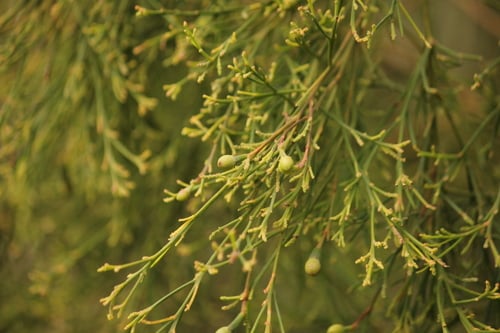
Exocarpos cupressiformis
Cherry Ballart, Native Cherry, Wild Cherry
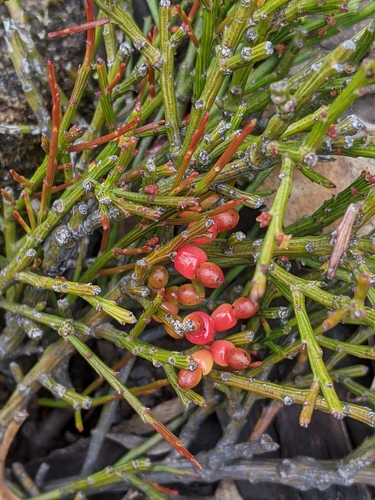
Exocarpos humifusus
Mountain native-cherry, Mountain Ballart, Alpine native cherry
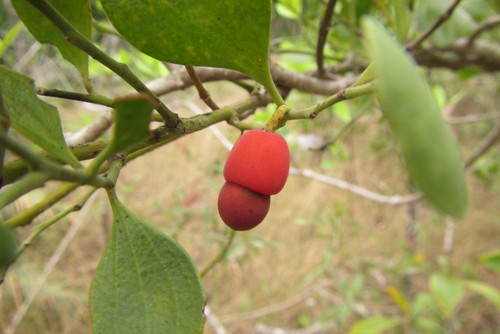
Exocarpos latifolius
Broad-leaved native cherry, Misletoe tree, Broad-leaved Ballart
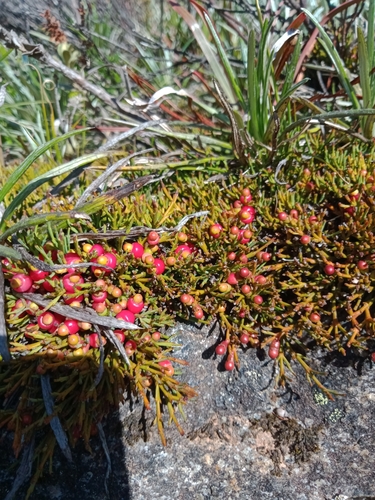
Exocarpos nanus
Alpine native-cherry, Alpine Ballart
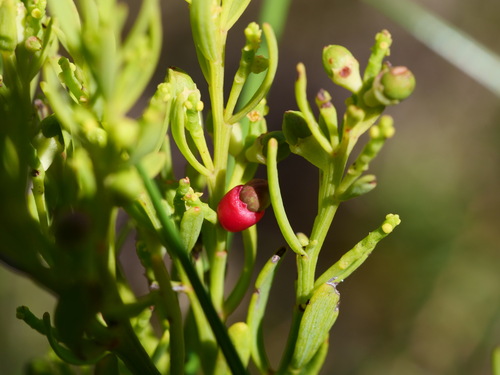
Exocarpos odoratus
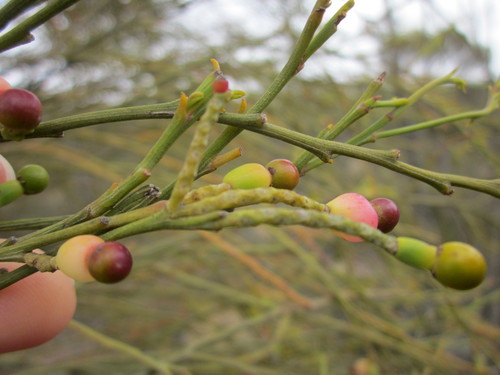
Exocarpos sparteus
Slender Cherry, Broom Ballart, Native cherry