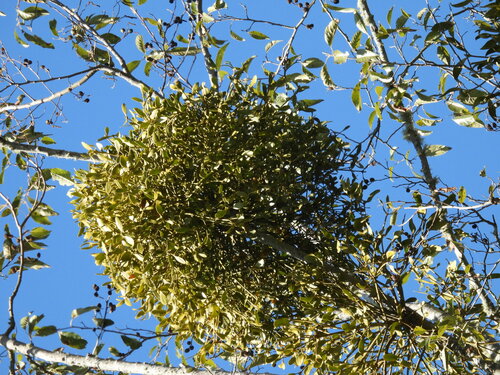
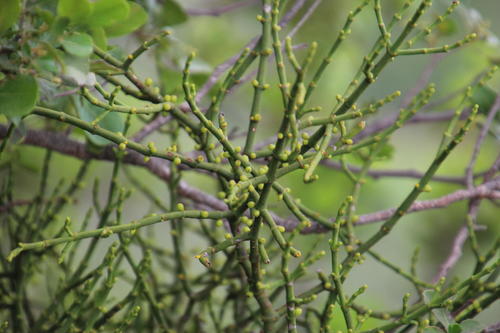
Exocarpos latifolius
R. Br.
Broad-leaved native cherry, Misletoe tree, Broad-leaved Ballart
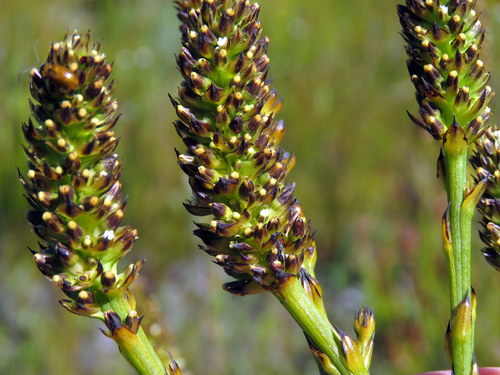
iNaturalist· cc-by
(c) coenobita, some rights reserved (CC BY), uploaded by coenobita
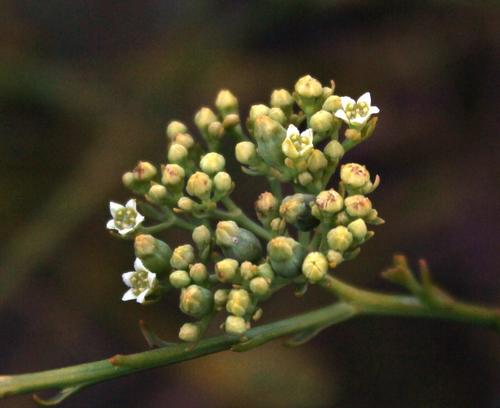
iNaturalist· cc-by-nc
(c) Mick Drews, some rights reserved (CC BY-NC), uploaded by Mick Drews
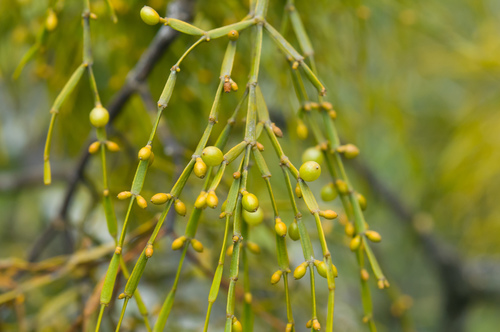
iNaturalist· cc-by-nc
(c) jxg3510, some rights reserved (CC BY-NC)
Summary
Source: WikipediaExocarpos latifolius is a species of parasitic tree, in the plant family Santalaceae. They have the common names broad leaved ballart, scrub sandal-wood, scrub cherry, oringorin, broad leaved cherry or native cherry. The species is found in monsoon forest, littoral rainforest and occasionally in more open forest types in Malesia and across Northern Australia. It is a small tree (or large shrub) growing to 10 metres tall, hemiparasitic on the roots of other trees. The leaves are approximately as broad as long, around 4 cm long. Flowers are produced in slender spikes mostly approximately 1 cm long. The fruit is a globular nut on a short stalk. As it ripens the stalk swells and turns red, like an inside out cherry. The fruit is 4–6 mm long and is inedible, though the stalk is, and was used as a traditional food source by Aboriginal Australians. The seed is found on the outside of the fruit, hence the name exocarpus, from the Latin meaning outer. The wood is very fine-grained with little figure but often striking colour variation and was historically used for cabinet work. The tree was used for many purposes by Aboriginal Australians.The bark was used as a contraceptive. The leaves were burned to repel insects and leaves used in a solution to treat sores. The 1889 book 'The Useful Native Plants of Australia’ records that Indigenous Australians of Queensland referred to this tree as "Oringorin". Common names included Broad-leaved "Native Cherry" and "Scrub Sandalwood". It also states that "The fruit is edible."
Description
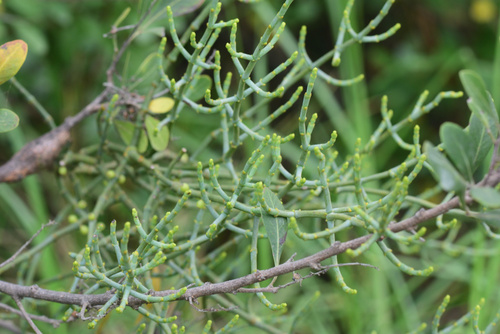
A small tree. It grows 4-8 m high. It spreads 3-6 m across. It has very dark green shiny leaves. The leaves are egg shaped. They are 1.5-7 cm long by 1.5-7 cm wide. They are leathery and have veins along them. The flowers a very small and cream. They are arranged in spikes. These can be 1.2 cm long. The fruit are 8 mm long and red. The fruit have a base or stalk which swells and turns bright red when ripe. This plant grows as a parasite on the roots of other plants.
Edible Uses
The ripe fruit stalk is eaten raw and is juicy and sweet. The fruit and seed are sometimes chewed with betel leaf.
Traditional Uses
The fruit and seed are sometimes chewed with betel leaf. The ripe fruit stalk is eaten. It is juicy and sweet.
This uses section is brief — help expand it
Medicinal Uses
An infusion of the bark and the seeds is used as a contraceptive. The seeds, leaves, bark and wood have all been used medicinally by the Australian Aborigines.
Known Hazards
The plant is considered to be poisonous by some native peoples.
Distribution
A tropical and subtropical plant. It can grow in coastal sand dunes and in mountains near the coast. In tropical Queensland it grows from sea level to 900 m altitude. It suits hardiness zones 9-11.
Where It Grows
Asia, Australia*, East Timor, Indonesia, Malaysia, Pacific, Philippines, SE Asia, Timor-Leste, Torres Strait,
Cultivation
A plant of tropical and subtropical climates. A very variable plant, occurring in a range of habitats.
Propagation
Seed - when sown fresh in the nursery, it usually germinates within a few months, but it is extremely difficult to get the seedlings to survive very long, even when they are potted with potential hosts.
Other Uses
The dark-coloured, fragrant wood is very hard and coarse-grained. The wood is whitish to pale reddish-brown, heavy, hard, strong and durable. It takes an excellent polish and is used for cabinet work when of sufficient dimensions. It is considered to be an inferior substitute for sandalwood, losing its fragrance rapidly. It is not suited for timber because it is usually only available in small crooked dimensions, but it is used to make small utensils and handles.
Notes
There are about 26 Exocarpus species.
Nutrition
| Part | Moisture | kJ | kcal | Protein | Vit A | Vit C | Iron | Zinc |
|---|---|---|---|---|---|---|---|---|
| Fruit | 71.1 | 286 | 68 | 2.4 | — | — | 1.4 | 0.6 |
Synonyms
Also Known As
Agsum, Ballat, Blaping, Cedana semut, Kamiing, Kamoneng alas, Murinyini, Nulkngawakbunbun, Oringorin, Thidirr, Uksur
References (36)
- Beasley, J., 2011, Plants of Tropical North Queensland - the compact guide. Footloose publications. p 54
- Calvert, G., 2010, The Burdekin Delta Tree Guide. Lower Burdekin Landcare Association., Inc., Ayr p 77
- Cherikoff, V. & Isaacs, J., The Bush Food Handbook. How to gather, grow, process and cook Australian Wild Foods. Ti Tree Press, Australia p 200
- Cooper, W. and Cooper, W., 2004, Fruits of the Australian Tropical Rainforest. Nokomis Editions, Victoria, Australia. p 474
- Cowie, I, 2006, A Survey of Flora and vegetation of the proposed Jaco-Tutuala-Lore National Park. Timor-Lests (East Timor) www.territorystories.nt/gov.au p 52
Show all 36 references Hide references
- Cribb, A.B. & J.W., 1976, Wild Food in Australia, Fontana. p 34
- Elliot, W.R., & Jones, D.L., 1992, Encyclopedia of Australian Plants suitable for cultivation. Vol 4. Lothian. p 270
- Etherington, K., & Imwold, D., (Eds), 2001, Botanica's Trees & Shrubs. The illustrated A-Z of over 8500 trees and shrubs. Random House, Australia. p 319
- Fell, D.G. & Stanton, D.J., 2015: The vegetation and flora of Mabuyag, Torres Strait, Queensland. Memoirs of the Queensland Museum – Culture 8(1):1-33. Brisbane. ISSN 1440-4788
- Habitat Management Profile – Saibai Island. Appendix C. Preliminary List of Useful Plants for Saibai Island. p 118
- Jackes, B.R., 2001, Plants of the Tropics. Rainforest to Heath. An Identification Guide. James Cook University. p 80
- Kenneally, K.E., Edinger, D. C., and Willing T., 1996, Broome and Beyond, Plants and People of the Dampier Peninsula, Kimberley, Western Australia. Department of Conservation and Land Management. p 179
- Lazarides, M. & Hince, B., 1993, Handbook of Economic Plants of Australia, CSIRO. p 113
- Low, T., 1991, Wild Food Plants of Australia. Australian Nature FieldGuide, Angus & Robertson. p 137
- Low, T., 1992, Bush Tucker. Australia’s Wild Food Harvest. Angus & Robertson. p 4, 49
- Maiden, J. H., 1889, The Useful Native Plants of Australia (including Tasmania). The Technology Museum of NSW, Sydney. p 30
- Melzer, R. & Plumb, J., 2011, Plants of Capricornia. Belgamba, Rockhampton. p 317
- Mua Bioversity Profile, 2013, Profile for Management of the Habitats and Related Ecological and Cultural Resources of Mua Island. Torres Strait Regional Authority Land & Sea Management Unit. p 142
- Nicholson, N & H., 1994, Australian Rainforest Plants 4, Terania Rainforest Publishing. NSW. p 34
- Paczkowska, G . & Chapman, A.R., 2000, The Western Australian Flora. A Descriptive Calatogue. Western Australian Herbarium. p 526
- Plants for a Future database, The Field, Penpol, Lostwithiel, Cornwall, PL22 0NG, UK. http://www.scs.leeds.ac.uk/pfaf/
- PROSEA (Plant Resources of South East Asia) handbook, Volume 19, 1999, Essential oils.
- Scarth-Johnson, V., 2000, National Treasures. Flowering Plants of Cooktown and Northern Australia. Vera Scarth-Johnson Gallery Association. Cooktown, Australia. p 82
- Smith, N and Wightman, G.M., 1990, Ethnobotanical Notes from Belyuen Northern Territory Australia. Northern Territory Botanical Bulletin No 10. Parks and Wildlife Commission of the Northern Territory. p 12, 13.
- Smith, K & I., 1999, Grow your own bushfoods. New Holland. Australia. p 29
- Smith, N. M., 1991, Ethnobotanical Field Notes from the Northern Territory, Australia, J. Adelaide Bot. Gard. 14(1): 1-65
- Tiwi Plants and Animals. 2001, Aboriginal flora and fauna knowledge from Bathurst and Melville Islands, northern Australia. Northern Territory Botanical Bulletin; No. 24 p 51
- Townsend, K., 1994, Across the Top. Gardening with Australian Plants in the tropics. Society for Growing Australian Plants, Townsville Branch Inc. p 209
- Townsend, K., 1999, Field Guide to Plants of the Dry Tropics. Society for Growing Australian Plants, Townsville Branch Inc. p 56
- Vigilante, T., et al, 2013, Island country: Aboriginal connections, values and knowledge of the Western Kimberley islands in the context of an island biological survey. Records of the Western Australian Museum Supplement 81: 145-182
- Wheeler, J.R.(ed.), 1992, Flora of the Kimberley Region. CALM, Western Australian Herbarium, p 567
- Wightman, G. & Andrews, M., 1991, Bush Tucker Identikit. Common Native Food Plants of Australia’s top end. Conservation Commission Northern Territory. p 40
- Wightman, G. M. & Andrews, M.R., 1989, Plants of Northern Territory Monsoon Vine Forests (Vol 1). Conservation Commission of Northern Territory. p 102
- Wightman, G. & Brown, J., 1994, Jawoyn Plant Identikit, Common Useful Plants in the Katherine Area of Northern Australia. Conservation Commission Northern Territory. p 44
- Williams, J.B., Harden, G.J., and McDonald, W.J.F., 1984, Trees and shrubs in rainforests of New South Wales and Southern Queensland. Univ. of New England, Armidale. p 87
- Yallakool Reserve Plant List July 1, 2009 Off internet