Osyris compressa
(P. J. Bergius) A. DC.
Cape sumach
Wikipedia· cc-by-sa
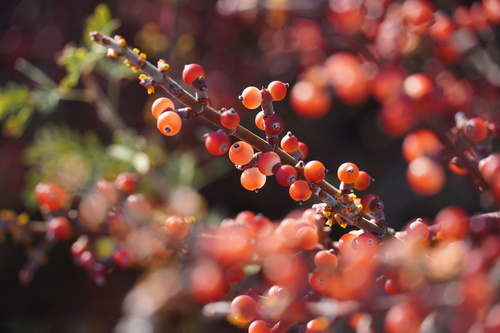
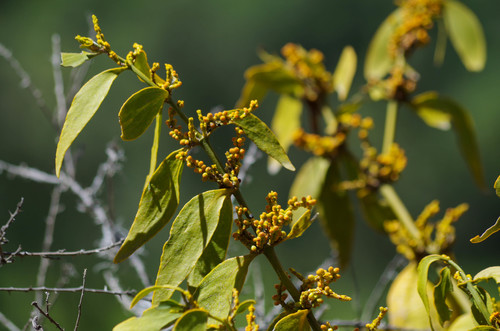
Wikimedia Commons - Osyris_compressa_berries_detail.JPG
iNaturalist· cc-by-nc
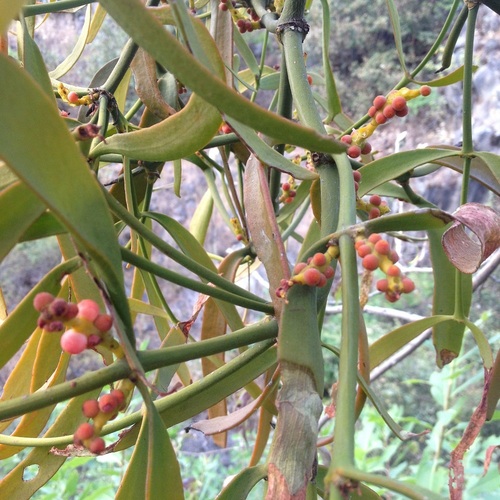
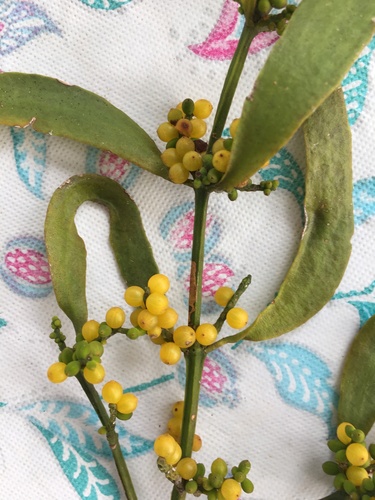
(c) sallyhey, some rights reserved (CC BY-NC)
iNaturalist· cc-by-nc
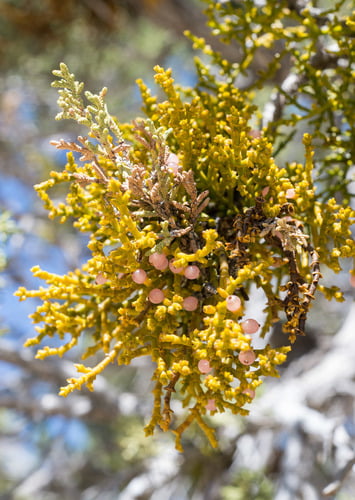
(c) sallyhey, some rights reserved (CC BY-NC)
Summary
Source: WikipediaOsyris compressa (Cape sumach or pruimbos) is a facultatively hemiparasitic, mainly South African plant of the sandalwood family, Santalaceae. Until recently, the favoured binomial name was Colpoon compressum, but around 2001, the genus Colpoon was included in Osyris on the basis of comparative DNA studies. That assignment is not final, however, and according to the Kew Gardens plant list, Colpoon compressum P.J.Bergius, though still in review, is the accepted name.
Description
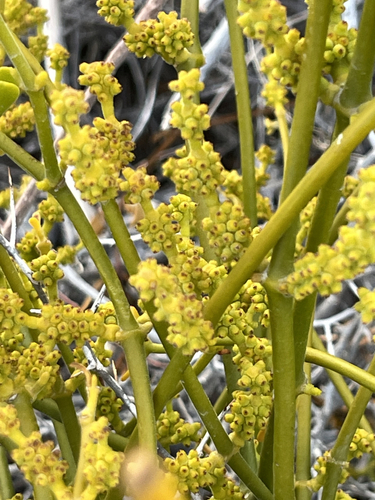
An evergreen shrub. It can grow 5 m tall. The trunk can be 25 cm across. It can grow as a parasite attached to the roots of other plants. The leaves are opposite and narrowly oval. They are erect and crowded on the stem. They are 1-5 cm long by 1-3 cm wide. The flowers are small and 2 mm across. They are yellowish-green. The fruit are red and turn dark purple when ripe.
Edible Uses
The fruit, leaves, bark, and root are edible, with the fruit being especially popular with children and able to be stored.
Traditional Uses
The fruit can be stored.
This uses section is brief — help expand it
Medicinal Uses
The fruit can be stored for later use.
Distribution
It is a tropical plant. It grows on dunes along the coast in scrub and forest. It grows well in sandy soils. It is best in a sunny position.
Where It Grows
Africa, Asia, Australia, East Africa, Eswatini, India, Kenya, Lesotho, Malawi, Mozambique, South Africa, Southern Africa, Swaziland,
Cultivation
Plants can be grown from seeds planted near a suitable host tree. They cannot be grown from cuttings.
Propagation
Seed - can be sown in situ, if there are other plants to serve as the hosts. It is not possible to grow plants from cuttings.
Other Uses
Both the bark and the fresh leaves can be used for tanning. A decoction of fresh leaves can be used to tan cotton, fishing lines and nets to make them more durable. The bark, stem, seeds and roots are used in the manufacture of aromatic oils that are used in making expensive perfumes, quality lotions, rare soaps and sweet-smelling candles. The wood yields between 4 - 10% essential oil when distilled. The heartwood scent is used in sacred ceremonies and to purify holy places. Incense sticks from the wood are burned in temples and houses. The wood is heavy, and fine-grained. Because of the small size of the tree, it is suitable only for carving ornaments and small utensils like pestles. The wood has been used for fuel. Plants thrive in sandy conditions and, together with other species of plants, can be used to form a soil stabilizer in coastal dune systems. Plants form very effective small windbreaks provided there are enough host plants growing with them.
Production
Plants fruit for about 8 months of the year.
Other Information
The fruit are especially eaten by children.
Also Known As
African sandalwood, Basbessie, Basboom, Basbos
References (4)
- De Vynk, J. C., et al, 2016, Indigenous edible plant use by contemporary Khoe-San descendants of South Africa's Cape South Coast. South African Journal of Botany. 102 (2016) 60-69
- Fern, K., 2012, Tropical Species Database http://theferns.info/tropical/
- Grivetti, L. E., 1980, Agricultural development: present and potential role of edible wild plants. Part 2: Sub-Saharan Africa, Report to the Department of State Agency for International Development. p 45
- www.worldagroforestrycentre.org/treedb/