Exocarpos humifusus
R. Br.
Mountain native-cherry, Mountain Ballart, Alpine native cherry
iNaturalist· cc-by-nc
(c) Nick Fitzgerald, some rights reserved (CC BY-NC), uploaded by Nick Fitzgerald
iNaturalist· cc-by-nc
(c) Geoffrey Sinclair, some rights reserved (CC BY-NC), uploaded by Geoffrey Sinclair
iNaturalist· cc-by-nc
(c) Kristen Lang, some rights reserved (CC BY-NC), uploaded by Kristen Lang
Summary
Source: WikipediaExocarpos humifusus, also known as mountain native-cherry, is a small shrub member of the family Santalaceae, all of which are hemiparasites. Exocarpos humifusus is a dwarfish and sprawling shrub with woody stems, and small dry fruits that grow atop a fleshy red stalk, hence the common name of native-cherry.
Description
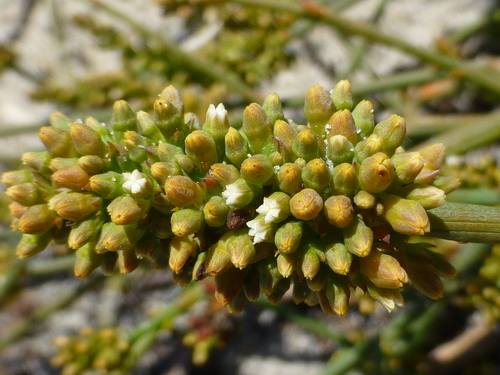
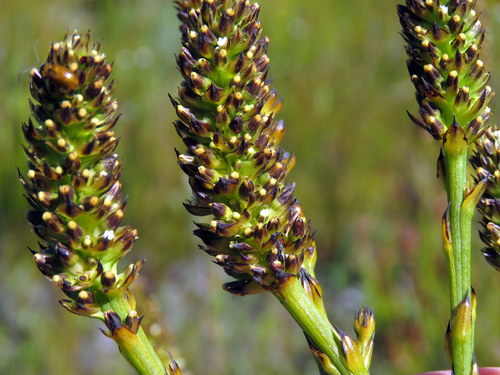
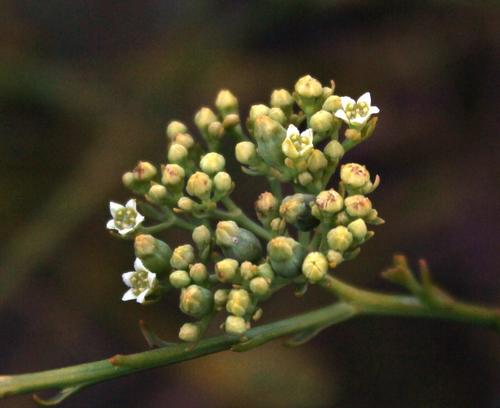
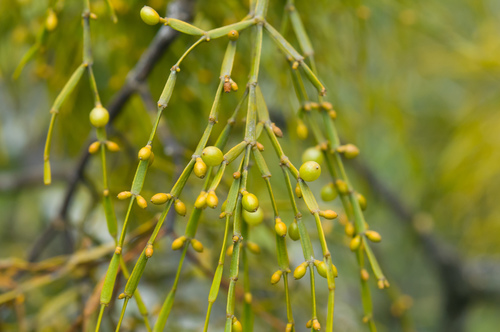
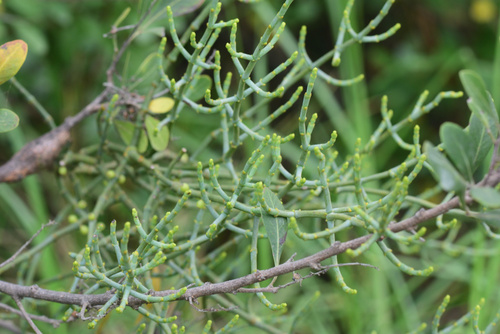
A small spreading shrub. It grows 30 cm high and spreads 0.5-1.5 m wide. There are many branches. They are rigid and ribbed. The leaves are reduced to small triangle shaped scales. The flowers are very small. They are reddish-yellow. There are 2-6 flowers in clusters in the axils of leaves. The fruit are about 4 mm across. They are red but mature to black. The stalk is succulent and dark red.
Edible Uses
The fruit are eaten.
Distribution
It is a temperate plant. It grows on mountain plateaux and mountain tops. In Tasmania it grows above 1300 m altitude. It often grows amongst rocks. It grows attached to other plants. Tasmania Herbarium.
Where It Grows
Australia*, Tasmania*,
Cultivation
This plant is hard to propogate.
Notes
There are about 26 Exocarpus species.
References (6)
- Curtis, W.M., 1993, The Student's Flora of Tasmania. Part 3 St David's Park Publishing, Tasmania, p 628
- Elliot, W.R., & Jones, D.L., 1992, Encyclopedia of Australian Plants suitable for cultivation. Vol 4. Lothian. p 269
- Kirkpatrick, J., 1997, Alpine Tasmania, An Illustrated guide to the flora and vegetation. Oxford, p 56
- Low, T., 1992, Bush Tucker. Australia’s Wild Food Harvest. Angus & Robertson. p 50
- Tasmanian Herbarium Vascular Plants list p 53
Show all 6 references Hide references
- Whiting, J. et al, 2004, Tasmania's Natural Flora. Tasmania's Natural Flora Editorial Committee PO Box 194, Ulverstone, Tasmania, Australia 7315 p 308