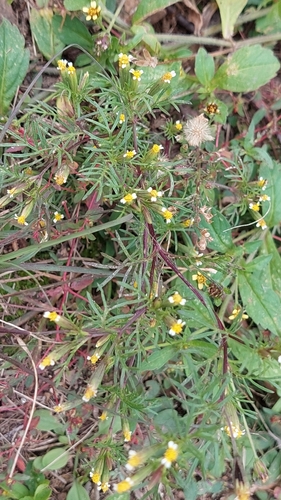
Ligularia sibirica - (L.)Cass.
(L.)Cass.
gbif· cc-by-nc
Alexey P. Seregin
gbif· cc-by-nc
Alexey P. Seregin
gbif· cc-by
Moscow State University (copyright is managed by Dr. Alexey P. Seregin)
Description
Ligularia sibirica is a PERENNIAL growing to 1 m (3ft 3in) by 0.5 m (1ft 8in). See above for USDA hardiness. It is hardy to UK zone 3. It is in flower from July to October, and the seeds ripen from August to October. The species is hermaphrodite (has both male and female organs) and is pollinated by Insects. Suitable for: light (sandy), medium (loamy) and heavy (clay) soils. Suitable pH: mildly acid, neutral and basic (mildly alkaline) soils. It can grow in semi-shade (light woodland) or no shade. It prefers moist soil.
Edible Uses
Leaves - cooked.
Distribution
Europe to E. Asia - China, Japan, Himalayas.
Where It Grows
TEMPERATE ASIA: Turkey, Armenia, Azerbaijan, Georgia, Russian Federation (Buryatia, Tyva, Respublika, Yakutia-Sakha, Altay, Krasnoyarsk, Chita, Irkutsk, Kemerovskaja oblast, Kurganskaja oblast, Novosibirsk, Omsk, Tomsk, Tyumen), Kazakhstan (east), Mongolia, Russian Federation (Habarovskij kraj, Magadanskaja oblast), China (Heilongjiang Sheng, Jilin Sheng, Nei Mongol Zizhiqu) EUROPE: Austria, Czech Republic, Hungary, Liechtenstein, Poland, Slovakia, Russian Federation (European part), Belarus, Estonia, Ukraine, Bulgaria, Croatia, Italy, Romania, France
Cultivation
Prefers a deep moist or even boggy fertile humus-rich soil. Succeeds in sun or semi-shade. Plants often wilt on bright windy days. The young growth in spring is very susceptible to damage by slugs and snails. The subspecies L. sibirica speciosa. (Schrad.)DC. is the form used in China as a food.
Propagation
Seed - sow spring in a cold frame. Only just cover the seed. When they are large enough to handle, prick the seedlings out into individual pots and plant them out in the summer. Division in spring. Very easy, larger clumps can be replanted direct into their permanent positions, though it is best to pot up smaller clumps and grow them on in a cold frame until they are rooting well. Plant them out in the spring.