Boerhavia coulteri - (Hook.f.) S.Watson
(Hook.f.) S.Watson
Coulter’s Spiderling
gbif· cc-by-nc
Jaxon Lane
gbif· cc-by-nc
Jaxon Lane
gbif· cc-by-nc
Jaxon Lane
Description
Boerhavia coulteri is a ANNUAL growing to 0.3 m (1ft) by 0.6 m (2ft in) at a fast rate. See above for USDA hardiness. It is hardy to UK zone 10 and is frost tender. The flowers are pollinated by Insects. It is noted for attracting wildlife. Suitable for: light (sandy) and medium (loamy) soils, prefers well-drained soil and can grow in nutritionally poor soil. Suitable pH: neutral and basic (mildly alkaline) soils and can grow in very alkaline and saline soils. It cannot grow in the shade. It prefers dry or moist soil and can tolerate drought.
Edible Uses
Edible Uses & Rating: Shoots and leaves have been eaten traditionally, but strong oxalate levels make them irritating, with a burning sensation that increases with quantity. Boiling does not adequately remove the irritation. Other parts are not recommended as food. As a practical wild edible this species ranks very low. Edibility rating: 1/5 (emergency only). Taste, Processing & Kitchen Notes: Raw leaves present a fleeting suggestion of green beans and spinach overlaid by a peculiar, resinous “chemical” note; within a few bites a throat/mouth burn develops. Boiling softens texture to a spinach-like mush but does not meaningfully reduce the oxalate burn or improve flavor. Shoots may be marginally milder than mature leaves, yet still irritating. There is no reliable processing method (blanching, multiple water changes, drying) that yields consistently palatable results; consequently, routine culinary use is not advised. Seasonality (Phenology): Germinates rapidly after summer monsoon rains; vegetative growth and flowering occur from mid-summer into early autumn, followed by quick fruit set and senescence as soils dry. In frost-free microsites it may persist or resprout, but most plants behave as fast-cycling annuals. Harvest & Processing Workflow: If documentation or tasting is required: harvest very young shoots/leaves immediately after a rain when turgid. Rinse thoroughly. Briefly blanch and test a tiny portion; discontinue if any burn develops. There is no safe or effective home method to convert this plant into a regular potherb; do not attempt seed use.Look-Alikes & Confusion Risks: Readily confused with other Boerhavia (e.g., B. coccinea, B. spicata, B. wrightii) that share the thin, wiry habit and tiny, 5-lobed flowers; all are broadly similar in edibility (poor) and chemistry (oxalates). Distinguish from Mirabilis (four-o’clocks) by the small, funnelform flowers and club-ribbed anthocarps of Boerhavia versus larger showy perianths in Mirabilis. Seedlings can resemble small Amaranthus; check for opposite, unequal leaves and sticky ribbed fruits as plants mature. Traditional/Indigenous Use Summary: Ethnobotanical notes record shoots and leaves eaten by some Native American groups despite irritation, likely as opportunistic greens following monsoon rains. Use appears limited and situational rather than a staple, aligning with modern field experience of poor palatability.
Known Hazards
Leaves and shoots are high in oxalates and can cause mouth/throat burning and irritation; people with kidney stone history or calcium-oxalate sensitivity should avoid. Boiling does not reliably mitigate irritation. Given the poor flavor and risk of discomfort, routine consumption is not recommended.
Distribution
S. California to SW. Texas and N. & W. Mexico.
Where It Grows
US. USA. Arizona, California, Mexico Northeast, Mexico Northwest, Mexico Southwest, New Mexico, Texas, Utah
Cultivation
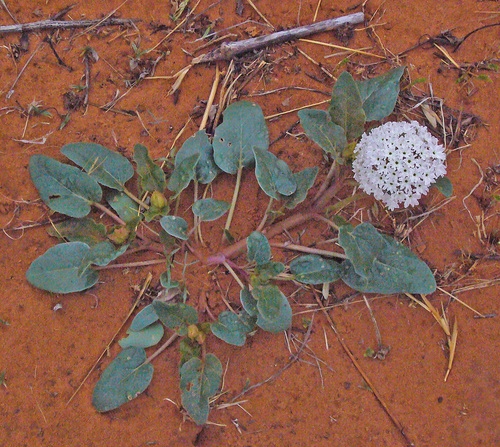
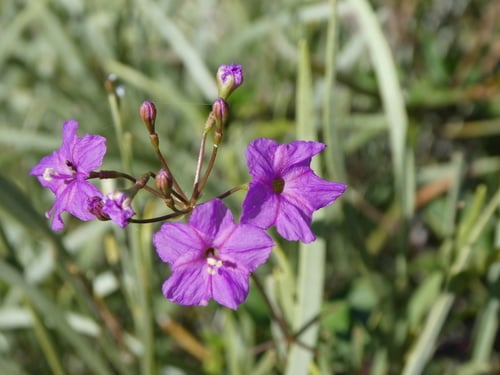
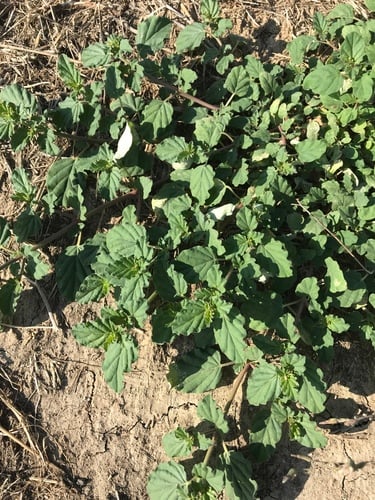
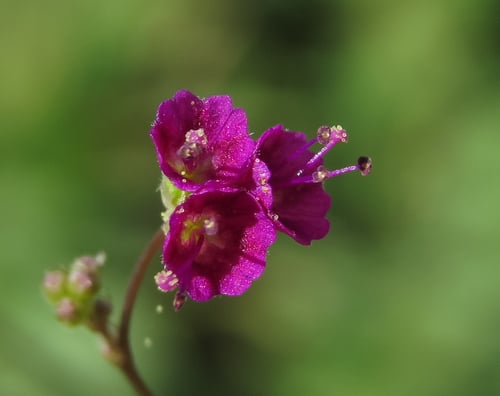
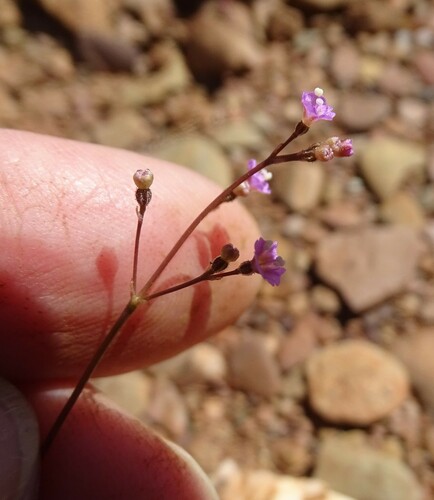
A tough, monsoon-responsive desert annual/short-lived perennial that briefly greens the landscape and supports small pollinators, but offers minimal edible value and significant sensory drawbacks. Best appreciated as a native component of desert ecology, not as a foraging target. Identification & Habit: Coulter’s spiderling is a low, often sprawling annual or short-lived perennial with multiple thin, green to reddish, wiry branches arising from a small crown. Leaves are opposite but often unequal in each pair, simple, entire to faintly wavy, and variable in shape from narrow-lanceolate to rounded; surfaces are thin and quickly wilt in dry air. Inflorescences are open cymes borne on threadlike stalks; individual flowers are tiny, white to pinkish, 5-lobed, and funnel-bell shaped. Fruits are distinctive club- to ob-pyramidal anthocarps with 3–5 ribs or angles; surfaces can be tacky, aiding dispersal. Plants emerge quickly after summer rains, set many small fruits, and then senesce. Growing Conditions: Best in very well-drained sandy or gravelly soils with full, intense sun, reflective heat, and episodic summer moisture. Extremely drought-tolerant between rain pulses; over-irrigation or heavy, wet soils reduce vigor. Neutral to slightly alkaline substrates are typical; salinity tolerance is moderate. Habitat & Range: Native to deserts and desert grasslands—roadsides, washes, open flats, and disturbed sites—across Arizona, New Mexico, southern Nevada, far west Texas, and into northern Mexico. Most abundant where summer rainfall is reliable. Size & Landscape Performance; Plants are typically 10–30 cm tall and wider than tall, forming loose, open mats or airy mounds to 20–60 cm across. In designed landscapes it offers ephemeral, quick green-up after summer storms, filling gaps among cacti and stones, then quietly disappearing as heat and drought resume. Cultivation (Horticulture): Treat as a warm-season annual in most settings. Direct-sow just before expected summer rains or irrigate sparingly to mimic a storm event, then allow soil to dry between pulses. No fertilization is needed; excess nutrients encourage rank, floppy growth. Because it is visually delicate and short-lived, it is best used in naturalistic desert plantings or habitat restoration rather than formal beds.
Propagation
Seed is straightforward: sow shallowly (lightly covered) onto warm, free-draining media; germination follows moisture pulses. No stratification is required. Transplanting is possible at small size but seedlings establish best in place. Vegetative propagation is impractical given the wiry habit and short lifecycle.
Other Uses
Ecology & Wildlife: Flowers provide small quantities of nectar/pollen for minute desert pollinators during the monsoon window. The plant’s rapid boom-and-bust cycle converts brief moisture pulses into seed and modest cover, contributing to patchy ground-layer diversity. Sticky or ribbed anthocarps aid epizoochorous dispersal (on fur, feathers, clothing).
Synonyms
Also Known As
Boerhavia coulteri (Coulter’s Spiderling)