Boerhavia diffusa
L.
Hogweed, Tar vine, Red hogweed
iNaturalist· cc-by-nc
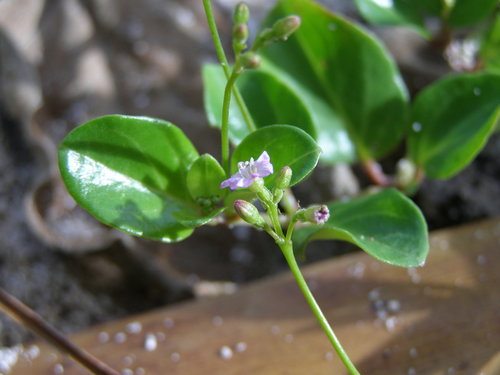
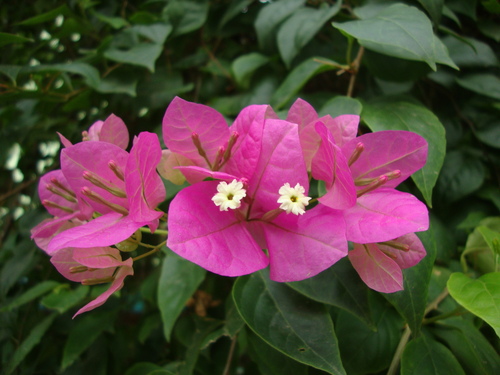
(c) Breno Farias, some rights reserved (CC BY-NC), uploaded by Breno Farias
iNaturalist· cc-by-sa
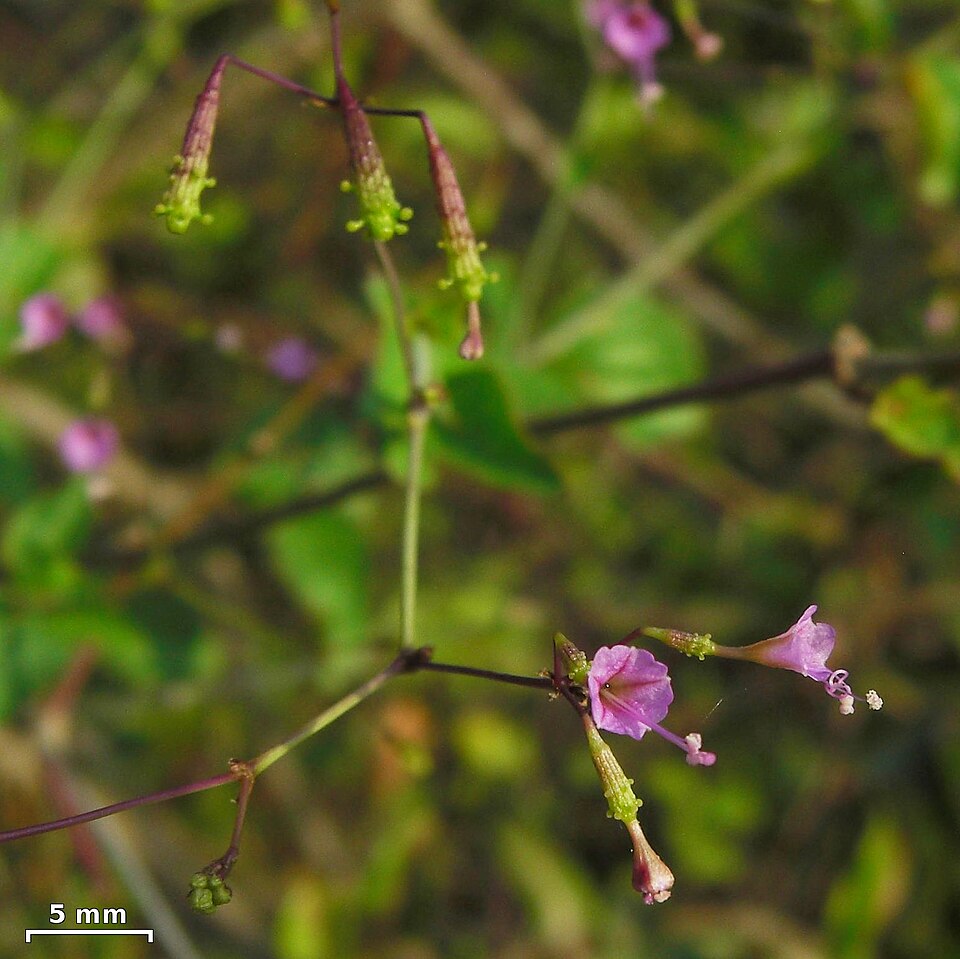
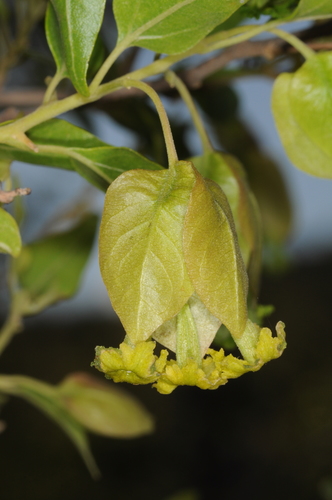
(c) Douglas Goldman, some rights reserved (CC BY-SA), uploaded by Douglas Goldman
iNaturalist· cc-by-sa
(c) Nicola van Berkel, some rights reserved (CC BY-SA), uploaded by Nicola van Berkel
Summary
Source: WikipediaBoerhavia diffusa is a species of flowering plant in the four o'clock family which is commonly known as punarnava (meaning that which rejuvenates or renews the body in Ayurveda), red spiderling, spreading hogweed, or tarvine. It is taken in herbal medicine for pain relief and other uses. The leaves of Boerhavia diffusa are often used as a green vegetable in many parts of India.
Description
A weedy evergreen vine or shrub which lays over. It grows to 70 cm high. It spreads about 50-200 cm wide. The stem is slender, creeping and twining. It has a large root system. The leaves are dull green and in opposite unequal pairs. They are 1-2.5 cm long by 1-2 cm wide. The lower leaves are broadly oval while the upper leaves are more narrow. The edges of the leaves are wavy. The flowers are yellow and white or pink. They occur in groups of 3 at the ends of branches. They are 0.5 cm long. The fruit are about 0.4 cm long. They have glands that make them sticky. In a similar plant Boerhavia erecta the fruit are smooth and not sticky.,
Edible Uses
Edible Parts: Leaves Root Seed Edible Uses: Edible portion: Leaves, Root, Fruit, Seeds, (Caution) Vegetable. Root - eaten by the Aborigines of central Australia. The root is long, thick and fleshy. Leaves - cooked as a pot herb or added to soups. Occasionally used as a vegetable. Seeds - cooked. Added to cereals.
Traditional Uses
The tender leaves are chopped small and then eaten cooked as a vegetable. The harvested leaves can be stored for 6-7 days. The fleshy taproot is baked and eaten. It is also eaten raw. The seeds are added to cereals. Caution: It may cause diarrhoea if eaten in large amounts.
Medicinal Uses
Antidote Diuretic Dysentery Emetic Expectorant Laxative Stomachic Spreading hogweed is used in traditional medicine in several parts of its range, but is especially popular in India where it is a part of the Ayurvedic tradition. The whole herb, including the root, is used and it is said to be bitter, diaphoretic, diuretic, emetic, expectorant, laxative and stomachic. Research has shown the presence of an alkaloid, beta sitosterol and various other compounds in the roots An alcohol extract of the whole plant has shown significant antiinflammatory activity, a cardiotonic effect, an increase in blood pressure, a relaxant effect and promising diuretic activity. The plant is emetic and purgative. It is used in the treatment of various conditions including gastric disturbances, asthma, jaundice, anascara, anaemia and internal inflammation. It has also been used as an antidote to snake venom. A decoction of the leaves is used to treat jaundice. The leaves are used in a cataplasm for treating indurated liver. The root can be used as an ipecacuanha (Carapichea ipecacuanha) substitute. Antispasmodic, very astringent, diuretic, emetic, emmenagogue, purgative and sudorific herb, it can be used in a decoction to treat dysentery and a range of other conditions. The boiled roots are applied to ulcers, abscesses and to assist in the extraction of Guinea worm.
Known Hazards
The very viscid perianth tube containing the fruit readily adheres to other objects and detaches itself from the plant. Small insects are caught by the secretion, and young chickens and turkeys sometimes die in consequence of their eyes becoming sealed up by the sticky fruits.
Distribution
It is a warm region or tropical plant. It will grow on most soils. It is drought and frost resistant and very hardy. It does best in an open sunny position. It forms a good ground cover in dry regions. It grows throughout Nepal to about 2300 m altitude. It grows in areas with an annual rainfall above 300 mm. It can grow in arid places. In XTBG Yunnan.
Where It Grows
Afghanistan, Africa, Angola, Argentina, Asia, Australia (Not), Bangladesh, Benin, Bhutan, Bolivia, Botswana, Brazil, Burkina Faso, Cambodia, Chile, China, Congo DR, Côte d'Ivoire, Dominican Republic, East Africa, Easter Island, Eswatini, Fiji, Gambia, Guam, Guiana, Guianas, Guinea, Guinée, Guinea-Bissau, Guyana, Haiti, Himalayas, India, Indochina, Indonesia, Iran, Ivory Coast, Japan (Ryuku), Kenya, Kiribati, Laos, Liberia, Madagascar, Malawi, Malaysia, Maldives, Mali, Marshall Islands, Mauritania, Micronesia, Middle East, Mozambique, Myanmar, Namibia, Nepal, Nigeria, Niue, Northeastern India, Pacific, Pakistan, Papua New Guinea, PNG, Paraguay, Peru, Philippines, Rotuma, Rwanda, Samoa, Sao Tome and Principe, SE Asia, Senegal, Sierra Leone, South Africa, Southern Africa, South America, Sri Lanka, Suriname, Swaziland, Taiwan, Thailand, Tonga, Uruguay, Vietnam, West Africa, West Indies, Yemen, Zambia, Zimbabwe,
Cultivation
We have very little information on this species and do not know if it will be hardy in Britain, though judging by its native range it could succeed outdoors at least in the milder parts of this country. It is hardy to at least -7°c in Australian gardens but this cannot be translated directly to the British climate because our summers are cooler and our winters longer, colder and wetter. If the plant is capable of surviving our winters it is likely to need a sheltered very sunny position in a well-drained soil. Most if not all members of this genus have the same edible uses.
Propagation
Seed - we have no information on this species but suggest sowing the seed in a greenhouse in the spring. When they are large enough to handle, prick the seedlings out into individual pots and grow them on in the greenhouse for at least their first winter. Plant them out into their permanent positions in late spring or early summer, after the last expected frosts. Cuttings
Other Uses
Fodder Boerhavia diffusa is recorded as a host for the virus causing aubergine mosaic disease (EMV); as a host of zucchini yellow mosaic polyvirus (ZYMV); and as an alternative host for the cotton aphid (Aphis gossypii). Yield losses attributed to these factors are difficult to determine. Fodder/animal feed, Forage. Special Uses
Other Information
It is not known if it is used for food in Papua New Guinea. It is an important food in some places.
Notes
This plant has medicinal properties for kidney and urine conditions. There are about 40 Boerhavia species. They are mostly in the tropics and subtropics. Chemical composition (root): Sand (dry sample) = 0.34%; (fresh sample) = 0.17%. Silica (dry sample) = 0.22%; (fresh sample) = 0.11%. Calcium (dry sample) = 1.246%, (fresh sample) = 0.623%. Magnesium (dry sample) = 0.344%, (fresh sample) = 0.172%. Phosphorus (dry sample = 0.155^%, (fresh sample) = 0.077%. Potassium (dry sample) = 2.89%, (fresh sample) = 1.440%. Ca: 8.03. Fe: 345. Cu: 6. Mn: 20 (in ppm on dry P basis). Moisture = 50. Fibre (crude, dry sample) = 9.6%, (fresh sample) = 4.8%. Ether extract (dry sample) = 1.62%, (fresh sample) = 0.91%. Protein (crude, dry sample) = 9.1%, (fresh sample) = 4.56%. Ash (dry sample) = 8.42%, (fresh sample) = 4.21%. Carbohydrate (dry sample) = 71.2%, (fresh sample) = 35.6%. Albuminous nitrogen (dry sample) = 1.02%, (fresh sample) = 0.51%. Amido nitrogen (dry sample) = 0.44%; fresh sample) = 0.22%. Fuel value [calories] (dry sample) = 29.0, (fresh sample) = 58.0.
Nutrition
| Part | Moisture | kJ | kcal | Protein | Vit A | Vit C | Iron | Zinc |
|---|---|---|---|---|---|---|---|---|
| Fruit dried | 10.2 | 1363 | 326 | 8.3 | — | — | — | — |
| Root | 50 | 678 | 162 | 4.6 | — | — | 0.3 | — |
| Leaves | 82 | — | 52 | 4.5 | — | — | 7.8 | 0.4 |
Synonyms
Also Known As
Adegandheri, Agarra-pinto, Ama rra-pinto, Ambati kura, Anleewa, Aule sag, Batata-de-porco, Beambava, Beldroega-grande, Boduraalhu, Bredo-deporco, Bulga, Burandha gondi, Caa ruru i, Caa ruru pe, Celido nia, Dhagarphodiyu, Dibata bata, Etingel, Fendala, Ghetuli, Horse purslane, Huang xi xin, Ipecacuanha de Cayenne, Kalamatonga, Katule, Khaparfuti, Khomhin pak, Laije, Lengle, Mangalarety, M'guta, Mookkanacharana, Mookkirattai, Moradilla, Mozote morado, Mukatan kodi, Mukkarattai, Mukaratte-kirei, Ohoic arak, Patharphodiyu, Patherchatta, Pegajocilla, Pega-pinto, Punarnaba, Punarnava, Punarnava, Purnanava, Purnava, Purnonapa, Rakta punarnava, Sacha verdolaga, Samkanka, Sant, Santi, Saranathy, Sata, Satna, Serandai, Solidonia, Tagres, Tambadi vasu, Tangara, Tangaraca, Tanguara-mansa, Tedigui, Thazhuthama, Tikpeninla, Umujugurira, Vakka khaparo, Yerba tostada, Zhu er yan
References (111)
- Achigan-Dako, E, et al (Eds), 2009, Catalogue of Traditional Vegetables in Benin. International Foundation for Science.
- Ambasta, S.P. (Ed.), 2000, The Useful Plants of India. CSIR India. p 76
- Ara, R. I. T., 2015, Leafy Vegetables in Bangladesh. Photon eBooks. p 115
- Arinathan, V., et al, 2007, Wild edibles used by Palliyars of the western Ghats, Tamil Nadu. Indian Journal of Traditional Knowledge. 6(1) pp 163-168
- Arora, R. K., 2014, Diversity in Underutilized Plant Species - An Asia-Pacific Perspective. Bioversity International. p 37
Show all 111 references Hide references
- Banerjee, A., et al, 2013, Ethnobotanical Documentation of Some Wild Edible Plants in Bankura District, West Bengal, India. The Journal of Ethnobiology and Traditional Medicine. Photon 120 (2013) 585-590
- Baro, D., Baruah, S. and Borthukar, S. K. 2015, Documentation on wild vegetables of Baksa district, BTAD (Assam). Scholars Research Library. Archives of Applied Science Research, 2015, 7 (9):19-2
- Bircher, A. G. & Bircher, W. H., 2000, Encyclopedia of Fruit Trees and Edible Flowering Plants in Egypt and the Subtropics. AUC Press. p 60
- Bodkin, F., 1991, Encyclopedia Botanica. Cornstalk publishing, p 152
- Boedecker, J., et al, 2014, Dietary contribution of Wild Edible Plants to women’s diets in the buffer zone around the Lama forest, Benin – an underutilized potential. Food Sec. 6:833–849
- Bohra, N., et al, 2017, Ethnobotany of wild edible plants traditionally used by the local people in the Ramnagar regions from Nainital District, Uttarakhand, India. Biolife 5(1): 12-19
- Bonou, A., et al, 2013, Valeur economique des Produits Forestiers Non Ligneux (PFNL) au Benin. Editions Universitaires Europeennes p 91
- Burkill, H. M., 1985, The useful plants of west tropical Africa, Vol. 4. Kew.
- Burkill, I.H., 1966, A Dictionary of the Economic Products of the Malay Peninsula. Ministry of Agriculture and Cooperatives, Kuala Lumpur, Malaysia. Vol 1 (A-H) p 346
- Chauhan, S. H., et al, 2018, Consumption patterns of wild edibles by the Vasavas: a case study from Gujarat, India. Journal of Ethnobiology and Ethnomedicine (2018) 14:57
- Cherikoff V. & Isaacs, J., The Bush Food Handbook. How to gather, grow, process and cook Australian Wild Foods. Ti Tree Press, Australia p 188, 194
- Chowdery, T., et al, 2014, Wild edible plants of Uttar Dinajpur District, West Bengal. Life Science Leaflets. 47:pp 20-36 http://lifesciencesleaflets.ning.com
- Chowdhury, A. & Das, A. P., 2014, Conservation through sustainable utilization of wetland leafy vegetables of Terai and Duars, West Bengal, India. International Journal of Advanced Life Sciences (IJALS), 7(4) p 653
- Chowdhury, M. & Mukherjee, R., 2012, Wild Edible Plants Consumed by Local Communities of Maldah of West Bengal, India. Indian J.Sci.Res.3(2) : 163-170
- Clarke, P. A., 2013, The Aboriginal Ethnobotany of the Adelaide Region, South Australia. Transactions of the Royal Society of South Australia. (2013), 137(1): 97-126
- Codjia, J. T. C., et al, 2003, Diversity and local valorisation of vegetal edible products in Benin. Cahiers Agricultures 12:1-12
- Crawford, I. M., 1982, Traditional Aboriginal Plant Resources in the Kalumburu Area: Aspects in Ethno-economics. Records of the Western Australian Museum Supplement No. 15
- Cribb, A.B. & J.W., 1976, Wild Food in Australia, Fontana. p 146
- DADSWELL,
- Dalziel, J. M., 1937, The Useful plants of west tropical Africa. Crown Agents for the Colonies London.
- Dangol, D. R. et al, 2017, Wild Edible Plants in Nepal. Proceedings of 2nd National Workshop on CUAOGR, 2017.
- Dansi, A., et al, 2008, Traditional leafy vegetables and their use in the Benin Republic. Genet Resour Crop Evol (2008) 55:1239–1256
- Dutta, U., 2012, Wild Vegetables collected by the local communities from the Churang reserve of BTD, Assam. International Journal of Science and Advanced Technology. Vol. 2(4) p 119
- Elliot, W.R., & Jones, D.L., 1982, Encyclopedia of Australian Plants suitable for cultivation. Vol 2. Lothian. p 332
- Flora of Australia, Volume 4, Phytolaccaceae to Chenopodiaceae, Australian Government Publishing Service, Canberra (1984) p 13 NB species does not occur in Australia
- Flora of China @ efloras.org Volume 5
- Food Composition Tables for use in Africa FAO http://www.fao.org/infoods/directory No. 943
- Fowler, D. G., 2007, Zambian Plants: Their Vernacular Names and Uses. Kew. p 50
- Fox, F. W. & Young, M. E. N., 1982, Food from the Veld. Delta Books. p 278
- Grivetti, L. E., 1980, Agricultural development: present and potential role of edible wild plants. Part 2: Sub-Saharan Africa, Report to the Department of State Agency for International Development. p 30
- GUPTA & KANODIA,
- Gupta, S., et al, 2005, Analysis of nutrient and antinutrient content of underutilized green leafy vegetables. LWT 38:339-345
- Hall, N. et al, 1972, The Use of Trees and Shrubs in the Dry Country of Australia, AGPS, Canberra. p 178
- Harisha, R. P. & Padmavathy, S., 2013, Knowledge and Use of Wild Edible Plants in Two Communities in Malai Madeshwara Hills, Southern India. International Journal of Botany 9(2): 64-72.
- Henty, E.E., & Pritchard, G.S., 1973, Weeds of New Guinea and their control. Botany Bulletin No 7, Division of Botany, Lae, PNG. p 128
- Hossain, U. & Rahman, A., 2018, Study and quantitative analysis of wild vegetable floral diversity available in Barisal district, Bangladesh. Asian J. Med. Biol. Res. 2018, 4 (4), 362-371
- Hu, Shiu-ying, 2005, Food Plants of China. The Chinese University Press. p 383
- IRVINE;
- Jardin, C., 1970, List of Foods Used In Africa, FAO Nutrition Information Document Series No 2.p 59, 123
- Joshi, N., et al, 2007, Traditional neglected vegetables of Nepal: Their sustainable utilization for meeting human needs. Tropentag 2007. Conference on International Agricultural Research for Development.
- Joshi, N. & Siwakoti, M., 2012, Wild Vegetables Used by Local Community of Makawanpur District and Their Contribution to Food Security and Income Generation. Nepal Journal of Science and Technology Vol. 13, No. 1 (2012) 59-66
- Karthi, Sathya, & Salome, 2014, Uncultivated Edible Greens from Small Millet Farms Tamil Nadu India. IDRC
- Koni, J. M. & Bostein, K., 2008, Noms et usages des plantes utiles chez les Nsong, DR Congo. University of Gothenburg. Department of Oriental and African Languages. p 27
- Kouahkou-Siransy, G., et al, 2010, Oxygen species scavenger activities and phenolic contents of four West African plants. Food Chemistry 118: 430-435
- Kumar, A., 2013, Ethnobotanical study of wild vegetables used by rural communities of Kannauj district, Uttar Pradesh, India. Emir. J. Food Agric. 2013. 25 (10): 760-766
- Latham, P., 2004, Useful Plants of Bas-Congo province. Latham & DFID p 52
- Latham, P. & Mbuta, A. K., 2014, Useful Plants of Bas-Congo Province, Democratic Republic of Congo. Volume 1. Salvation Army. p 80
- Latz, P.K., 1996, Bushfires and Bushtucker: Aboriginal plant use in Central Australia. IAD Press Alice Springs p 130
- Levitt, D., 1981, Plants and people. Aboriginal uses of plants on Groote Eylandt. Australian Institute of Aboriginal Studies, Canberra. p 111
- Lim, T. K., 2015, Edible Medicinal and Non Medicinal Plants. Volume 9, Modified Stems, Roots, Bulbs. Springer p 16
- Long, C., 2005, Swaziland's Flora - siSwati names and Uses http://www.sntc.org.sz/flora/
- Low, T., 1991, Wild Food Plants of Australia. Australian Nature FieldGuide, Angus & Robertson. p 160
- Lu De-quan, Nyctaginaceae. Flora of China
- Macmillan, H.F. (Revised Barlow, H.S., et al), 1991, Tropical Planting and Gardening. Sixth edition. Malayan Nature Society. Kuala Lumpur. p 356
- Malezas Comestibles del Cono Sur, INTA, 2009, Buernos Aires
- Manandhar, N.P., 2002, Plants and People of Nepal. Timber Press. Portland, Oregon. p 116
- Martin, F.W. & Ruberte, R.M., 1979, Edible Leaves of the Tropics. Antillian College Press, Mayaguez, Puerto Rico. p 208
- McMakin, P.D., 2000, Flowering Plants of Thailand. A Field Guide. White Lotus. p 99
- Mertz, O., Lykke, A. M., and Reenberg, A., 2001, Importance and Seasonality of Vegetable Consumption and Marketing in Burkina Faso. Economic Botany, 55(2):276-289
- Morley, B.D., & Toelken, H.R., (Eds), 1983, Flowering Plants in Australia. Rigby. p 71
- Muzila, M., 2006. Boerhavia diffusa L. [Internet] Record from Protabase. Schmelzer, G.H. & Gurib-Fakim, A. (Editors). PROTA (Plant Resources of Tropical Africa), Wageningen, Netherlands. < http://database.prota.org/search.htm>. Accessed 14 October 2009.
- Narayanan Ratheesh, M. K. et al, 2011, Wild edible plants used by the Kattunaikka, Paniya and Kuruma tribes of Wayanad District, Kerala, India. Journal of Medicinal Plants Research Vol. 5(15), pp. 3520-3529
- Okigbo, B.N., Vegetables in Tropical Africa, in Opena, R.T. & Kyomo, M.L., 1990, Vegetable Research and development in SADCC countries. Asian Vegetable Research and development Centre. Taiwan. p 44
- Parham, B. E. V., 1972, Plants of Samoa. New Zealand Department of Scientific and Industrial Research. Information Series. No. 85 p 136
- Patiri, B. & Borah, A., 2007, Wild Edible Plants of Assam. Geethaki Publishers. p 106
- Peekel, P.G., 1984, (Translation E.E.Henty), Flora of the Bismarck Archipelago for Naturalists, Division of Botany, Lae, PNG. p 172, 171
- Peters, C. R., O'Brien, E. M., and Drummond, R.B., 1992, Edible Wild plants of Sub-saharan Africa. Kew. p 155
- Pham-Hoang Ho, 1999, An Illustrated Flora of Vietnam. Nha Xuat Ban Tre. p 717
- Plants for a Future database, The Field, Penpol, Lostwithiel, Cornwall, PL22 0NG, UK. http://www.scs.leeds.ac.uk/pfaf/
- Plants of Haiti Smithsonian Institute http://botany.si.edu/antilles/West Indies
- Plowes, N. J. & Taylor, F. W., 1997, The Processing of Indigenous Fruits and other Wildfoods of Southern Africa. in Smartt, L. & Haq. (Eds) Domestication, Production and Utilization of New Crops. ICUC p 186
- Pradhan, R., et al, 2020, Potential Wild Edible Plants and its Significance in Livelihood of Indigenous People of Male Mahadeshwara Hills, Karnataka. Economic Affairs Vol. 64, No. 4 pp. 01-14
- Prafulla, S., 2017, Wild Food Diversity of Nawegaon-Nagzira Tiger Reserve in Gondia-Bhandara district of Maharashtra, India. Int. J. of Life Sciences, 2017, Vol. 5 (4): 620-626
- Rajkalkshmi, P. et al, 2001, Total carotenoid and beta-carotene contents of forest green leafy vegetables consumed by tribals of south India. Plant Foods for Human Nutrition 56:225-238
- Ramachandran, V. S., 2007, Wild edible plants of the Anamalais, Coimbatore district, western Ghats, Tamil Nadu. Indian Journal or Traditional Knowledge. 6(1) pp 173-176
- Rao, M. L. S., et al, 2014, Indigenous Plant Foods which are commonly consumed by the tribal communities in Dumbriguda Area of Visakhapatnam District, Andhra Pradesh, India. Biolife. Vol 2, Issue 3
- Rasingam, L., 2012, Ethnobotanical studies on the wild edible plants of Irula tribes of Pillur Valley, Coimbatore district, Tamil Nadu, India. Asian Pacific Journal of Tropical Biomedicine. (2012) S1493-S1497
- Ray, A., et al, 2020, How many Wild Edible Plants do we Use. Frontiers in Sustainable Food Systems. 4:56 p 12
- Reddy, B. M., 2012, Wild edible plants of Chandrapur district, Maharashtra, India. Indian Journal of Natural Products and Resources. 3(1) pp 110-117
- Royal Botanic Gardens, Kew (1999). Survey of Economic Plants for Arid and Semi-Arid Lands (SEPASAL) database. Published on the Internet; http://www.rbgkew.org.uk/ceb/sepasal/internet [Accessed 4th May 2011]
- Ruiters-Welcome, A. K., 2019, Food plants of southern Africa. Ph.D. thesis. Univ. of Johannesburg p 81
- Sakar, A. & Das, A. P., 2018, The traditional knowledge on edible wild leafy vegetables of Rabha Tribe in Duars of North Bengal: a potential reinforcement to food security. Pleione 12(2): 275 - 281. 2018.
- Scarpa, G. F., 2009, Wild food plants used by the indigenous peoples of South American Gran Chaco: A general synopsis and intercultural comparison. Journal of Applied Botany and Food Quality 83:90-101 (As var. leiocarpa)
- Sarma, H., et al, 2010, Updated Estimates of Wild Edible and Threatened Plants of Assam: A Meta-analysis. International Journal of Botany 6(4): 414-423
- Sarvalingam, A., et al, 2014, Wild edible plant resources used by the Irulas of the Maruthamalai Hills, Southern Western Ghats, Coimbatore, Tamil Nadu. Indian Journal of Natural Products and Resources 5(2):198-201
- Setiya, A. V., et al, 2016, Exploration and documentation of some wild edible plants used by the aboriginals from Gadchiroli District (M.S.) India. International Advanced Research Journal in Science, Engineering and Technology. 3(7)
- SHANKARNARAYAN & SAXENA,
- Singh, A. G., Panthi, M. P., & Tewari, D. D., 2012, Wild Plants Used as Vegetable in Rupandehi District of Nepal and their Ethnomedicinal Importance. J. Nat. Hist. Mus. Vol. 26, 2012, 111-125
- Singh, H.B., Arora R.K.,1978, Wild edible Plants of India. Indian Council of Agricultural Research, New Delhi. p18
- Sinha, R. & Lakra, V., 2007, Edible weeds of tribals in Jharkhand, Orissa and West Bengal. Indian Journal of Traditional Knowledge 6(1) January 2007 pp 217-222
- Smith, A.C., 1981, Flora Vitiensis Nova, Lawaii, Kuai, Hawaii, Volume 2 p 264
- Specht, R.L., 1958,
- Sp. pl. 1:3. 1753
- Sujanapal, P., & Sankaran, K. V., 2016, Common Plants of Maldives. FAO & Kerala FRI, p 56
- Swaziland's Flora Database http://www.sntc.org.sz/flora
- Terra, G.J.A., 1973, Tropical Vegetables. Communication 54e Royal Tropical Institute, Amsterdam, p 29
- Thaman, R. R., 1992, Batiri Kei Baravi: The Ethnobotany of Pacific Island Coastal Plants. Atoll Research Bulletin. No. 361.
- Vernon, R., 1983, Field Guide to Important Arable Weeds of Zambia. Dept of Agriculture, Chilanga, Zambia. p 30
- WATT
- Welcome, A. K. & Van Wyk, B.-E., 2019, An inventory and analysis of the food plants of southern Africa. South African Journal of Botany 122 (2019) 136–179
- World Checklist of Useful Plant Species 2020. Royal Botanic Gardens, Kew
- Wrigley, J.W., & Fagg, M., 1982, Australian Native Plants. Collns. p 7
- Yuncker, T. G., 1943, The Flora of Niue Island. Bernice P. Bishop Museum Bulletin 178 p 52
- Yuncker, T.G., 1959, Plants of Tonga, Bernice P. Bishop Museum, Hawaii, Bulletin 220. p 109
- Zizka, G., 1991, Flowering Plants of Easter Island. Palmarum Hortus Francofurtensis
- Zon, A.P.M. van der, Grubben, G.J.H., 1976, Les legumes-feuilles spontanes et cultives du Sud-Dahomey, Communication 65, Royal Tropical Institute, Amsterdam, p 38