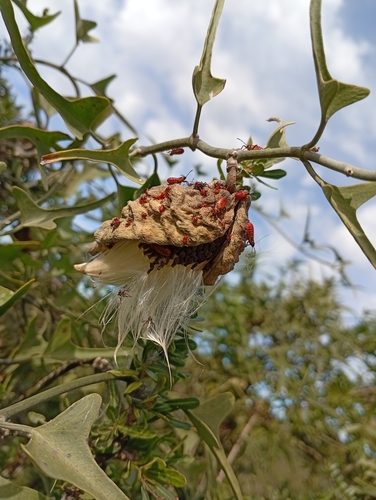
Asclepias subverticillata - (A.Gray) Vail
(A.Gray) Vail
Poison Milkweed
gbif· cc-by
Jackson Irvin
gbif· cc-by
Jackson Irvin
gbif· cc-by-nc
Priscilla Titus
Description
Asclepias subverticillata is a PERENNIAL growing to 0.4 m (1ft 4in) by 0.3 m (1ft) at a fast rate. See above for USDA hardiness. It is hardy to UK zone 7 and is not frost tender. The flowers are pollinated by Bees, Insects. It is noted for attracting wildlife. Suitable for: light (sandy) and medium (loamy) soils and prefers well-drained soil. Suitable pH: mildly acid, neutral and basic (mildly alkaline) soils. It cannot grow in the shade. It prefers dry or moist soil.
Edible Uses
Edible parts (after thorough boiling): Leaves only, but very bitter and unpleasant. Preparation: Requires multiple water changes; still unsatisfactory. Safety: Extremely toxic raw; dangerous even after cooking.
Known Hazards
Extremely toxic raw; dangerous even after cooking. Although no specific reports have been seen for this species, many, if not all, members of this genus contain toxic resinoids, alkaloids and cardiac glycosides. They are usually avoided by grazing animals.
Distribution
Arizona, New Mexico, Colorado, and surrounding states.
Where It Grows
USA. Arizona, Colorado, Kansas, Mexico Northeast, Mexico Northwest, Mexico Southeast, Mexico Southwest, Missouri, New Mexico, Oklahoma, Texas, Utah, Wyoming
Cultivation
Form: Perennial herb, 30–80 cm tall, thread-like leaves. Leaves: Very narrow, linear, whorled. Flowers: White to greenish. Bloom: May–September. Hardiness: USDA zones 6–10. Weed Potential: Locally dominant; toxic to livestock.
Propagation
Seed; colonizes easily.
Synonyms
Also Known As
Horsetail / Poison Milkweed (Asclepias subverticillata)