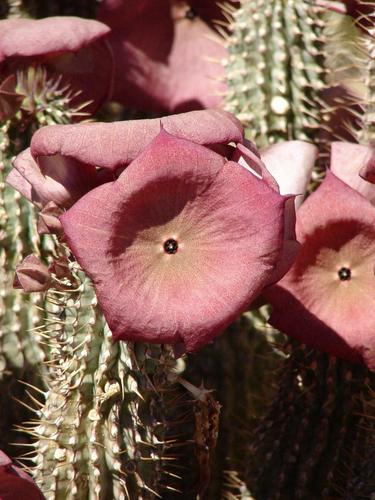
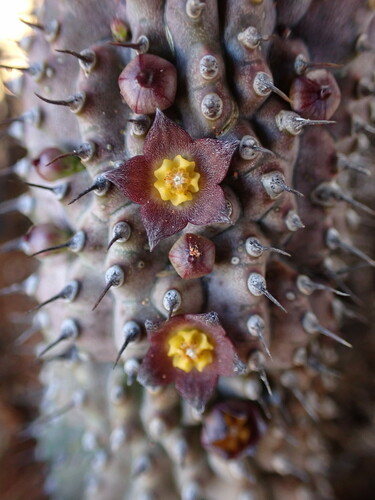
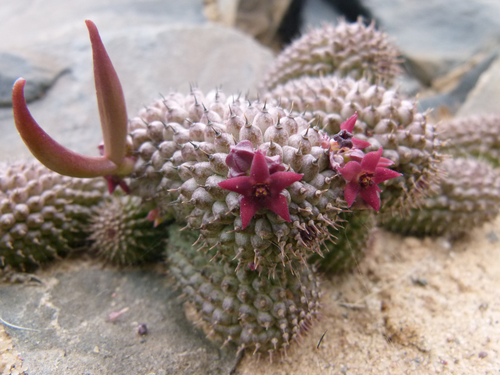
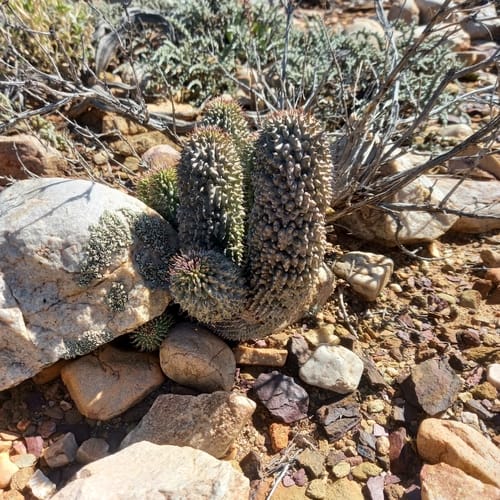
Dregea volubilis
(Linnaeus f.) Bentham ex J. D. Hooker
Green milkwood climber
iNaturalist· cc-by-nc
(c) Radha Veach, some rights reserved (CC BY-NC)
iNaturalist· cc-by-nc
(c) Radha Veach, some rights reserved (CC BY-NC)
iNaturalist· cc-by-nc
(c) Radha Veach, some rights reserved (CC BY-NC)
Description
A climbing herb or vine. Leaves are oblong and narrow to a point. They are rounded at the base. They are 6-11 cm long by 4-7.5 cm wide. The leaf stalks is 3-6 cm long. The flowers are in the axils of leaves in groups. They are 5-9 cm long. The fruit are in dry sacs. The fruit are 5 cm long and 2.5 cm wide. The seeds are yellow and oval and flat.
Edible Uses
Young leaves are boiled, drained, and eaten in curries or cooked dishes. Flowers are fried as a vegetable. Ripe fruit, seeds, and roots are also eaten. The plant is cultivated as a microgreen and sold in local markets.
Traditional Uses
The young leaves are eaten in curries but also cooked. They are boiled and drained. The flowers are cooked as a vegetable. They are fried. The ripe fruit is eaten. The seeds are eaten. The root is eaten.
Medicinal Uses
The plant is used in traditional medicine.
Distribution
A tropical plant. It grows in dry evergreen forest in north Thailand. In India it grows in all kinds of soils at altitudes up to 2,000 meters. It is being grown as a microgreen. In XTBG Yunnan.
Where It Grows
Asia, Bangladesh, Cambodia, China, Himalayas, India, Indochina, Indonesia, Kashmir, Laos, Malaysia, Nepal, Northeastern India, Pacific, Philippines, SE Asia, Sri Lanka, Taiwan, Thailand, Vietnam,
Cultivation
Plants can be grown from seeds or from stem cuttings.
Other Uses
A fine fiber is obtained from the stems. The stem is used as a cordage substitute for binding bundles of wood. A methanol extraction of the leaf powder has been shown to be a potent larvicide in mosquito control programmes. The extract from the plant could be used in stagnant water bodies which are known to be the breeding grounds for mosquitoes.
Other Information
It is sold in local markets.
Notes
It is also used in medicine. Chemical composition (after Paton & Dunlop) (grams per 100g): Protein = 14.62g. Fat = 7.60g. Carbohydrate (soluble) = 41.08g. Fibre = 23.50g. Ash = 4.50g. Water = 8.70g. Calories = 299.
Nutrition
| Part | Moisture | kJ | kcal | Protein | Vit A | Vit C | Iron | Zinc |
|---|---|---|---|---|---|---|---|---|
| Leaves | 85.7 | 188 | 45 | 4 | — | 99 | — | — |
Synonyms
Also Known As
Akar lilin hijau, Ambri, Chiri, Cotton milk plant, Doda, Dodi, Dudhipaala, Dugdhika, Dugdhike, Gharphul, Hemajivanti, Hirandodi, Jukti, Kadvishir, Kamal, Khamal-lota, Kharkhodi, Kiri-anguna, Kodipalai, Kra thung maabaa, Ku cai, Kurinja, Ku teng, Madhumalati, Malati, Ma ying mei, Milkwid hijau, Nak-chhikni, Nan shan teng, Oriya, Pagaiwuonu, Pa men, Perunkurinchan, Phundi, Shendri, Sneeze wort, Thei-kel-ki, Titakunga, Titta-anguna, Vattakkakkakkodi
References (25)
- Ambasta, S.P. (Ed.), 2000, The Useful Plants of India. CSIR India. p 183
- Anderson, E. F., 1993, Plants and people of the Golden Triangle. Dioscorides Press. p 210
- Bandyopadhyay, S., et al, 2012, A Census of Wild Edible Plants from Howrah District, West Bengal, India. Proceedings of UGC sponsored National Seminar 2012
- Cao, Y., et al, 2020, Ethnobotanical study on wild edible plants used by three trans-boundary ethnic groups in Jiangcheng County, Pu’er, Southwest China. Journal of Ethnobiology and Ethnomedicine (2020) 16:66
- Chauhan, S. H., et al, 2018, Consumption patterns of wild edibles by the Vasavas: a case study from Gujarat, India. Journal of Ethnobiology and Ethnomedicine (2018) 14:5
Show all 25 references Hide references
- Flora and Livestock in Coastal Karnataka. 2007, Report. EMPRI p 192 (As Wattakaka volubilis)
- Flora of China. www.eFloras.org
- GAMMIE; (Also as Hoya viridiflora)
- Hedrick, U.P., 1919, (Ed.), Sturtevant's edible plants of the world. p 282
- Jacquat, C., 1990, Plants from the Markets of Thailand. D.K. Book House p 86
- Japanese International Research Centre for Agricultural Science www.jircas.affrc.go.jp/project/value_addition/Vegetables
- Kar, A., et al, 2013, Wild Edible Plant Resources used by the Mizos of Mizoram, India. Kathmandu University Journal of Science, Engineering and Technology. Vol. 9, No. 1, July, 2013, 106-126 (As Wattakaka volubilis)
- Li Ping-tao; Michael G. Gilbert, W. Douglas Stevens, ASCLEPIADACEAE Flora of China.
- Liu, Yi-tao, & Long, Chun-Lin, 2002, Studies on Edible Flowers Consumed by Ethnic Groups in Yunnan. Acta Botanica Yunnanica. 24(1):41-56
- Luo, B., et al, 2019, Wild edible plants collected by Hani from terraced rice paddy agroecosystem in Honghe Prefecture, Yunnan, China. Journal of Ethnobiology and Ethnomedicine 15:56
- Macmillan, H.F. (Revised Barlow, H.S., et al), 1991, Tropical Planting and Gardening. Sixth edition. Malayan Nature Society. Kuala Lumpur. p 356
- Martin, F.W. & Ruberte, R.M., 1979, Edible Leaves of the Tropics. Antillian College Press, Mayaguez, Puerto Rico. p 177
- Nakahara, K. et al, 2002, Antimutagenicity of Some Edible Thai Plants, and a Biocative Carbazole Alkaloid, Mahanine, Isolated from Micromelum minutum. Journal of Agricultural and Food Chemistry. 50: 4796-4892
- PATON & DUNLOP, (As Hoya viridiflora)
- Rajapaksha, U., 1998, Traditional Food Plants in Sri Lanka. HARTI, Sri Lanka. p 88
- SHORTT, (As Hoya viridiflora)
- Singh, H.B., Arora R.K.,1978, Wild edible Plants of India. Indian Council of Agricultural Research, New Delhi. p 39 (As Marsdenia volubilis)
- Sivakumar, A. & Murugesan, M., 2005, Ethnobotanical Studies of the wild edible plants used by the tribals of the Anaimalai Hills, the Western Ghats. Ancient Science of Life. XXV(2) Oct-Dec. (As Wattakaka volubilis)
- WATT, (Also as Hoya viridiflora)
- Xu, You-Kai, et al, 2004, Wild Vegetable Resources and Market Survey in Xishuangbanna, Southwest China. Economic Botany. 58(4): 647-667.