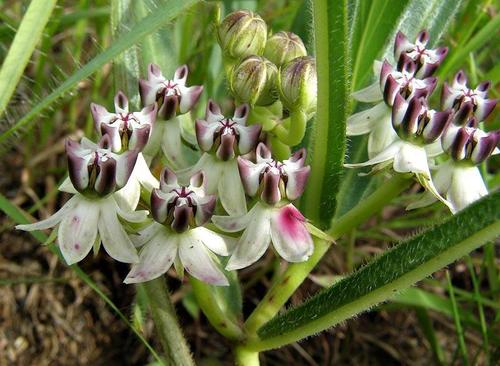
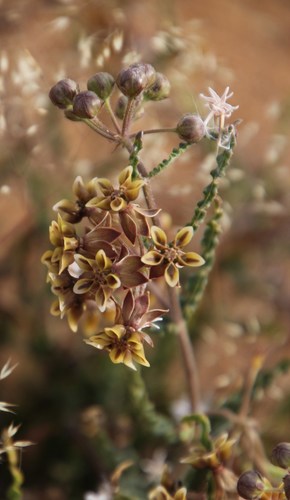
Duvalia polita
N. E. Br.
Polished star
iNaturalist· cc-by-nc
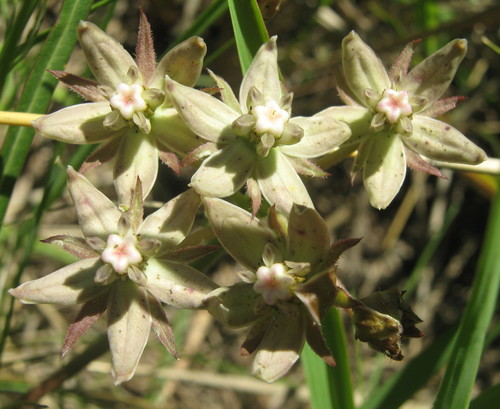
(c) Bart Wursten, some rights reserved (CC BY-NC), uploaded by Bart Wursten
iNaturalist· cc-by-nc
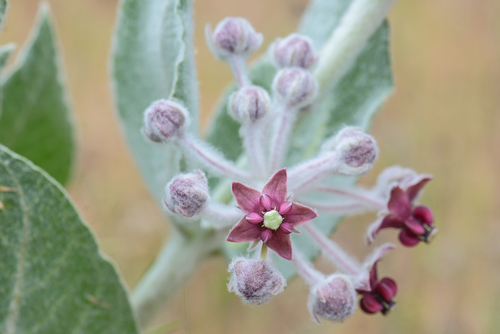
(c) nolliecilliers, some rights reserved (CC BY-NC)
Description
A succulent plant. The plant is leafless and it is the stems that are used. The stems are succulent. They are 8 cm long and 1.3 cm thick. They are bluntly 6 angled with pointed teeth. It has runners or stolons. The plant forms a clump. The flowers occur as 3 or 4 together. They open one after the other. The flower tube is 3 cm across.
Edible Uses
The above-ground shoots are eaten raw. The underground stems are eaten roasted and provide water. The plant is also baked in hot ashes and pounded with other foods including nuts.
Traditional Uses
The above ground shoots are eaten raw. The underground stems are eaten roasted. They also provide water. The plant is baked in hot ashes then pounded with other foods including nuts.
Medicinal Uses
The plant is used in medicine.
Distribution
It is a subtropical and tropical plant. They need warm conditions. In Swaziland it grows in the lowveld. It is best in rich, sandy, well-drained soils. It needs a protected, shaded position. It is damaged by frost or drought. It re-grows after fire. In southern Africa it grows between 1,000-1,600 m above sea level. In Namibia it grows in places where the dry season is 6-11 months. It can grow in arid places.
Where It Grows
Africa*, Angola, Australia, Botswana, Central Africa, East Africa, Eswatini, Malawi, Mozambique, Namibia, South Africa, Southern Africa, Swaziland, Zambia, Zimbabwe,
Cultivation
It can be grown by seed or cuttings.
Other Information
The stems contain Vitamin C.
Notes
It is used in medicine.
Synonyms
Also Known As
Hottentot's toes, Tililo lomnocane
References (16)
- Anderson, M., 2002, The World Encyclopedia of Cacti and Succulents. Hermes House, New York. p 150 (Genus)
- Bodkin, F., 1991, Encyclopedia Botanica. Cornstalk publishing, p 367
- Fox, F. W. & Young, M. E. N., 1982, Food from the Veld. Delta Books. p 118
- Jardin, C., 1970, List of Foods Used In Africa, FAO Nutrition Information Document Series No 2.p 76
- Leger, S., 1997, A Description of Today's Use of Plants in West Bushmanland (Namibia). German Development Service. PO Box 220035, 14061 Berlin, Germany. http://www.sigridleger.de/book/
Show all 16 references Hide references
- Long, C., 2005, Swaziland's Flora - siSwati names and Uses http://www.sntc.org.sz/flora/
- Maguire, 1978,
- Martin, F.W. & Ruberte, R.M., 1979, Edible Leaves of the Tropics. Antillian College Press, Mayaguez, Puerto Rico. p 177
- Peters, C. R., O'Brien, E. M., and Drummond, R.B., 1992, Edible Wild plants of Sub-saharan Africa. Kew. p 63
- Plowes, N. J. & Taylor, F. W., 1997, The Processing of Indigenous Fruits and other Wildfoods of Southern Africa. in Smartt, L. & Haq. (Eds) Domestication, Production and Utilization of New Crops. ICUC p 190
- Royal Botanic Gardens, Kew (1999). Survey of Economic Plants for Arid and Semi-Arid Lands (SEPASAL) database. Published on the Internet; http://www.rbgkew.org.uk/ceb/sepasal/internet [Accessed 30th March 2011]
- Ruiters-Welcome, A. K., 2019, Food plants of southern Africa. Ph.D. thesis. Univ. of Johannesburg p 23
- Silberbauer, 1965, 1972, 1981,
- Swaziland's Flora Database http://www.sntc.org.sz/flora
- Welcome, A. K. & Van Wyk, B.-E., 2019, An inventory and analysis of the food plants of southern Africa. South African Journal of Botany 122 (2019) 136–179
- World Checklist of Useful Plant Species 2020. Royal Botanic Gardens, Kew