Eucalyptus intertexta
R. Baker
Inland Red Box, Gum-barked Coolibah, Western Red Box
iNaturalist· cc-by-nc
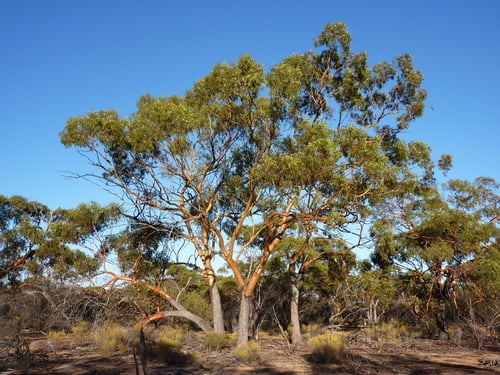
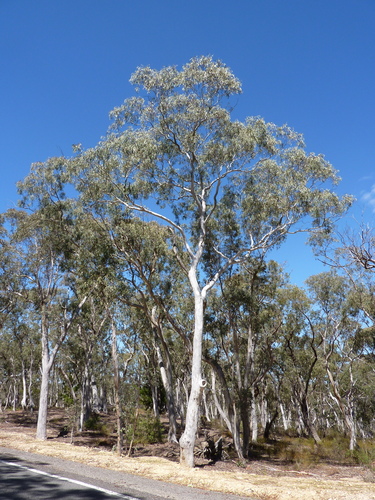
(c) Dean Nicolle, some rights reserved (CC BY-NC), uploaded by Dean Nicolle
iNaturalist· cc-by-nc
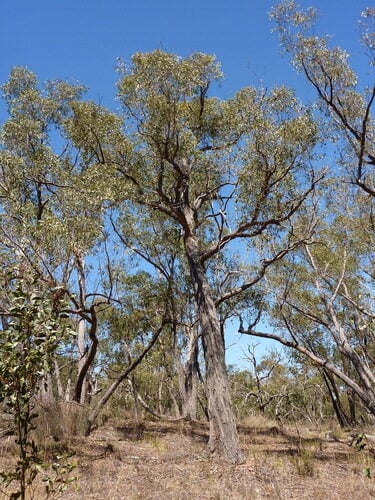
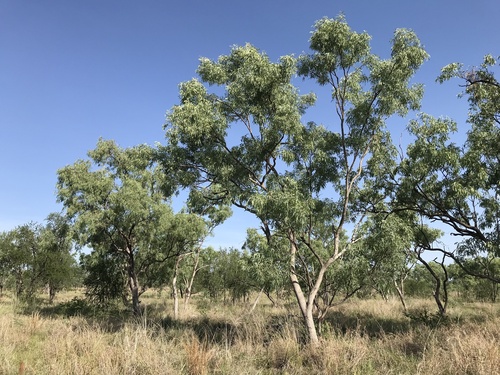
(c) Dean Nicolle, some rights reserved (CC BY-NC)
Summary
Source: WikipediaEucalyptus intertexta, commonly known as inland red box, western red box, gum coolibah or the bastard coolibah, is a species of tree that is endemic to central Australia. It has rough, fibrous or flaky bark on the base of the trunk, smooth white to brownish bark above, lance-shaped adult leaves, flower buds in groups of seven on the ends of branchlets, white flowers and cup-shaped to hemispherical fruit.
Description
A small to tall tree. It can be 7-25 m high. It spreads 4-15 m wide. The bark is rough and does not peel off. The upper branches are white. The leaves are broad and silvery. The flowers are white.
Edible Uses
The seeds are ground and used as food.
Traditional Uses
The seed are ground and used as food.
This uses section is brief — help expand it
Distribution
It grows in inland Australia. It suits warm temperate and semiarid locations. It needs well drained soil. It can grow in full sun or light shade. It can stand heavy frosts.
Where It Grows
Australia*,
Cultivation
Eucalyptus intertexta is a plant of arid areas from the warm temperate zone to the tropics, where it is found at elevations up to 1,250 metres. It grows best in areas where annual daytime temperatures are within the range 28 - 38°c, but can tolerate 10 - 42°c. Plants tolerate 10 - 15 frosts a year in the wild, though fresh young growth can be killed by temperatures of -1°c or lower, whilst temperatures down to -7°c will kill even the dormant plant. It prefers a mean annual rainfall in the range 300 - 600mm, but tolerates 150 - 700mm. Prefers a sunny position. Prefers a well-drained, light to medium soil, tolerating conditions of low fertility. Plants can tolerate a severe dry season of 8 months in the wild.Prefers a pH in the range 6 - 7, tolerating 5.5 - 8.8. The plant develops a lignotuber - this is a woody tuber that starts to develop near the base of seedlings and can become massive in the mature plants of some species. It possesses embedded vegetative buds, allowing the plant to regenerate following crown destruction, for example by fire. Annual wood production potential is 4 - 5 cubic metres per hectare.
Propagation
Seed - surface sow in a sunny position and make sure the compost is not allowed to dry out. Species that come from high altitudes appreciate 6 - 8 weeks cold stratification at 2°c. Pot up the seedlings into individual pots as soon as the second set of seed leaves has developed, if left longer than this they might not move well. The seedlings are ready for planting in the field when they are 25 - 30 cm tall, usually after 3 - 4 months. The seed has a long viability.
Other Uses
A small quantity of essential oil is obtained from the leaves. Total quantity of the oil, and its composition, can vary widely from plant to plant, but we have reports that the fresh leaves contain around 0.2 - 1.6% (1.5 - 1.5% dry weight) essential oil. The main components include pinene, 1,8-cineole (up to 68% in some reports), cymene, trans-pinocarveol, globulol and limonene. The heartwood is red; the narrow band of sapwood is white. The wood is hard, heavy, moderately durable in the ground and with a very interlocked grain. It is used in the round for farm construction. The wood is used for fuel.
Notes
There are at least 500 Eucalyptus species mostly originally in Australia.
Also Known As
Bastard Coolibah
References (12)
- Bodkin, F., 1991, Encyclopedia Botanica. Cornstalk publishing, p 429
- Boomsma, C.D., 1972, Native Tree of South Australia. Woods & Forests Department South Australia, Bulletin No.19. p 128
- Cronin, L., 1989, The Concise Australian Flora. Reed. p 196
- Elliot, W.R., & Jones, D.L., 1992, Encyclopedia of Australian Plants suitable for cultivation. Vol 4. Lothian. p 118
- Facciola, S., 1998, Cornucopia 2: a Source Book of Edible Plants. Kampong Publications, p 141
Show all 12 references Hide references
- Hall, N. et al, 1972, The Use of Trees and Shrubs in the Dry Country of Australia, AGPS, Canberra. p 370
- Hibbert, M., 2002, The Aussie Plant Finder 2002, Florilegium. p 97
- Lazarides, M. & Hince, B., 1993, Handbook of Economic Plants of Australia, CSIRO. p 102
- Molyneux, B. and Forrester, S., 1997, The Austraflora A-Z of Australian Plants. Reed. p 86
- Paczkowska, G . & Chapman, A.R., 2000, The Western Australian Flora. A Descriptive Calatogue. Western Australian Herbarium. p 373
- Proc. Linn. Soc. New South Wales 25:308. 1900
- World Checklist of Useful Plant Species 2020. Royal Botanic Gardens, Kew