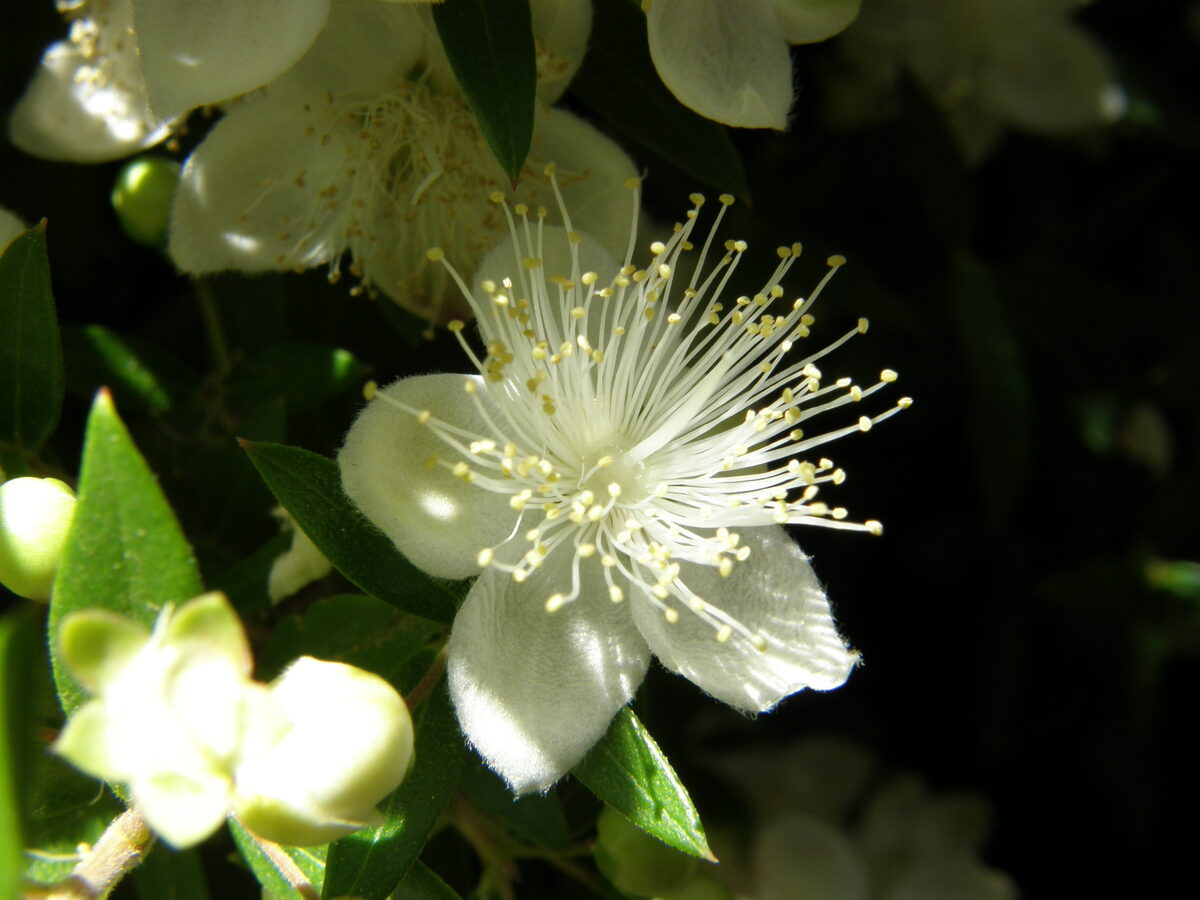
Decaspermum parviflorum
(Lam.) A. J. Scott
Silky Myrtle
iNaturalist· cc-by-nc
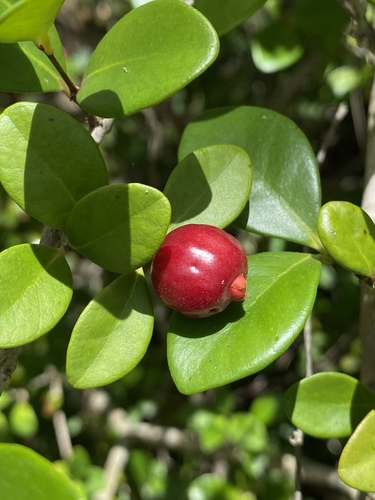
(c) Omar Faustino, some rights reserved (CC BY-NC), uploaded by Omar Faustino
iNaturalist· cc-by-nc
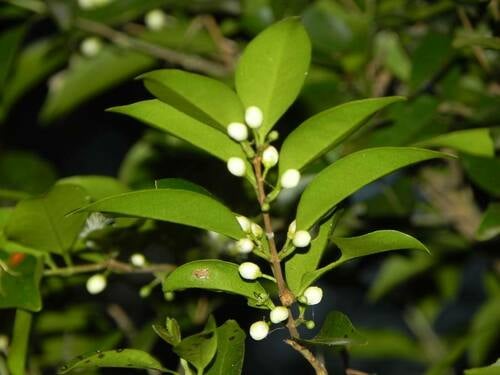
(c) Hiromi kobori, some rights reserved (CC BY-NC)
iNaturalist· cc-by-nc
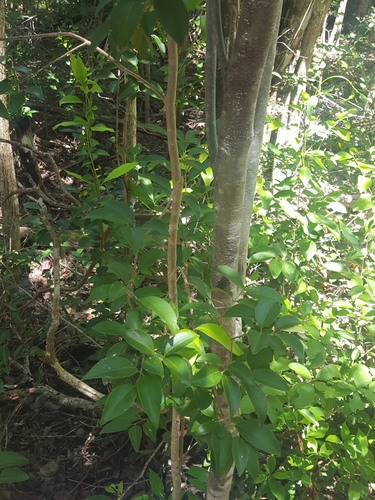
(c) Hiromi kobori, some rights reserved (CC BY-NC)
Description
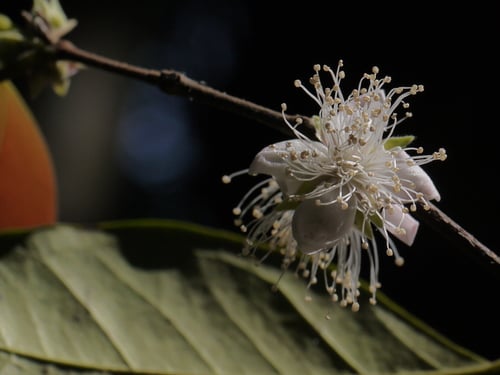
A small tree or shrub. The small branches are very numerous. The leaves are pink in new growth and have a fine covering of silky hairs. They are shiny and become soft green. The leaves are opposite with a blunt point at the base and smooth when old. The flower arrangement is at the ends of branches or from upper leaf axils. The petals are white or pink. The fruit are flat and round and turn red when ripe.
Edible Uses
Fruit - raw. The ripe fruit has a sweet flavour. The fruit is rounded, flattened, 5 - 8mm thick. The terminal shoots are used as a seasoning.
Traditional Uses
The ripe fruit are eaten raw.
This uses section is brief — help expand it
Medicinal Uses
The root, mixed with the leaves and root of Ixora elliptica, is boiled and the infusion is taken, to treat warm body and fatigue. The decoction is also used as a bath. The fruit is used as a remedy for stomach pains. The leaves are astringent. They are chewed with betel (Areca catechu) as a treatment for dysentery and also for helping the teeth become firm.
Distribution
A tropical plant. They are abundant in the Philippines in areas of shrub near the seacoast and to an altitude of 2000 m throughout the islands. In Yunnan.
Where It Grows
Asia, Australia, Cambodia, China, India, Indochina, Indonesia, Laos, Pacific, Malaysia, Micronesia, Myanmar, Northeastern India, Pacific, Palau, Philippines, SE Asia, Thailand, Tibet, Tonga, Vietnam,
Cultivation
Plants are grown from fresh seed or cuttings.
Other Information
The fruit are often eaten by children.
Notes
There are about 30 Decaspermum species.
Synonyms
Also Known As
A gong gong ni a bo, Lipet, Taung-thabye
References (11)
- Cooper, W. and Cooper, W., 2004, Fruits of the Australian Tropical Rainforest. Nokomis Editions, Victoria, Australia. p 342 (Decaspermum humile)
- Dobriyal, M. J. R. & Dobriyal, R., 2014, Non Wood Forest Produce an Option for Ethnic Food and Nutritional Security in India. Int. J. of Usuf. Mngt. 15(1):17-37
- Elliot, W.R., & Jones, D.L., 1984, Encyclopedia of Australian Plants suitable for cultivation. Vol 3. Lothian. p 213
- Gardner, S., et al, 2000, A Field Guide to Forest Trees of Northern Thailand, Kobfai Publishing Project. p 199
- Hibbert, M., 2002, The Aussie Plant Finder 2002, Florilegium. p 84
Show all 11 references Hide references
- Hoare, A., 2003, Food use of the Lundayeh SW Sabah. Borneo Research Council.
- Luo, B., et al, 2019, Wild edible plants collected by Hani from terraced rice paddy agroecosystem in Honghe Prefecture, Yunnan, China. Journal of Ethnobiology and Ethnomedicine 15:56
- Martin, F.W. & Ruberte, R.M., 1979, Edible Leaves of the Tropics. Antillian College Press, Mayaguez, Puerto Rico. p 207
- Ratcliffe D & P., 1987, Australian Native Plants for Indoors. Little Hills press. p 78
- World Checklist of Useful Plant Species 2020. Royal Botanic Gardens, Kew
- Yuncker, T.G., 1959, Plants of Tonga, Bernice P. Bishop Museum, Hawaii, Bulletin 220. p 201