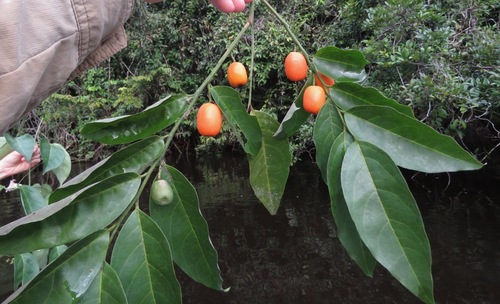
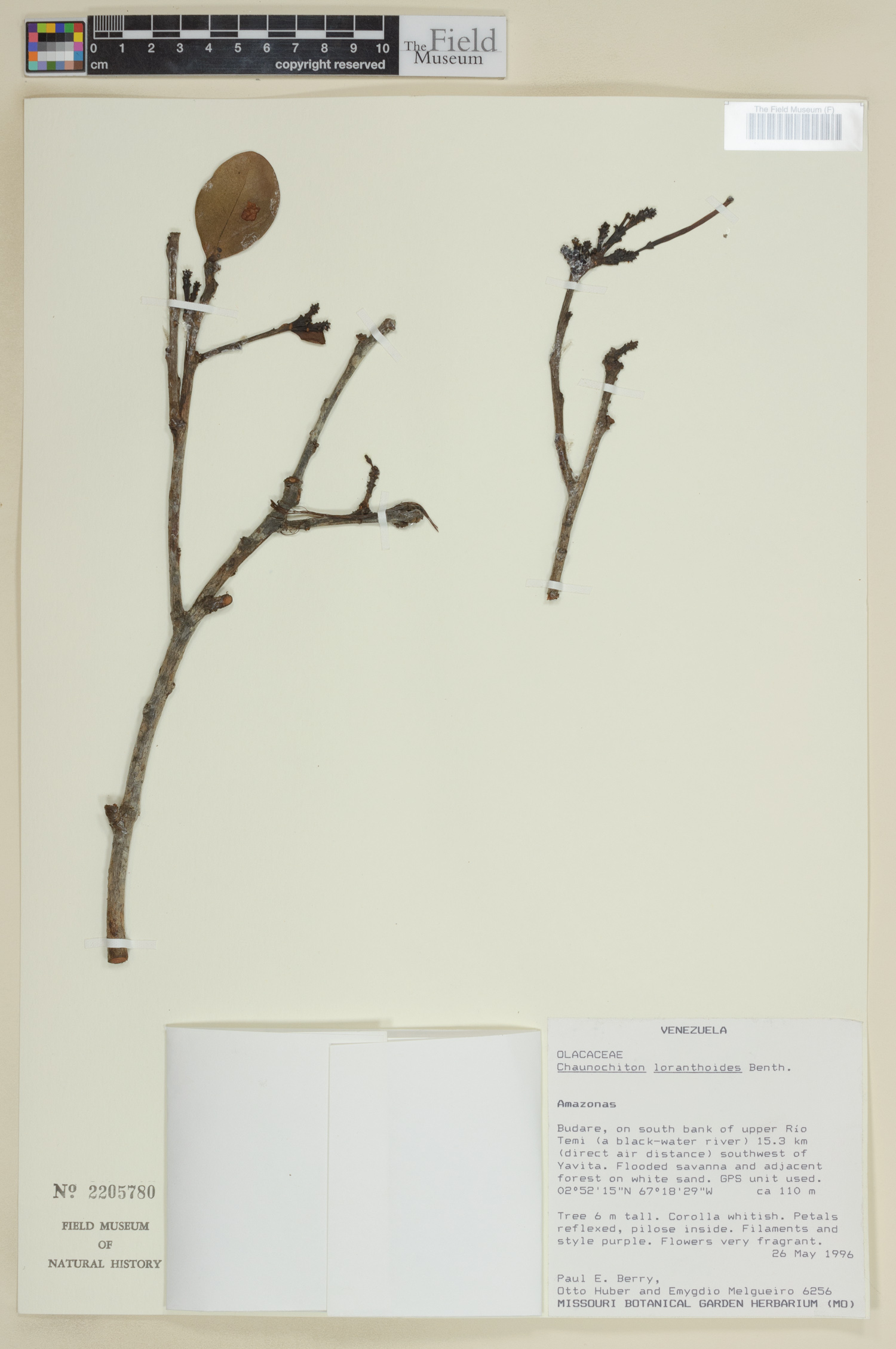
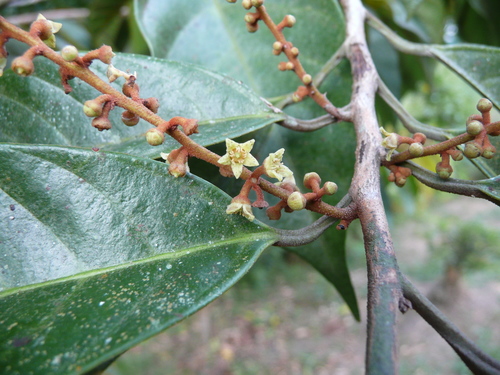
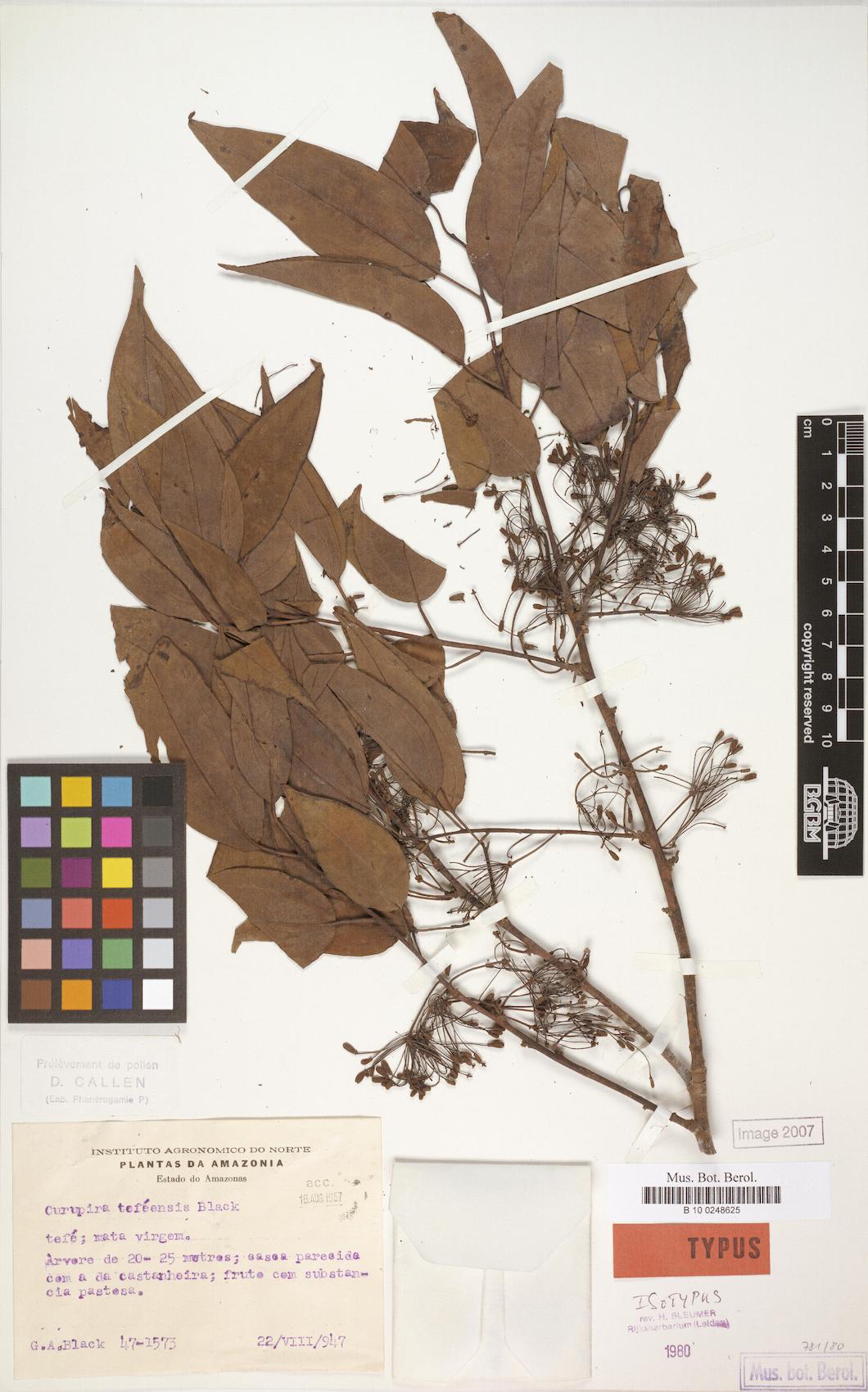
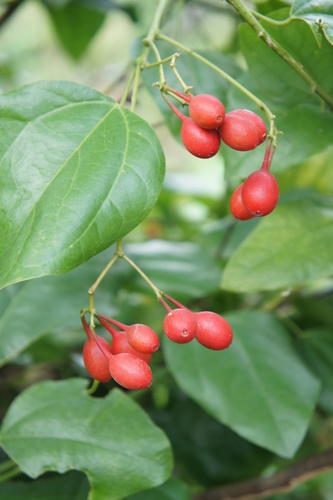
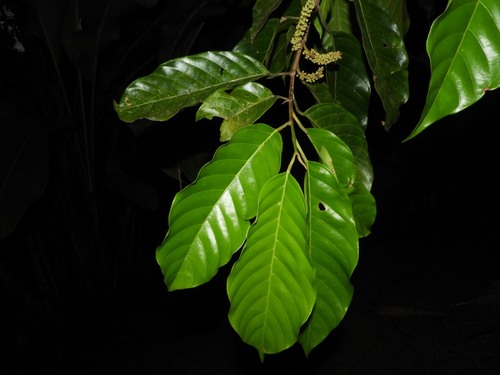
Ongokea gore - (Hua) Pierre
(Hua) Pierre
Boleko Nut
gbif· cc-by-nc
Stive MASSALA BOUKONGO
gbif· cc-by-nc
Stive MASSALA BOUKONGO
gbif· cc-by-nc
Stive MASSALA BOUKONGO
Description
Ongokea gore is an evergreen Tree growing to 30 m (98ft) by 20 m (65ft) at a medium rate. See above for USDA hardiness. It is hardy to UK zone 10. Suitable for: light (sandy), medium (loamy) and heavy (clay) soils and prefers well-drained soil. Suitable pH: mildly acid, neutral and basic (mildly alkaline) soils. It can grow in semi-shade (light woodland) or no shade. It prefers dry or moist soil.
Edible Uses
The pulp of the fruit is edible. Sweet, but slightly astringent. The pulp of the fresh fruit contains 67% moisture, its smell is reminiscent of apple. The fruit is a globose drupe, 2 - 4cm in diameter.
Medicinal Uses
Laxative Styptic. The bark is laxative. The bark is used to treat enlargement of the spleen. The fresh bark is rubbed on the breasts of lactating mothers to purge their babies. Similarly, a decoction of the bark is used as a wash for babies, or they are given a pinch of pounded bark mixed with a little salt. The sap is used as styptic. The root and stem bark contain cyclohexanoid protaflavanones named ongokeins; they are related to sakuranetin and are characterized by a non-aromatic C6-ring moiety that is otherwise only known from certain ferns.
Distribution
West tropical Africa - Sierra Leone to the Congo, south to Angola.
Where It Grows
AFRICA: Cameroon, Democratic Republic of the Congo (west), Gabon, Equatorial Guinea, Côte D‘Ivoire, Ghana, Nigeria (south), Sierra Leone, Angola (northwest)
Cultivation
Ongokea gore is found scattered in dense evergreen forest and in moist semi-deciduous forest. It occurs on dry ground and in periodically inundated localities. In Gabon it often occurs in forest dominated by Sacoglottis gabonensis (Baill.) Urb. and Aucoumea klaineana Pierre. Fruits of Ongokea gore are collected from the wild and mostly the pulp is allowed to rot away before the fruit stones are collected from the soil.
Propagation
Seed - germination is slow and may take several months, perhaps even more than one year.
Other Uses
Furniture Soap Wood. Other Uses The dry seed contains about 63% of a reddish yellow oil, thickening on exposure to air, with an unpleasant odour. Known as 'boleko oil' or 'isano oil', it is inedible but has a wide range of other uses. This oil differs from other vegetable oils in its fatty acid composition. It has a high iodine number, but it does not dry like linseed oil or tung oil do when exposed in a thin film. When heated to 250°c a strongly exothermic spontaneous polymerization reaction starts, which may lead to a further increase in temperature to more than 400°c and to an explosion. Traditionally, it is used to anoint the skin. It can also be used to make soap and to protect metal and wooden surfaces. The oil can be used to make de-emulsifying products for the crude oil extraction industry and for the prevention of icing-up of airplane wings. It can be vulcanized to yield highly resistant synthetic-rubber products. Polymerization at moderately high temperatures yields a film with remarkable properties: strong, flexible and insoluble in acid and alkaline solvents. This makes it suitable for manufacturing brake pads and linings. Ozonolytic cleavage can yield saturated double acids, which are used in the synthesis of polyamides. The use of fatty acids from boleko oil in the manufacturing of silicones and of isolating glue for lithium-based batteries has been patented. The oil can be used as an additive to linseed oil in the manufacture of paints, varnishes and linoleum. In association with linseed oil, the oil can be made into a standoil (a heat-polymerized oil, very thick and strongly adhesive, but slowly drying; used as a final coat in oil painting) of superior qualities. Boiling boleko oil with copal gives this resin a very high heat resistance. The fruits are used as spinning tops for children. The heartwood is pale yellow to pale brown, darkening on exposure to light; it is indistinctly demarcated from the 6 - 10 cm thick band of sapwood. The texture is fine and even; the grain is straight, sometimes finely interlocked or wavy. The wood is heavy; moderately hard to hard; durable - it is little affected by decay fungi or termites and is resistant to marine borers. It seasons slowly, with a high risk of distortion and a slight risk of checking; once dry it is moderately to poorly stable in service. The wood is easy to work with ordinary tools; it saws and planes with little blunting; is easy to finish, sand and polish; can be painted, varnished, waxed and glued without difficulty. For nailing preboring is often required. It can be sliced into veneer, but requires much force. The wood, called 'angueuk' in the trade, is used mostly locally in heavy construction, for railway sleepers and vehicle frames, in interior and exterior carpentry, for flooring, containers and boxes, turnery and veneer. It is well suited for interior joinery provided it is perfectly dry to avoid deformation.
Synonyms
Also Known As
Boleko Nut, Angueuk, Bodwe, Busolo, Bwelabako, Ekuso, Elede, Kouero, Kuwi, Mobenge, Njek, Nke, Sanou, okoubaka aubrevillei.