Olax gambecola
Baill.
iNaturalist· cc-by-nc
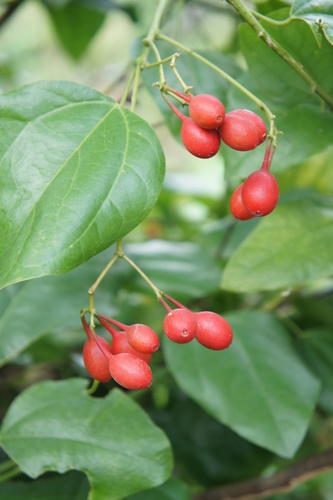
(c) Bart Wursten, some rights reserved (CC BY-NC), uploaded by Bart Wursten
iNaturalist· cc-by-nc
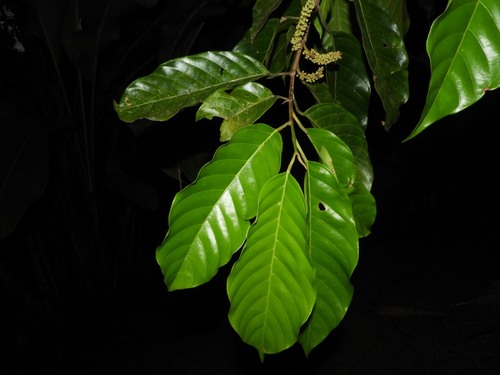
(c) Bart Wursten, some rights reserved (CC BY-NC)
Description
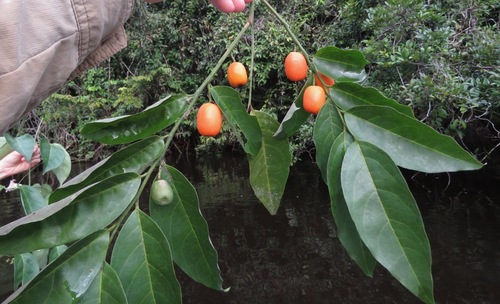
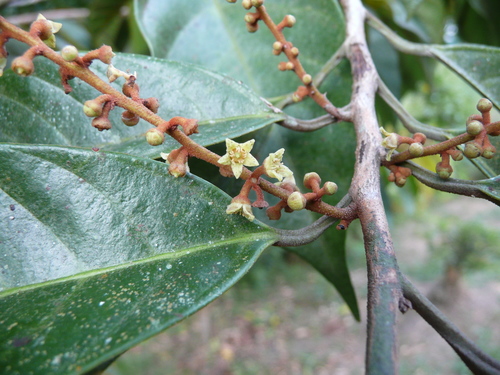
A shrub or small tree. It grows 3 m high. The leaves are narrowly oval and 11 cm long by 4 cm wide. The flowers are white. The fruit are round and red. They are 5 mm across. They are edible when ripe.
Edible Uses
The fruits are eaten when ripe. The seeds are grated and used as a garlic substitute in cooking. The leaves, which have a garlic taste, are also edible.
Traditional Uses
The leaves and fruit have the taste of garlic. The seeds are grated and added to food as a garlic substitute. The fruit are eaten.
This uses section is brief — help expand it
Medicinal Uses
Valued as a flavouring.
Distribution
It is a tropical plant. It grows in the closed forest often near the edges of swamps in West Africa.
Where It Grows
Africa, Angola, Cameroon, Central Africa, Congo DR, Congo R, Liberia, Nigeria, Sierra Leone, Uganda, West Africa,
Other Information
It is valued as a flavouring.
Synonyms
Also Known As
Bakwi, Gumundui, Kiwaya, Kubi, Oruatu ogili, Va
References (5)
- Burkill, H. M., 1985, The useful plants of west tropical Africa, Vol. 4. Kew. (As Olax viridis)
- Latham, P & Mbuta, A., 2017, Useful Plants of Central Province, Democratic Republic of Congo. Volume 2. Salvation Army p 69
- Martin, F.W. & Ruberte, R.M., 1979, Edible Leaves of the Tropics. Antillian College Press, Mayaguez, Puerto Rico. p 208 (As Ptychopetalum alliaceum)
- Nkeoua, G. & Boundzanga, G. C., 1999, Donnees sur les produits forestieres non ligneux en Republique du Congo. FAO. p 31 (As Olax viridis)
- World Checklist of Useful Plant Species 2020. Royal Botanic Gardens, Kew