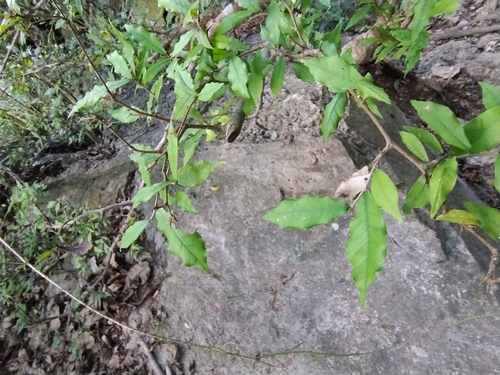
Morus macroura
Miq.
Himalayan Mulberry
wikimedia· cc-by-sa
Khalid Mahmood (via Wikimedia Commons)
wikimedia· cc-by-sa
Andre Abrahami (via Wikimedia Commons)
Description
Morus macroura is a deciduous Tree growing to 10 m (32ft 10in). See above for USDA hardiness. It is hardy to UK zone 8. It is in flower from April to May, and the seeds ripen from July to August. The species is monoecious (individual flowers are either male or female, but both sexes can be found on the same plant). Suitable for: light (sandy), medium (loamy) and heavy (clay) soils and prefers well-drained soil. Suitable pH: mildly acid, neutral and basic (mildly alkaline) soils. It can grow in semi-shade (light woodland) or no shade. It prefers moist soil.
Edible Uses
Fruit - raw or cooked. Dry and insipid. Sweetish when fully ripe. The yellowish-white fruit is 6 - 12cm long.
Medicinal Uses
Astringent. The juice of the bark is applied to cuts and wounds.
Distribution
E. Asia - S. China to the Himalayas and Burma.
Where It Grows
TEMPERATE ASIA: China (Xizang Zizhiqu (east), Yunnan Sheng (south)) TROPICAL ASIA: Bhutan, India (Arunachal Pradesh, Assam, Himachal Pradesh, Sikkim, Uttar Pradesh), Nepal, India (Andaman and Nicobar Islands), Cambodia, Myanmar, Thailand, Indonesia (Jawa, Sumatera)
Cultivation
Prefers a warm well-drained loamy soil in a sunny position. Not very hardy in the colder parts of Britain, it tolerates temperatures down to between -5 and -10°c. Mulberries have brittle roots and so need to be handled with care when planting them out. Any pruning should only be carried out in the winter when the plant is fully dormant because mulberries bleed badly when cut. Ideally prune only badly placed branches and dead wood. Plants in this genus are notably resistant to honey fungus.
Propagation
The seed germinates best if given 2 - 3 months cold stratification. Sow the seed as soon as it is ripe if possible, otherwise in February in a cold frame. The seed usually germinates in the first spring, though it sometimes takes another 12 months. Prick out the seedlings into individual pots when they are large enough to handle and grow them on in the cold frame for their first winter. Plant them out in late spring or early summer after the last expected frosts. Cuttings of half-ripe wood, 7 - 10cm with a heel, July/August in a frame. Plant out in spring. A good percentage take, though they sometimes fail to thrive. Cuttings of mature wood of the current season's growth, 25 - 30cm with a heel of 2 year old wood, autumn or early spring in a cold frame or a shady bed outside. Bury the cuttings to threequarters of their depth. Layering in autumn.
Other Uses
Dye Fibre Wood. The plant is used for paper making. No further details are given, but it is almost certainly the bark that is used as the source of fibre. A colour is distilled from the wood and leaves. Wood - hard, close grained with a beautiful lustre. Used for furniture, construction etc.