Erodium malacoides
(L.) L'Hér.
Oval heron's bill, Mediterranean Stork's Bill
iNaturalist· cc-by-nc
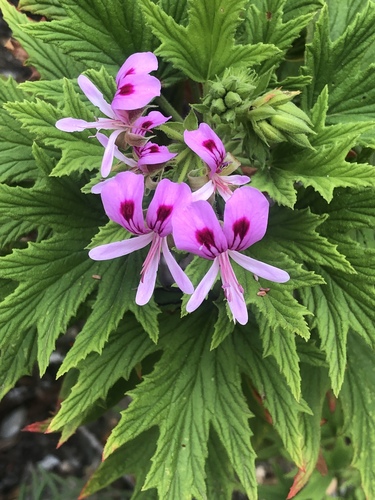
(c) Saif Albornoz H., some rights reserved (CC BY-NC), uploaded by Saif Albornoz H.
iNaturalist· cc-by
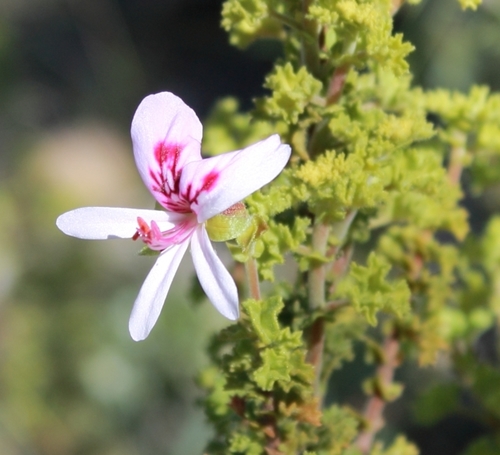
(c) Marios Thoma, some rights reserved (CC BY)
Summary
Source: WikipediaErodium malacoides is a species of flowering plant in the geranium family known by the common names mallow-leaved stork's bill, Mediterranean stork's bill, and soft stork's-bill. It is an annual or biennial herb which is native to the Mediterranean region in southern Europe (north to 49°N in western France), northern Africa, and southwest Asia. It can be found locally elsewhere is an introduced species.
Description
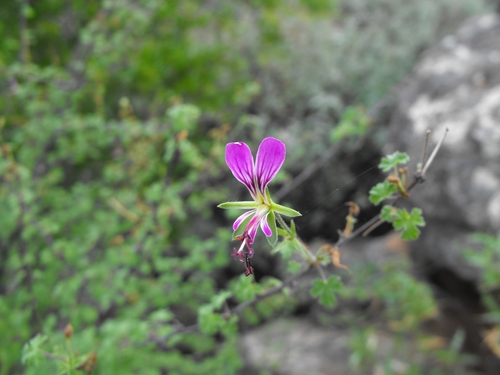
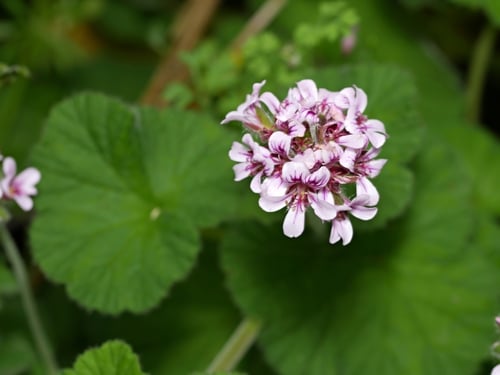
An erect or sprawling herb. It has hairs. It can grow for one or two years. The leaves are oval or oblong. They are heart shaped at the base and have teeth. The leaves can have 3 lobes. The leaves are covered with small shiny glands. The flowers are purple or pink and 11-18 mm across. There are 3-7 flowers in a group. The fruit has a beak 18-35 mm long.
Edible Uses
Leaves can be eaten raw or cooked.
Traditional Uses
The leaves are cooked as a potherb. The bottom of the immature fruit is chewed as a snack.
This uses section is brief — help expand it
Medicinal Uses
None known
Distribution
It is a Mediterranean plant. It grows in dry open places. In Pakistan it is in shady places between 700-1,000 m altitude. It can grow in arid places. Tasmania Herbarium.
Where It Grows
Africa, Albania, Algeria, Arabia, Argentina, Australia, Azores, Balkans, Canary Islands, Cape Verde, Central Asia, Chile, China, Cyprus, Egypt, Europe, France, Greece, India, Iran, Iraq, Israel, Italy, Jamaica, Japan, Jordan, Libya, Mediterranean, Middle East, Morocco, New Zealand, North Africa, North America, Oman, Pakistan, Peru, Portugal, Saudi Arabia, Somalia, South Africa, South America, Spain, Sudan, Syria, Tajikistan, Tasmania, Tunisia, Turkey, Türkiye, Ukraine, United Arab Emirates, UAE, Uruguay, West Indies, Yemen, Yugoslavia,
Propagation
Sow seed in situ as soon as it is ripe in late summer, or alternatively in late spring. It usually germinates readily.
Other Uses
A green dye can be obtained from the whole plant and requires no mordant.
Notes
There are about 200 Erodium species.
Synonyms
Also Known As
Alfilerillo hembra, Alfileteros, Donbaba, Ignelik, Kocakariignesi, Mallow-leaved stork's-bill, Soft stork's-bill
References (15)
- Ahiskali, M., Ari, C. & Selvi, S., Edible wild plants and their consumption during winterin a rural village of Kazdagi (Mount Ida)
- W. Aiton, Hort. kew. 2:415. 1789
- Blamey, M and Grey-Wilson, C., 2005, Wild flowers of the Mediterranean. A & C Black London. p 114
- Dogan, Y., 2012, Traditionally used wild edible greens in the Aegean Region of Turkey. Acta Societatis Botanicorum Poloniae 81(4): 329-342
- Ertug, F., 2004, Wild Edible Plants of the Bodrum Area. (Mugla, Turkey). Turk. J. Bot. 28 (2004): 161-174
Show all 15 references Hide references
- Ertug, F, Yenen Bitkiler. Resimli Türkiye Florası -I- Flora of Turkey - Ethnobotany supplement
- Flora of Pakistan. www.eFloras.org
- Gurdal, B. & Kultur, S., 2014, The edible and miscellaneous useful plants in Marmaris (Southwest Turkey). İstanbul Ecz. Fak. Derg. / J. Fac. Pharm. Istanbul 44(1) 2014 pp.69-78
- Kizilarslan, C. & Ozhatay, N., 2012, An ethnobotanical study of the useful and edible plants of İzmit. Marmara Pharmaceutical Journal 16: 134-140, 2012.
- Malezas Comestibles del Cono Sur, INTA, 2009, Buernos Aires
- Plants for a Future database, The Field, Penpol, Lostwithiel, Cornwall, PL22 0NG, UK. http://www.scs.leeds.ac.uk/pfaf/
- Royal Botanic Gardens, Kew (1999). Survey of Economic Plants for Arid and Semi-Arid Lands (SEPASAL) database. Published on the Internet; http://www.rbgkew.org.uk/ceb/sepasal/internet [Accessed 16th April 2011]
- Tasmanian Herbarium Vascular Plants list p 34
- Tardio, J., et al, Ethnobotanical review of wild edible plants in Spain. Botanical J. Linnean Soc. 152 (2006), 27-71
- World Checklist of Useful Plant Species 2020. Royal Botanic Gardens, Kew