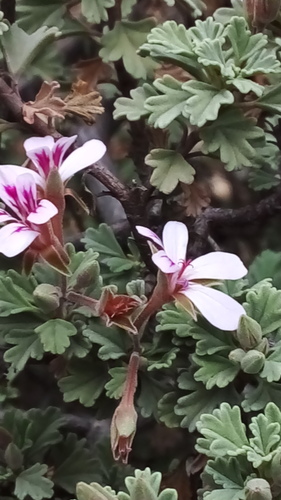
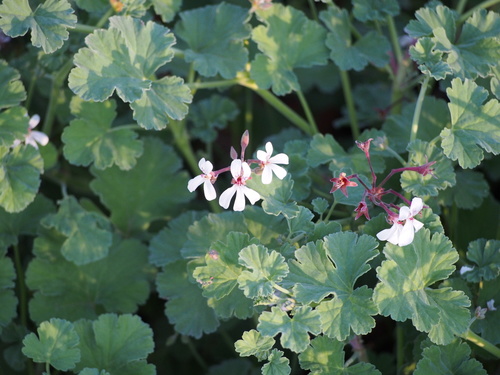
Pelargonium luridum
(Andr.) Sweet
Variable stork's-bill
iNaturalist· cc-by-sa
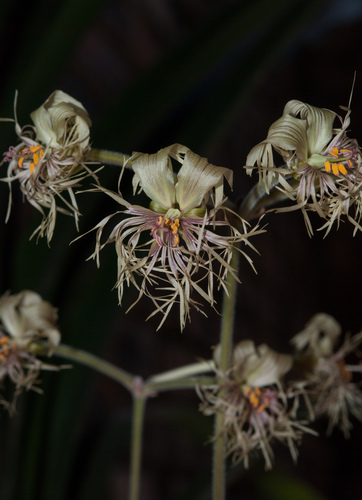
(c) jeanetteclarke, some rights reserved (CC BY-SA), uploaded by jeanetteclarke
iNaturalist· cc-by-nc-sa
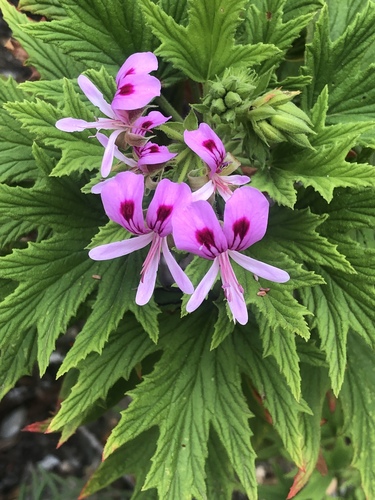
(c) Arista Botha, some rights reserved (CC BY-NC-SA), uploaded by Arista Botha
iNaturalist· cc-by-nc
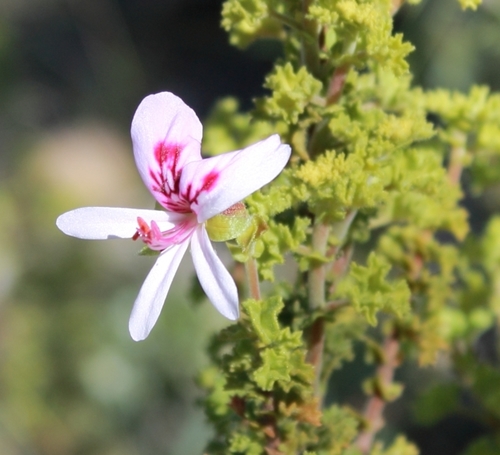
(c) Richard Gill, some rights reserved (CC BY-NC), uploaded by Richard Gill
Summary
Source: WikipediaPelargonium luridum, locally called variable stork's bill, is a medium high, tuberous herbaceous perennial geophyte, belonging to the Stork's bill family, with white to pink, slightly mirror symmetrical flowers in umbels on long unbranched stalks directly from the ground rosette that consists of few initially ovate, later pinnately incised or linear leaves, with blunt teeth around the margin. The variable stork's bill naturally occurs from South Africa to Angola, southern Congo and Tanzania.
Description
A herb. It has a rootstock that lasts from year to year. It grows 70 cm high. The leaves are in a dense ring near the base. New leaves are almost round and later leaves have lobes. The flowering stalk is tall with a large number of flowers. The flowers are white tinged with pink. The leaves on the one plant can vary considerably in size and shape. The lower leaves are less divided. It may be that these plants cross breed or form hybrids.
Edible Uses
Leaves and stems are eaten raw.
Traditional Uses
The leaves and stems are eaten raw.
This uses section is brief — help expand it
Distribution
It is a tropical plant. It grows in poorly drained soils. It grows between 800-2,440 m above sea level. It can grow in arid places. In Zimbabwe it grows above 1,350 m above sea level.
Where It Grows
Africa, Angola, Central Africa, Congo, East Africa, Eswatini, Lesotho, Malawi, Mozambique, South Africa, Southern Africa, Swaziland, Tanzania, Zambia, Zimbabwe,
Synonyms
References (9)
- Fowler, D. G., 2007, Zambian Plants: Their Vernacular Names and Uses. Kew. p 81
- Fox, F. W. & Young, M. E. N., 1982, Food from the Veld. Delta Books. p 236
- Peters & Maguire, 1981,
- Peters, C. R., O'Brien, E. M., and Drummond, R.B., 1992, Edible Wild plants of Sub-saharan Africa. Kew. p 115
- Royal Botanic Gardens, Kew (1999). Survey of Economic Plants for Arid and Semi-Arid Lands (SEPASAL) database. Published on the Internet; http://www.rbgkew.org.uk/ceb/sepasal/internet [Accessed 16th April 2011]
Show all 9 references Hide references
- Ruiters-Welcome, A. K., 2019, Food plants of southern Africa. Ph.D. thesis. Univ. of Johannesburg p 64
- Swaziland's Flora Database http://www.sntc.org.sz/flora
- Welcome, A. K. & Van Wyk, B.-E., 2019, An inventory and analysis of the food plants of southern Africa. South African Journal of Botany 122 (2019) 136–179
- World Checklist of Useful Plant Species 2020. Royal Botanic Gardens, Kew