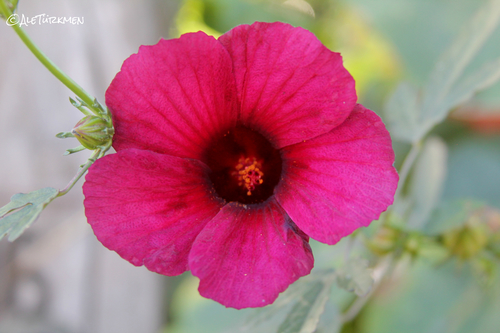
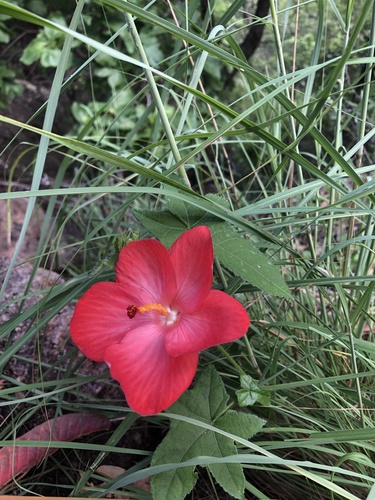
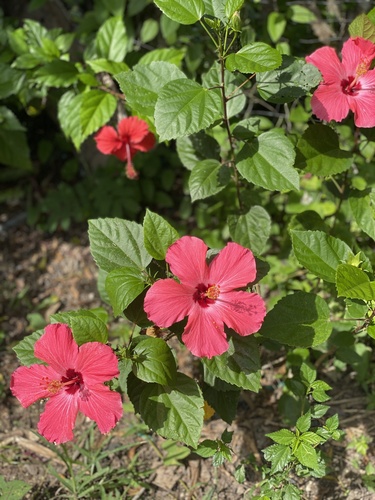
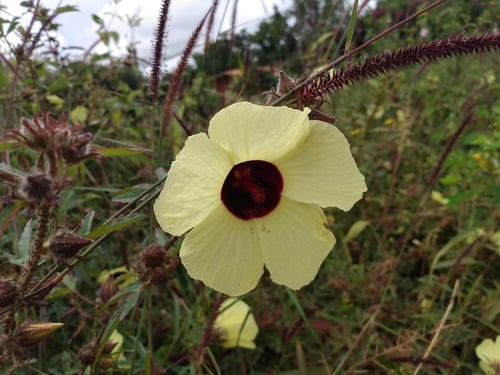
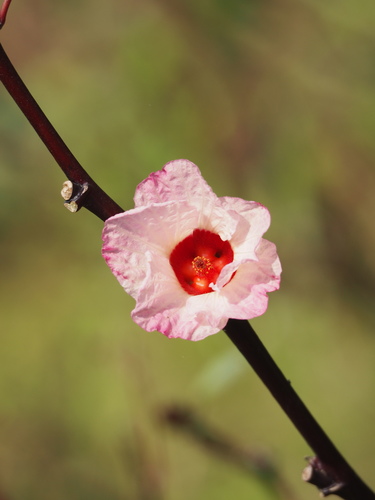
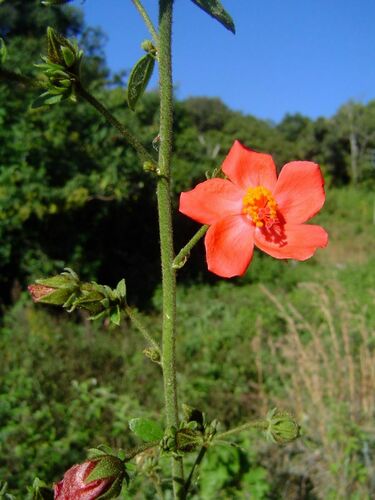
Anoda cristata - (L.) Schltdl.
(L.) Schltdl.
Crested Anoda
gbif· cc-by-nc
Marco Polo amarillas vargas
gbif· cc-by-nc
Esmeralda Aispuro
gbif· cc-by-nc
Esmeralda Aispuro
Description
Anoda cristata is a ANNUAL growing to 0.8 m (2ft 7in) by 0.3 m (1ft) at a fast rate. See above for USDA hardiness. It is hardy to UK zone 9 and is not frost tender. The flowers are pollinated by Bees, Insects. Suitable for: light (sandy), medium (loamy) and heavy (clay) soils and prefers well-drained soil. Suitable pH: mildly acid, neutral and basic (mildly alkaline) soils. It cannot grow in the shade. It prefers dry or moist soil.
Edible Uses
Crested anoda provides edible leaves and flowers, though both are minor resources compared to other mallows. The leaves can be eaten raw or cooked, with a mild, agreeable flavor similar to mallows, but their hairy and mucilaginous texture limits appeal. Boiling softens the hairs but does not eliminate them, leaving the leaves only marginally useful as potherbs. The flowers, particularly the petals, stamens, and pistils, are mild, sweet, and mucilaginous, in line with other members of the mallow family. However, the flower stalks and sepals are covered in irritating hairs and must be removed, and collecting sufficient petals is tedious. Immature fruits resemble small, hairy green wheels, but are not considered a practical food. In regions where it grows abundantly, especially in Mexico, the plant is sometimes gathered as a green leafy vegetable, but in the southwestern United States it remains a resource of minor importance. Edibility rating: 2/5 – edible but minor; leaves and petals are palatable, though textural issues and difficulty of harvesting reduce their value.
Distribution
The native range of this species is tropical and subtropical America but introduced to other areas including Europe.
Where It Grows
Argentina Northeast, Argentina Northwest, Arizona, Belize, Bolivia, Brazil South, Chile Central, Chile North, Chile South, Colombia, Costa Rica, Cuba, Dominican Republic, Ecuador, El Salvador, Guatemala, Honduras, Jamaica, Mexico Central, Mexico Gulf, Mexico Northeast, Mexico Northwest, Mexico Southeast, Mexico Southwest, New Mexico, Nicaragua, Panamá, Peru, Puerto Rico, Texas, Uruguay, Venezuela
Cultivation
An annual or subshrub that grows primarily in the seasonally dry tropical biome. This species thrives in disturbed sites such as agricultural fields, rangelands, roadsides, and riparian areas. It appears in response to summer rainfall, grows quickly, and wilts soon after blooming. It prefers warm climates, open sun, and soils with adequate moisture following rains. Crested anoda is an annual that grows rapidly after summer rains, producing purple flowers in modest numbers. It is more common in Mexico than in the southwestern United States, where it is relatively localized. While technically considered a weed, it is a “well-behaved” one—restricted to disturbed or agricultural areas and not aggressively invasive outside those habitats. Likely suitable to USDA zones 8–11, where summer rains support its short life cycle. It cannot withstand frost and completes its life cycle quickly in hot weather.
Propagation
Seed
Other Uses
Crested anoda has no strong record of medicinal or non-food uses, unlike some other mallows. Its main value lies as a supplementary wild food where abundant, and it has occasionally been encouraged to grow near cultivated fields in Mexico as a leafy vegetable source.
Synonyms
Also Known As
Crested or spurred anoda (Anoda cristata (L.) Schltdl. = Anoda hastata Cav. = Sida cristata L.).