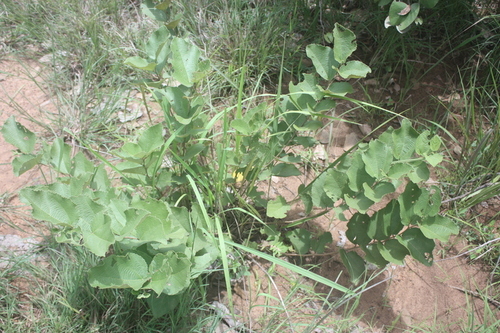
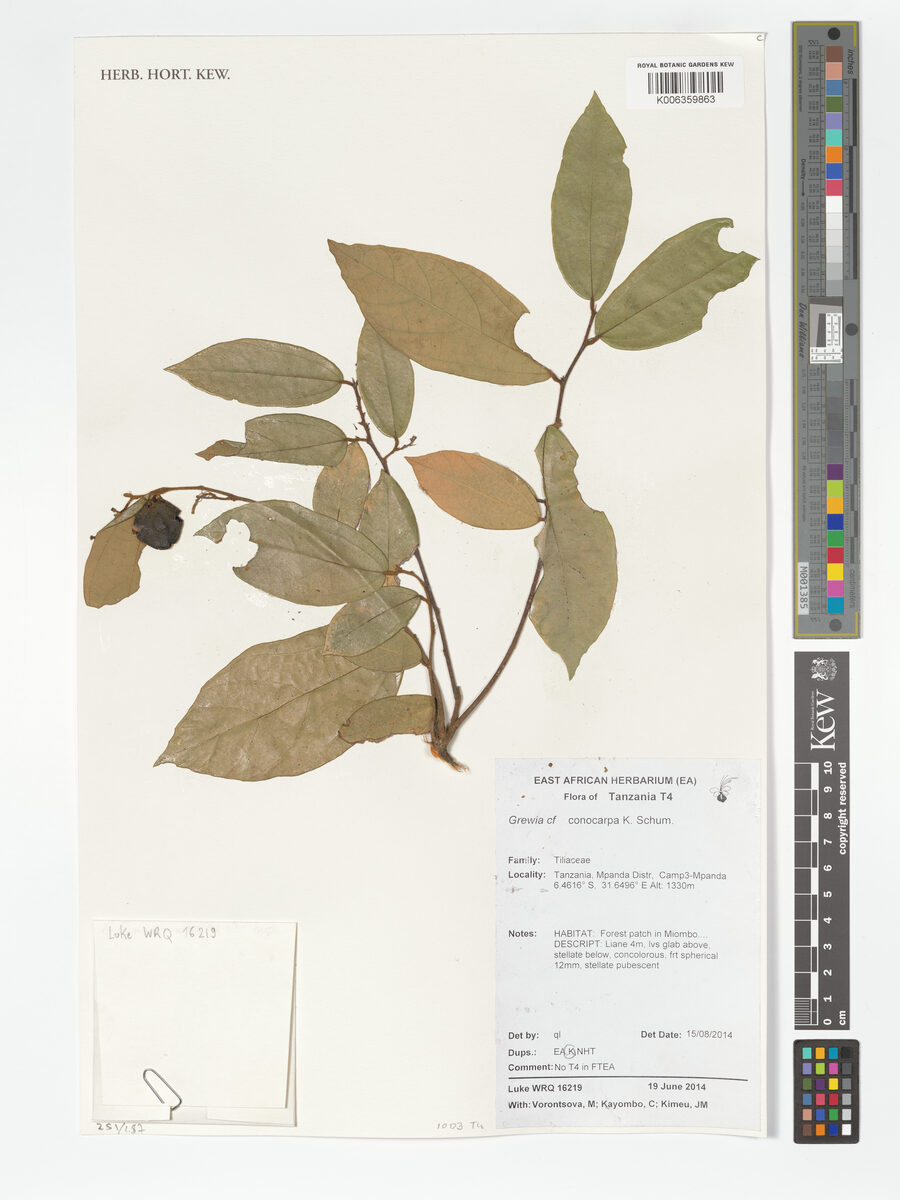
Cola cordifolia
(Cav.) R. Br.
Mandingo kola
iNaturalist· cc-by-nc
(c) AMADOU BAHLEMAN FARID, some rights reserved (CC BY-NC), uploaded by AMADOU BAHLEMAN FARID
iNaturalist· cc-by-nc
(c) Dr Anh Galat-Luong, some rights reserved (CC BY-NC)
Description
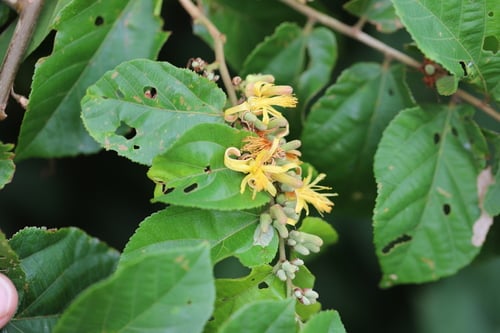
A large tree. It grows 15-25 m high. The trunk is short. It has buttresses. The branches occur low down and the crown is dense and spreading. The end branches have a rusty coating. The leaves are oval and 15-40 cm long by 10-35 cm wide. They are rounded at the tip and heart shaped at the base. The flowers are produces with the leaves. There are 2-4 flowering shoots on each stem and these are 3-12 cm long by 2-5 cm wide. The fruit are follicles 20 cm long, 17 cm high and 6 cm wide. The seeds are oblong and 3.5 cm long by 2 cm wide.
Edible Uses
The seeds are chewed as a stimulant, and the pulp of the fruit is eaten. The leaves are also consumed.
Traditional Uses
The seeds are chewed as a stimulant. The pulp of the fruit is eaten.
This uses section is brief — help expand it
Distribution
A tropical plant. It grows in the savannah in West Africa. It grows in woodland. It grows between 950-1,500 m above sea level.
Where It Grows
Africa, Benin, Burkina Faso, Cameroon, Central African Republic, CAR, Congo R., East Africa, Ghana, Guinea, Guinée, Guinea-Bissau, Mali, Mozambique, Nigeria, Senegal, Sudan, Uganda, West Africa,
Cultivation
A plant of the lowland moist tropics, growing in areas with a distinct dry season.
Other Uses
A fibre obtained from the bark is used for cordage.
Notes
Also put in the family Sterculiaceae.
Nutrition
| Part | Moisture | kJ | kcal | Protein | Vit A | Vit C | Iron | Zinc |
|---|---|---|---|---|---|---|---|---|
| Fruit | 3.8 | 380 | 91 | 1.2 | — | — | 2.5 | — |
Synonyms
Also Known As
Abobu, A-mbamb, Bubab, Bubem, Bubom, Bugitin, Budjanhi, Ga-mbamb, Mandjanja, Manjandja, M'bue, Taba, Tabayer, Tabo, Tamba noko, Utuludjene
References (12)
- Burkill, H. M., 1985, The useful plants of west tropical Africa, Vol. 5. Kew.
- Catarino, L., et al, 2016, Ecological data in support of an analysis of Guinea-Bissau's medicinal flora. Data in Brief 7 (2016):1078-1097
- Dalziel, J. M., 1937, The Useful plants of west tropical Africa. Crown Agents for the Colonies London.
- Diarra, N. et al, 2016, Etude ethnobotanique des plantes alimentaires utilisées en période de soudure dans les régions Sud du Mali. Int. J. Biol. Chem. Sci. 10(1): 184-197
- Djihounouck, Y., et al, 2018, Diversité Et Importance Socio-Economique Des Espèces Fruitières Sauvages Comestibles En Zone Kasa (Sud-Ouest Du Sénégal). European Scientific Journal December 2018 edition Vol.14, No.36 ISSN: 1857 – 7881
Show all 12 references Hide references
- Djihounouck, Y., et al, 2021, Ethnobotanical Uses of Non-cultivated Edible Fruit Species in the Department of Oussouye (South Senegal). Journal of Food Research; Vol. 10, No. 4 p 20
- East African Herbarium records, 1981,
- Food Composition Tables for use in Africa FAO http://www.fao.org/infoods/directory No. 1041
- Gueye, M., et al, 2014, Wild Fruits Traditionally Gathered by the Malinke Ethnic Group in the Edge of Niokolo Koba Park (Senegal). American Journal of Plant Sciences 5, 1306-1317
- Jardin, C., 1970, List of Foods Used In Africa, FAO Nutrition Information Document Series No 2.p 129
- Peters, C. R., O'Brien, E. M., and Drummond, R.B., 1992, Edible Wild plants of Sub-saharan Africa. Kew. p 187
- World Checklist of Useful Plant Species 2020. Royal Botanic Gardens, Kew