Willughbeia edulis
Roxb.
Gedraphol, Kuy
wikimedia· cc-by-sa
Willuconquer (via Wikimedia Commons)
Description
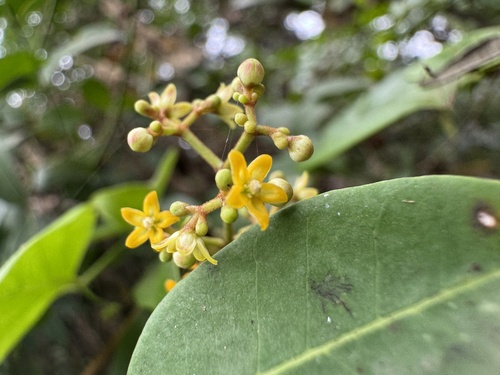
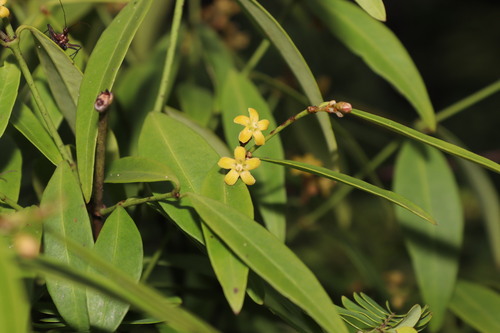
Willughbeia edulis is an evergreen Climber growing to 25 m (82ft) by 0.2 m (0ft 8in) at a fast rate. See above for USDA hardiness. It is hardy to UK zone 10. Suitable for: light (sandy), medium (loamy) and heavy (clay) soils and prefers well-drained soil. Suitable pH: mildly acid, neutral and basic (mildly alkaline) soils. It can grow in semi-shade (light woodland) or no shade. It prefers moist soil.
Edible Uses
Fruit - raw. A pleasant flavour. The yellowish, ovoid fruit is about the size of a lemon. The fruit is about 5cm in diameter.
Medicinal Uses
Antidiarrhoeal Dysentery. The latex is used as a plaster for sores and as a treatment for yaws. The stems are used to treat yaws, dysentery, and liver discomfort. The roots are used internally to treat jaundice, heartburn, and diarrhoea.
Distribution
E. Asia - Bangladesh, Assam, Myanmar, Thailand, Malaysia, Cambodia, Laos, Vietnam.
Where It Grows
Coming Soon
Cultivation
Industrial Crop: Hydrocarbon Management: Standard Regional CropA plant of the lowland wet tropics.
Propagation
Seed
Other Uses
Latex. Every part of the plant, on being wounded, discharges copiously a very pure white viscid latex, which is soon, by exposure to the air, changed into an indifferent kind of rubber.
Synonyms
Also Known As
Aguh, Akar getah gerip, Arkurbal, Bel tota, Bel-tata, Buah padang, Cay guoi, Gedra-phol, Hrenchi, Jitan, Kenjet, Kubal madu, Kuy, Laleng-tenga, Lalong, Laong-doukha, Lathi am, Luti-am, Pabhoi tenga, Tabu, Talaing-no, Thitkyauk-nwe, Vuak-duo. kuy (Cambodia), gedraphol, laleng-tenga, bel-tata (India), dton-kuy, kuiton, kreua and katong-katiew (Thai), talaing-no (Myanmar) and gu?i (Vietnamese).Kubal madu in Indonesia refers to a similar edible relative, W. sarawacensis.