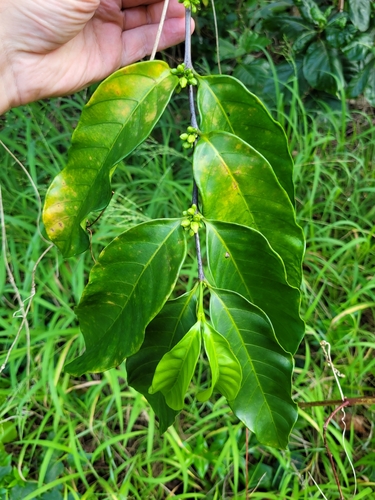
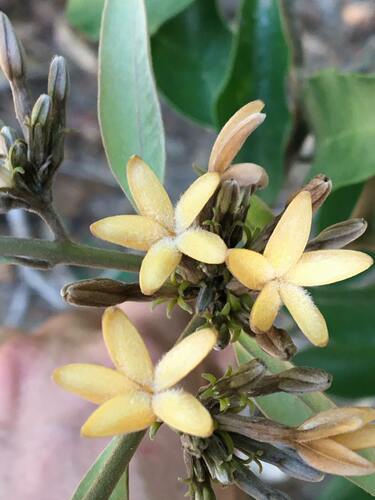
Fockea edulis
(Thunb.) K. Schum.
Kambro
iNaturalist· cc-by-nc
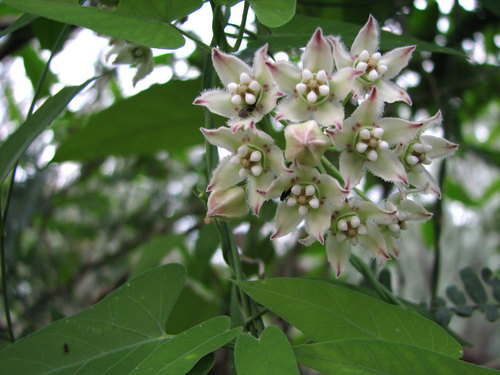
(c) AnneLise Vlok, some rights reserved (CC BY-NC), uploaded by AnneLise Vlok
iNaturalist· cc-by-sa
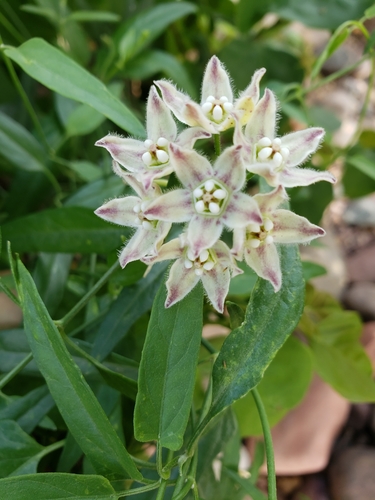
(c) Andrew Hankey, some rights reserved (CC BY-SA), uploaded by Andrew Hankey
Summary
Source: WikipediaFockea edulis is a species of caudiciform plant in the family Apocynaceae that is native to the Cape Provinces and KwaZulu-Natal in South Africa.
Description
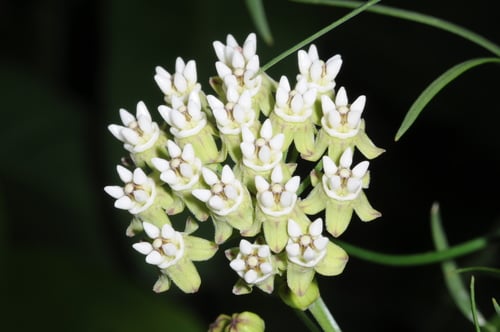
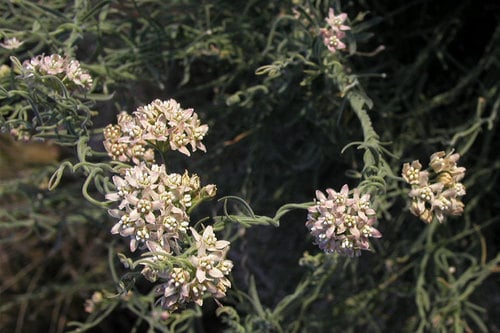
A climber. It is a plant with a large storage organ near the ground. This is white and rough. It can vary in shape. It produces vines. The vines can grow 30 cm in a year. The leaves are dark green. They are 3-4 cm long and 1 cm wide. They have wavy edges. The flowers are green and 1.5 cm wide. The fruit are greyish pods 8 cm long.
Edible Uses
Root. A milky, somewhat sweetish flavour. The large tubers have been used to make a 'konfyt' (a type of jam) as an alternative to watermelon. The tubers can be up to 60cm in diameter.
Traditional Uses
The large watery roots are eaten. The young leaves are eaten as a potherb.
This uses section is brief — help expand it
Medicinal Uses
The root and tubers are used traditionally as food and medicine.
Known Hazards
A latex in the plant is poisonous.
Distribution
It is a tropical plant. It cannot tolerate frost. It grows in drier places.
Where It Grows
Africa, Australia, Eswatini, Japan, Namibia, South Africa, Southern Africa, Swaziland,
Cultivation
Plants are grown from seed.
Production
An edible tuber may weigh 22 kg.
Notes
There are about 10 Fockea species.
References (17)
- Andersohn, G., 1983, Cacti and Succulents. EP Publishing. p 260
- Anderson, M., 2002, The World Encyclopedia of Cacti and Succulents. Hermes House, New York. p 165
- Barkhuizen, 1978,
- Bodkin, F., 1991, Encyclopedia Botanica. Cornstalk publishing, p 477
- Bruyns, P. V. & Klak, C., 2006, A Systematic Study of the Old World Genus Fockea (Apocynaceae) Annals of the Missouri Botanical garden, Vol. 93(4): 535-564
Show all 17 references Hide references
- Facciola, S., 1998, Cornucopia 2: a Source Book of Edible Plants. Kampong Publications, p 32
- Fox, F. W. & Young, M. E. N., 1982, Food from the Veld. Delta Books. p 109
- Hedrick, U.P., 1919, (Ed.), Sturtevant's edible plants of the world. p 471 (As Pergularia edulis)
- Jardin, C., 1970, List of Foods Used In Africa, FAO Nutrition Information Document Series No 2.p 79
- Lim, T. K., 2015, Edible Medicinal and Non Medicinal Plants. Volume 9, Modified Stems, Roots, Bulbs. Springer p 43
- Long, C., 2005, Swaziland's Flora - siSwati names and Uses http://www.sntc.org.sz/flora/
- Peters, C. R., O'Brien, E. M., and Drummond, R.B., 1992, Edible Wild plants of Sub-saharan Africa. Kew. p 63
- Ruiters-Welcome, A. K., 2019, Food plants of southern Africa. Ph.D. thesis. Univ. of Johannesburg p 24
- Swaziland's Flora Database http://www.sntc.org.sz/flora
- van Wyk, Be., & Gericke, N., 2007, People's plants. A Guide to Useful Plants of Southern Africa. Briza. p 88
- Welcome, A. K. & Van Wyk, B.-E., 2019, An inventory and analysis of the food plants of southern Africa. South African Journal of Botany 122 (2019) 136–179
- Youngblood, D., 2004, Identification and Quantification of Edible Plant Foods in the Upper (Nama) Karoo, South Africa. Economic Botany 58 (Supplement) :S43-S65