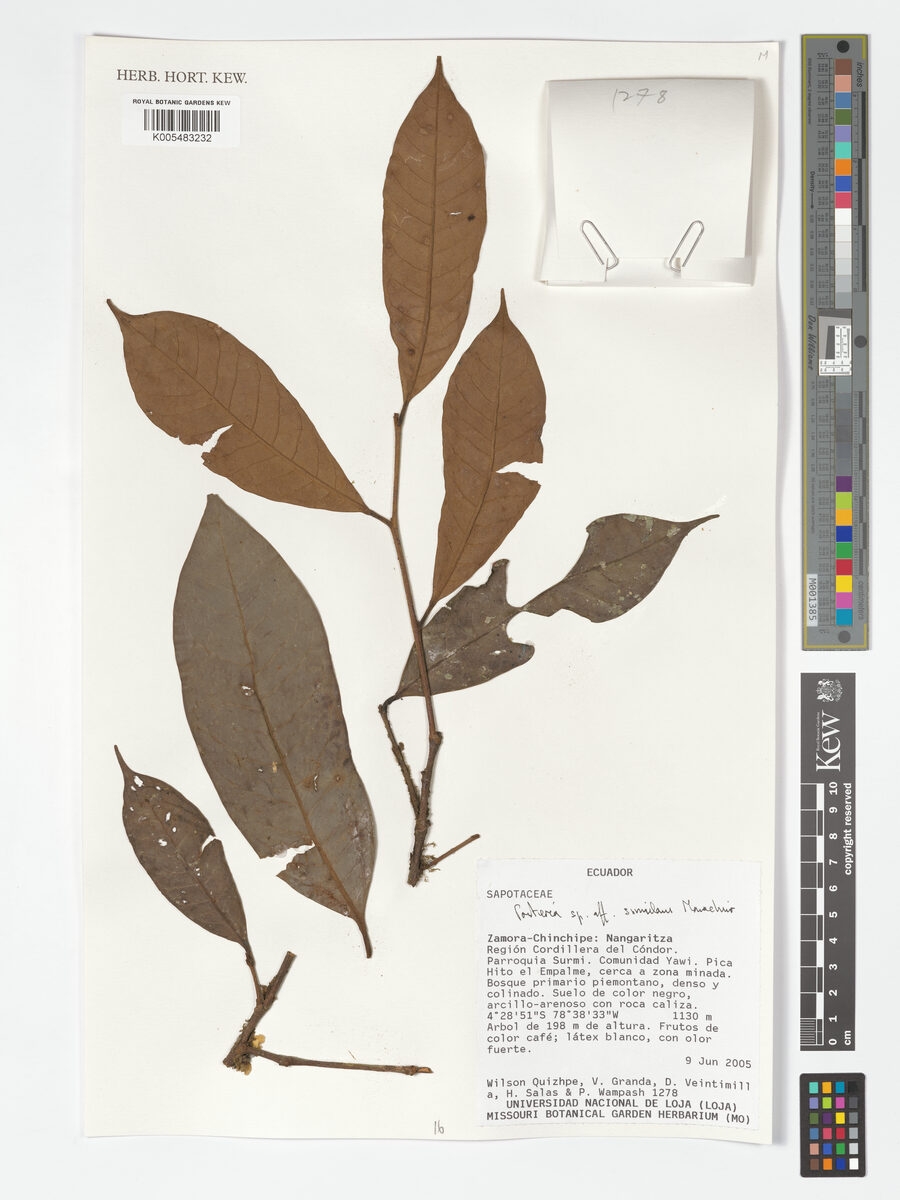
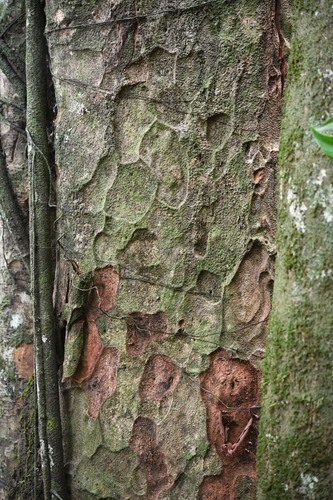
Tieghemella africana
Pierre
Douka
wikimedia· cc-by-sa
Wikimedia Commons (via Wikimedia Commons)
gbif· cc-by-nc
Christ Dibouka
Description
Tieghemella africana is an evergreen Tree growing to 45 m (147ft) by 30 m (98ft) at a fast rate. See above for USDA hardiness. It is hardy to UK zone 10. Suitable for: light (sandy), medium (loamy) and heavy (clay) soils and prefers well-drained soil. Suitable pH: mildly acid, neutral and basic (mildly alkaline) soils. It can grow in full shade (deep woodland) semi-shade (light woodland) or no shade. It prefers moist soil.
Edible Uses
Oil. The seed kernels are rich in an edible fat, which is locally popular as a cooking or seasoning oil. The fatty oil from the seed kernel is yellowish and semi-fluid, has a pronounced flavour and taste, and consists of about 55% oleic acid, 21.5% stearic acid, 16.5% palmitic acid and 5% linoleic acid. The kernel comprises about 50% of fat.
Medicinal Uses
Antirheumatic. The fat obtained from the seeds is used externally to treat rheumatism.
Known Hazards
Dust from sawn wood may cause irritation to skin and mucous membranes. It has been suggested that this is caused by the presence of saponins or the contact allergen 2,6-dimethoxy-1,4-benzoquinone. A highly haemolytic saponin has been isolated from the wood; on hydrolysis it gave d-glucose, l-rhamnose and d-xylose.
Distribution
West tropical Africa - Cote D'Ivoire, Cameroon, Equatorial Guinea, Gabon, Congo, DR Congo.
Where It Grows
AFRICA: Cameroon (south), Democratic Republic of the Congo, Gabon
Cultivation
Douka is a plant of the lowland humid tropics. Young trees are tolerant of shade, but can survive in full sun. Trees have a moderately fast rate of growth. Young trees were on average 9 metres tall 6 years after planting in Gabon. The survival rate was about 90% and was almost equal when planted exposed to full sunlight in comparison with planting in the shade of forest cleared from undergrowth. The young trees grow faster when planted in light shade; 11-year-old trees were on average 18.5 metres tall and 13cm in diameter when planted in light shade, and 15.5 metres tall and 9cm in diameter in full sunlight. In a 66-year-old plantation in Gabon the mean annual increment is 0.4cm in diameter and 1.8 cubic metres per hectare in wood volume. The fruits are eaten by elephants, which are probably the main seed dispersers.
Propagation
Seed - best sown as soon as it is ripe since the viability decreases rapidly once the seeds have been removed from the fruit. In the nursery, seeds are usually planted at a spacing of 40 cm _ 40 cm under light shade. Seedbeds should be watered well. Germination is over 90% in optimal conditions, and without pre-treatment. Germination begins after about 4 weeks, most seeds having germinated after 10 weeks, but it may continue for 16 weeks. Saplings of about 2.5 years old and 1 - 1.5 metres tall are planted out into the field usually at the beginning of the rainy season, but in western C?te d?Ivoire 0.5 year-old seedlings are used. The seeds are heavy, weighing 15 - 20g each. They should be planted within a few weeks because viability decreases rapidly.
Other Uses
Furniture Oil Wood Other Uses: The wood resembles African mahogany (Khaya and Entandrophragma spp.), but the texture is finer. The heartwood is pinkish-, purplish- or reddish-brown with a silky lustre, often with a decorative figure in the form of flames or stripes; it is very distinctly demarcated from the up to 8 cm wide band of pinkish white to greyish brown sapwood. The grain is straight or interlocked, texture fine and even. The wood is medium-weight; moderately hard; it is rated as one of the most durable African timbers, being resistant to termites and fungi although damage by pinhole borers and powder-post beetles has been recorded occasionally. Although it is resistant to marine borers in temperate waters, the wood is not very durable in tropical (especially brackish) waters. The wood is somewhat difficult to work due to the presence of silica - blunting effects are moderately severe when sawing, and stellite-tipped sawteeth are recommended; it finishes well, staining and polishing give good results; pre-boring for nailing and screwing is recommended to avoid splitting; gluing properties are good; the timber can be peeled satisfactorily. The heartwood is very difficult to impregnate, the sapwood moderately easy. Traded as makore or cherry mahogany, the wood is used for furniture, exterior and interior construction, flooring, doors, vehicle frames, sports goods, railway sleepers, turnery and sculptures. It makes a good and decorative veneer, often used to face plywood, especially for marine uses.
Synonyms
Also Known As
Biadjo, N'duka, Nom adjap elang, Okola