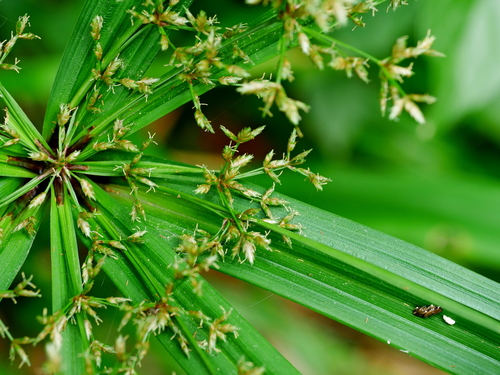
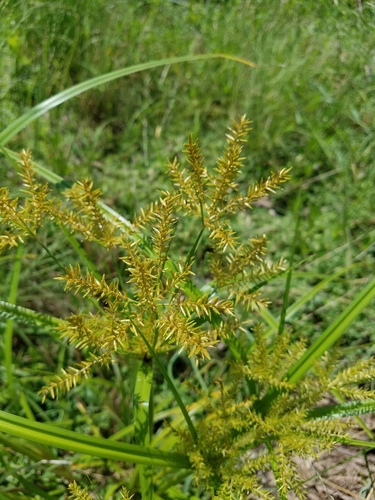
Scirpus lacustris
L.
Bulrush
gbif· cc-by-sa
Ivars Kabucis
gbif· cc-by-nc-nd
Felix Rey
gbif· cc-by-nc-nd
Felix Rey
Description
Scirpus lacustris is a PERENNIAL growing to 2.5 m (8ft 2in). See above for USDA hardiness. It is hardy to UK zone 4. It is in flower from June to August, and the seeds ripen from August to September. The species is hermaphrodite (has both male and female organs) and is pollinated by Wind. Suitable for: light (sandy), medium (loamy) and heavy (clay) soils. Suitable pH: mildly acid, neutral and basic (mildly alkaline) soils. It can grow in semi-shade (light woodland) or no shade. It prefers moist or wet soil and can grow in water.
Edible Uses
Root - raw or cooked. Rich in starch, it can be dried and ground into a powder or made into a syrup. The buds at the end of the rhizomes are crisp and sweet, making excellent eating raw. Young shoots - raw or cooked. Used in spring. Seed - ground up into a powder and mixed with flour for use in making cakes etc. The seed is small and rather fiddly to harvest and utilize. Base of mature stems - raw or cooked. Somewhat tough. Pollen - raw or cooked. Rich in pollen, it is mixed with flour and used in making cakes etc.
Medicinal Uses
Astringent Cancer Diuretic. The roots are astringent and diuretic. They were formerly employed medicinally but have fallen into disuse. This plant is a traditional medicine for cancer.
Distribution
Europe, incl Britain, south and east from Lapland to Africa and Asia. N. and C. America, Polynesia.
Where It Grows
TEMPERATE ASIA: Yemen, Afghanistan, Cyprus, Iran (north), Lebanon, Turkey, Russian Federation-Ciscaucasia (Ciscaucasia), Armenia, Azerbaijan, Georgia, Russian Federation (Dagestan), Russian Federation-Eastern Siberia (Eastern Siberia), Russian Federation (Altay, Gorno-Altay, Kemerovskaja oblast, Krasnoyarsk (south), Kurganskaja oblast, Novosibirsk, Omsk, Tomsk, Tyumen, Yakutia-Sakha), Kazakhstan, Kyrgyzstan, Tajikistan, Turkmenistan, Uzbekistan, Mongolia TROPICAL ASIA: India (Jammu and Kashmir) EUROPE: Denmark, Finland, United Kingdom, Ireland, Norway, Sweden, Austria, Belgium, Switzerland, Czech Republic, Germany, Hungary, Netherlands, Poland, Slovakia, Russian Federation (European part), Belarus, Estonia, Lithuania, Latvia, Moldova, Russian Federation (Kalmykija, Respublika, Astrakhan, Saratov, Volgogradskaja oblast), Ukraine (incl. Krym), Albania, Bulgaria, Bosnia and Herzegovina, Greece (incl. Crete), Croatia, Italy (incl. Sardinia, Sicily), Montenegro, Romania, Serbia, Slovenia, Spain (incl. Baleares), France (incl. Corsica), Portugal AFRICA: Algeria, Libya, Morocco, Tunisia, Eritrea, Lesotho
Cultivation
Succeeds in any wet to moisture retentive soil, pond margins and shallow water in full sun or shade. Plants can succeed in fairly deep water. Hardy to about -25°c. Some named forms have been selected for their ornamental value.
Propagation
Seed - sow in a cold frame as soon as it is ripe in a pot standing in 3cm of water. Only just cover the seed with soil. The seed usually germinates fairly quickly. Prick out the plants when large enough to handle and plant out in their permanent positions in early summer. Division in spring. Very easy, larger divisions can be planted out direct into their permanent positions. We have found it best to pot up the smaller divisions and grow them on in a lightly shaded position in a cold frame, planting them out once they are well established in the summer.
Other Uses
Paper Thatching Weaving. The stems are frequently used for making matting, chair bottoms etc and thatching[1, 4, 23, 85, 100, 115]. They were at one time imported in large quantities for this purpose. The pith of the stems is used in paper making.