Bolboschoenus caldwellii
(V. Cook) Sojak
Sea club rush, Marsh club rush, Seaside bulrush
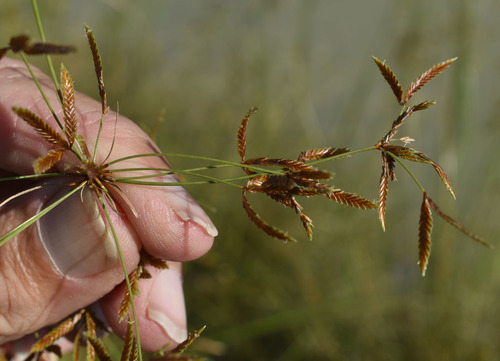
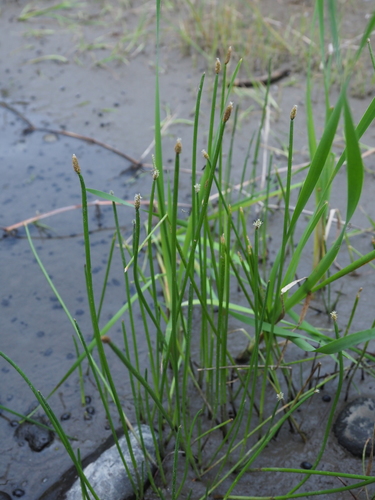
iNaturalist· cc-by
(c) John Barkla, some rights reserved (CC BY), uploaded by John Barkla
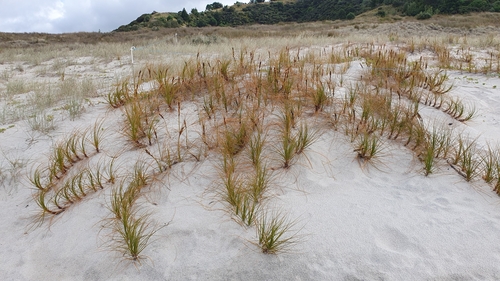
iNaturalist· cc-by
(c) John Barkla, some rights reserved (CC BY), uploaded by John Barkla
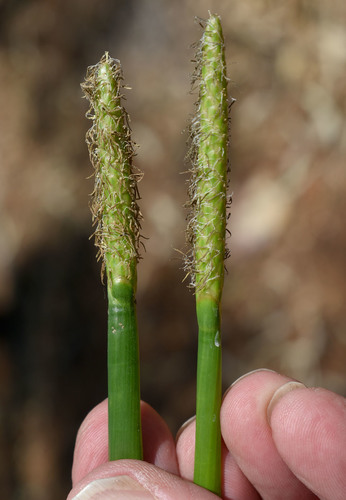
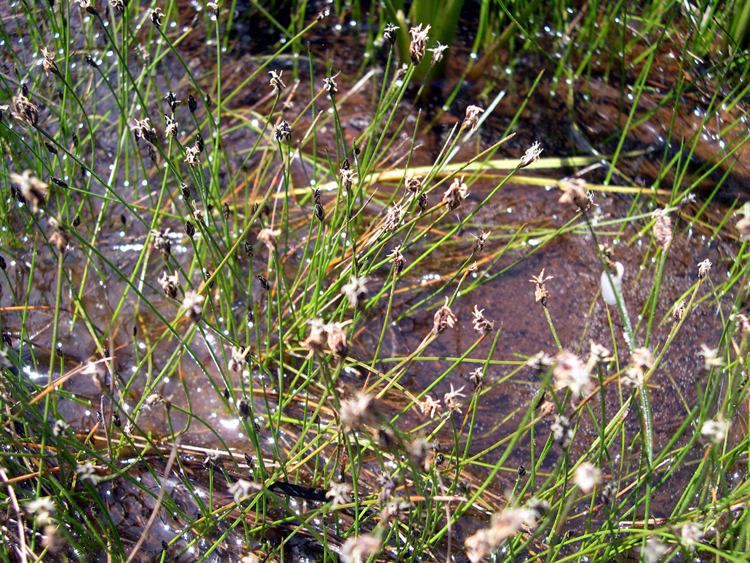
iNaturalist· cc-by
(c) Jeremy Rolfe, some rights reserved (CC BY), uploaded by Jeremy Rolfe
Summary
Source: WikipediaBolboschoenus caldwellii, commonly known as marsh club rush, is a flowering plant in the sedge family, Cyperaceae, that is native to Australia and New Zealand. The robust grass-like plant is rhizomatous and perennial. It typically grows to a height of 0.3 to 1.2 metres (1.0 to 3.9 ft). It blooms between August and March producing yellow-brown flowers. It's found in drains and swamps and on the margins of brackish lakes and creeks along coastal areas in Western Australia in the Mid West, Wheatbelt, Peel, South West, Great Southern and Goldfields-Esperance regions where it grows in muddy-silty to clay-sandy soils.
Description
A sedge that keeps growing from year to year. It grows 0.3-1.2 m high. The plants have underground runners or rhizomes. There are round corms at the ends of these stems. The flower heads are small and brown and club shaped. The flowers are yellow.
Edible Uses
The seeds are pounded into flour and mixed with millet. The roots are ground and used as flour. The tubers and rhizomes are also edible portions.
Traditional Uses
The seeds are pounded into flour and mixed with millet. The roots are ground and used as flour.
This uses section is brief — help expand it
Distribution
Mostly temperate. It does best in damp or wet soils. It grows near the edge of water. It can grow in salty silt. It is resistant to frost. Tasmanian Herbarium.
Where It Grows
Africa, Asia, Australia, Britain, China, Europe, India, New Zealand, North Africa, Tasmania,
Cultivation
Plants can be grown by division or by using dormant tubers. They can also be grown from seed.
Notes
There are about 16 Bolboschoenus species. The Cyperaceae or sedges are rush or grass like herbs. They grow in moist places.
Synonyms
Also Known As
Chid, Dila
References (27)
- Bodkin, F., 1991, Encyclopedia Botanica. Cornstalk publishing, p 918 (As Scirpus maritimus)
- Cherikoff V. & Isaacs, J., The Bush Food Handbook. How to gather, grow, process and cook Australian Wild Foods. Ti Tree Press, Australia p 194
- Clarke, P. A., 2013, The Aboriginal Ethnobotany of the Adelaide Region, South Australia. Transactions of the Royal Society of South Australia. (2013), 137(1): 97-126
- Cribb, A.B. & J.W., 1976, Wild Food in Australia, Fontana. p 158 (As Scirpus maritimus)
- Curtis, W.M., & Morris, D.I., 1994, The Student's Flora of Tasmania. Part 4B St David's Park Publishing, Tasmania, p 92
Show all 27 references Hide references
- Dashorst, G.R.M., and Jessop, J.P., 1998, Plants of the Adelaide Plains & Hills. Botanic Gardens of Adelaide and State Herbarium. p 190
- Duke, J.A., 1992, Handbook of Edible Weeds. CRC Press. p 178 (As Scirpus maritimus)
- GAMMIE, (As Scirpus maritimus)
- Gott, B & Conran, J., 1991, Victorian Koorie Plants. PO Box 666 Hamilton, Victoria 3300, Australia. p 10
- GUPTA & KANODIA, (As Scirpus maritimus)
- Hastings Advance Community College, 2017, Uses for Native Plants of the Mornington Peninsula. 86pp. p 25
- Hedrick, U.P., 1919, (Ed.), Sturtevant's edible plants of the world. p 598 (As Scirpus maritimus)
- Hibbert, M., 2002, The Aussie Plant Finder 2002, Florilegium. p 44
- Jardin, C., 1970, List of Foods Used In Africa, FAO Nutrition Information Document Series No 2.p 99 (As Scirpus maritimus)
- Lazarides, M. & Hince, B., 1993, Handbook of Economic Plants of Australia, CSIRO. p 34
- Lim, T. K., 2015, Edible Medicinal and Non Medicinal Plants. Volume 9, Modified Stems, Roots, Bulbs. Springer p 16
- Low, T., 1991, Wild Food Plants of Australia. Australian Nature FieldGuide, Angus & Robertson. p 52
- Low, T., 1992, Bush Tucker. Australia’s Wild Food Harvest. Angus & Robertson. p 102, 109
- Paczkowska, G. & Chapman, A.R., 2000, The Western Australian Flora. A Descriptive Catalogue. Western Australian Herbarium. p 42
- Plants and People in Mooro Country. Nyungar Plant use in Yellagonga Regional Park
- Plants for a Future database, The Field, Penpol, Lostwithiel, Cornwall, PL22 0NG, UK. http://www.scs.leeds.ac.uk/pfaf/ (As Scirpus maritimus)
- RIRDC, 2010, New Root Vegetables fo the Native Food Industry, Australian Government RIRDC Publication 9/161
- Romanowski, N., 2007, Edible Water Gardens. Hyland House. p 92
- SAXENA, (As Scirpus maritimus)
- Simpson, D. A. & Inglis, C. A., 2001, Cyperaceae of Economic, Ethnobotanical and Horticultural Importance: A checklist. Kew Bulletin Vol. 56, No. 2 (2001), pp. 257-360
- Tasmanian Herbarium Vascular Plants list p 64 (As Scirpus maritimus)
- Tasmanian Herbarium Vascular Plants list p 60